UTME 2019 Chemistry | Objective

Practice these randomly selected questions to test your readiness.

Question 1
The substance ZnO dissolves in sodium hydroxide solution and mineral acid solution to give soluble products in each case. ZnO is therefore referred to as
A. an allotropic oxide
B. an amphoteric oxide
C. a peroxide
D. a dioxide.
Question 2
Alkanoic acids have low volatility compared with alkanols because they
A. are more polar than alkanols
B. have two oxygen atoms while alkanols have one
C. form hydrogen bonds while alkanols do not
D. form two hydrogen bonds while alkanols form one
Question 3
An increase in temperature causes an increase in the pressure of a gas because there is an increase in the
A. average velocity of the molecules
B. number of collisions between the molecules
C. density of the molecules
D. free mean path between each molecules and the other.
Question 4
Calculate the mass in kilograms, of magnesium produced by the electrolysis of magnesium (II) chloride in a cell operating for 24 hours at 500 amperes.
A. 2.7
B. 5.4
C. 10.8
D. 21.7
Question 5
Synthetic detergents are preferred to soap for laundry using hard water because
A. detergents are water soluble while soap is not
B. the calcium salts of detergents are water soluble
C. the magnesium salt of soap is soluble in hard water
D. soap does not have a hydrocarbon terminal chain.
Question 6
The difference between colloids and suspensions is brought out clearly by the fact that while colloids
A. do not scatter light, suspensions do
B. can be separated by filtration, suspension cannot be so separated
C. can be separated by a membrane, suspension cannot
D. do not settle out on standing, suspensions do.
Question 7
The four classes of hydrocarbons are
A. ethane, ethene, ethyne and benzene
B. alkanes, alkenes, alkynes and aromatics
C. alkanes, alkenes, alkynes and benzene
D. methane, ethane, propane and butane.
Question 8
Which of the following is formed when maltose reacts with concentrated tetraoxosulphate (IV) acid?
A. Carbon (IV) oxide
B. Coal tar
C. Charcoal
D. Toxic fumes.
Question 9
Which of the following compounds has the highest boiling point?
A. \( \mathrm{CH}_{3} \mathrm{CH}_{2} \mathrm{CH}_{2} \mathrm{CH}_{2} \mathrm{OH} \quad \)
B. \( \mathrm{CH}_{3}, \mathrm{CH}, \mathrm{CHO} \)
C. \( \mathrm{CH}, \mathrm{CH}, \mathrm{CH}, \mathrm{CH} \)
D. \( \mathrm{CH}_{3} \mathrm{CH}_{2} \mathrm{OCH}_{2} \mathrm{CH}_{3} \)
Question 10
The ions \( X^- \) and \( Y^+ \) are isoelectronic, each containing a total of 10 electrons. How many protons are in the nuclei of the neutral atoms of \( X \) and \( Y \) respectively?
A. 10 and 10
B. 9 and 9
C. 11 and 9
D. 9 and 11
Question 11
Atoms of element \( X \) (with 2 electrons in the outer shell) combine with atoms of Y (with 7 electrons in the outer shell). Which of the following statements is FALSE? The compound formed
A. has formula XY
B. is likely to be ionic
C. contains \( \times 2+ \) ions
D. contains Y-ions.
Question 12
Which of the following physical properties decreases across the Periodic Table?
A. Ionization potential
B. Electron affinity
C. Electronegativity
D. Atomic radius.
Question 13
A given quantity of gas occupies a volume of 228 \( cm^3 \) at a pressure of 750 mm Hg. What will be its volume at atmospheric pressure?
A. \( 220 cm^3 \)
B. \( 225 cm^3 \)
C. \( 230 cm^3 \)
D. \( 235 cm^3 \)
Question 14
Helium is often used in observation balloons because it is
A. light and combustible
B. light and noncombustible
C. heavy and combustible
D. heavy and non-combustible.
Question 15
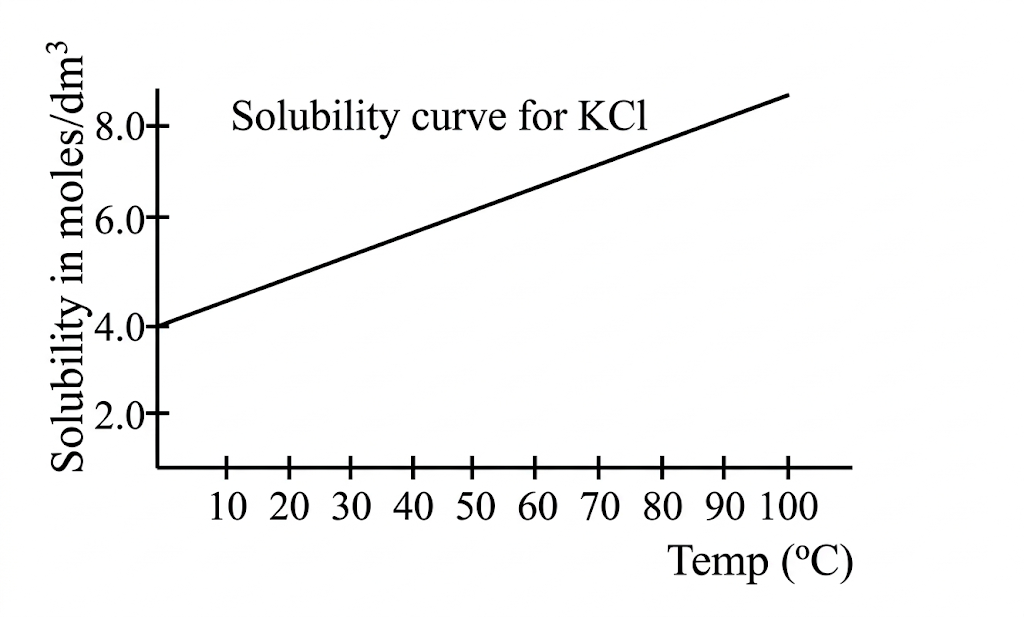
If in the graph, 1 dm3 of a saturated solution of KCl is cooled from 800 C to 300 C , the mass of crystals deposited will be \( \\ [\mathrm{~K}=39, \mathrm{Cl}=35.5] \)
A. 7.45 g
B. 14.90 g
C. 74.50 g
D. 49.00 g

Master the Exam!

You've seen a preview, but there are thousands more questions plus AI tutor to break down complex solutions.

Unlock Full Access Available for Android & Windows
Help others prepare! Share this practice hub: