POST UTME WELLSPRING UNIVERSITY 2021 Biology | Objective

Practice these randomly selected questions to test your readiness.

Question 1
A 40-year-old female presents with a 2-year history of progressive dysphagia and weight loss. Esophagogastroduodenoscopy (EGD) reveals a stricture at the level of the lower esophagus. What is the most likely diagnosis?
A. Esophageal cancer
B. Gastroesophageal reflux disease (GERD)
C. Esophageal stricture
D. Achalasia
Question 2
The process of photosynthesis in plants involves the conversion of light energy into chemical energy, resulting in the production of _______________________ and oxygen.
A. glu\cose and water
B. glu\cose and oxygen
C. starch and carbon dioxide
D. sucrose and nitrogen
Question 3
A 25-year-old man presents with a 5-year history of progressive muscle weakness, wasting, and atrophy. Physical examination reveals a characteristic 'horseshoe' shape of the hands and feet. Laboratory tests reveal a high creatine kinase level and a low serum potassium level. Which of the following is the most likely diagnosis?
A. Duchenne muscular dystrophy
B. Becker muscular dystrophy
C. Myotonic dystrophy
D. Spinal muscular atrophy
Question 4
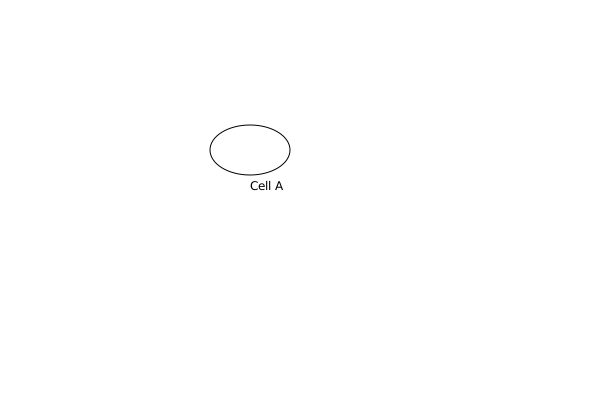
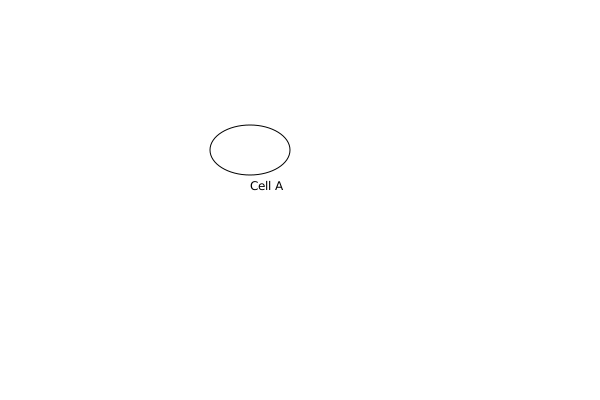
The diagram below shows the structure of a plant cell. What is the function of the cell labeled 'A'?
A. Stores genetic information
B. Provides structural support
C. Regulates cell growth
D. Produces proteins
Question 5
In the human body, the nervous system and the \endocrine system work together to regulate various bodily functions, including _______________________ and growth.
A. heart rate and blood pressure
B. hunger and thirst
C. growth and development
D. sleep and wakefulness
Question 6
A 35-year-old woman presents with a 2-year history of progressive weakness, fatigue, and shortness of breath. Physical examination reveals a pale complexion, dry skin, and brittle hair. Laboratory tests reveal a low hemoglobin level and a high mean corpuscular volume (MCV). Which of the following is the most likely diagnosis?
A. Iron deficiency anemia
B. Vitamin B12 deficiency anemia
C. Folate deficiency anemia
D. Thalassemia major
Question 7
A 20-year-old male presents with a 2-week history of progressive shortness of breath. Physical examination reveals a loud S3 gallop and a holosystolic murmur. Echocardiography shows a dilated left ventricle with a reduced ejection \fraction. What is the most likely diagnosis?
A. Hypertrophic cardiomyopathy
B. Dilated cardiomyopathy
C. Coronary artery disease
D. Mitral valve prolapse
Question 8
In a community of organisms, the presence of a specific species can be described as a(n) _______________________.
A. keystone species
B. foundation species
C. umbrella species
D. indicator species
Question 9
In a population of 1000 individuals, 70% are heterozygous for the gene controlling the production of a certain enzyme. If 20% of the population is homozygous recessive, what is the frequency of the recessive allele?
A. 0.15
B. 0.20
C. 0.25
D. 0.30
Question 10
A diagram of the human digestive system is shown below. What is the function of the pancreas?
A. To produce bile to aid in fat digestion
B. To produce enzymes to aid in protein digestion
C. To produce hormones to regulate blood sugar levels
D. To produce mucus to trap pathogens
Question 11
In the classification of living things, what is the primary criterion used to distinguish between prokaryotes and eukaryotes?
A. Cell wall composition
B. Presence of mitochondria
C. Cell membrane structure
D. DNA organization
Question 12
A 50-g sample of a subs\tance is dissolved in 100 mL of water. What is the molarity of the solution?
A. 0.5 M
B. 1.0 M
C. 2.0 M
D. 5.0 M
Question 13
A 25-year-old male presents with a 3-day history of fever, headache, and stiff neck. Lumbar puncture reveals a cerebrospinal fluid (CSF) glu\cose level of 20 mg/dL and a protein level of 100 mg/dL. What is the most likely diagnosis?
A. Meningitis
B. Encephalitis
C. Subarachnoid hemorrhage
D. Brain tumor
Question 14
A diagram of the human respiratory system is shown below. What is the function of the alveoli?
A. To exchange oxygen and carbon dioxide with the environment
B. To filter dust and other particles from the air
C. To produce mucus to trap pathogens
D. To regulate body temperature
Question 15
What is the process by which plants convert light energy into chemical energy?
A. Respiration
B. Photosynthesis
C. Decomposition
D. Fermentation

Master the Exam!

You've seen a preview, but there are thousands more questions plus AI tutor to break down complex solutions.

Unlock Full Access Available for Android & Windows
Help others prepare! Share this practice hub: