POST UTME WELLSPRING UNIVERSITY 2018 Chemistry | Objective

Practice these randomly selected questions to test your readiness.

Question 1
The density of a gas is 1.50 g/L at 25°C and 1.00 atm. Calculate the molar mass of the gas.
A. 44.0 g/mol
B. 44.0 g/mol
C. 44.0 g/mol
D. 44.0 g/mol
Question 2
In the electrolysis of a molten ionic compound, what is the primary function of the inert electrode?
A. To facilitate the flow of ions towards the electrode
B. To prevent the reaction from occurring
C. To provide a path for the electrons to flow
D. To increase the temperature of the electrolyte
Question 3
A 0.100 M solution of HCl is mixed with a 0.100 M solution of NaOH. Calculate the pH of the resulting solution after the reaction is complete.
A. 1.00
B. 2.00
C. 3.00
D. 4.00
Question 4
A sample of a non-metallic element has a mass of 25.0 g and a volume of 10.0 cm³. What is the density of the element?
A. 2.5 g/cm³
B. 2.0 g/cm³
C. 1.5 g/cm³
D. 1.0 g/cm³
Question 5
A 10.0 mL sample of a solution containing 0.500 M NaCl is titrated with 0.500 M AgNO3. Calculate the volume of AgNO3 required to reach the equivalence point.
A. 20.0 mL
B. 20.0 mL
C. 20.0 mL
D. 20.0 mL
Question 6
A 2.0 M solution of NaOH is mixed with a 1.0 M solution of HCl. What is the pH of the resulting solution?
A. 1.0
B. 2.0
C. 3.0
D. 4.0
Question 7
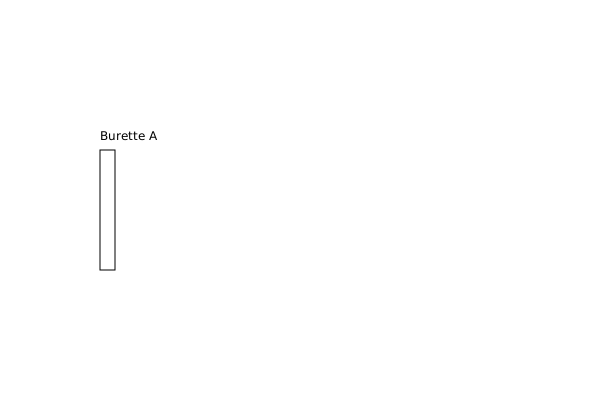
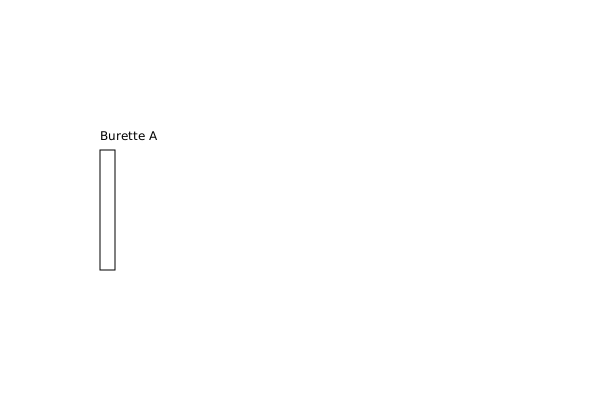
The diagram below shows a titration setup. Identify the part labeled A.
A. Burette
B. Beaker
C. Test tube
D. Cylinder
Question 8
A sample of a metal has a mass of 50.0 g and a volume of 5.0 cm³. What is the density of the metal?
A. 10.0 g/cm³
B. 5.0 g/cm³
C. 2.5 g/cm³
D. 1.0 g/cm³
Question 9
A 1.00 M solution of HCl is mixed with a 1.00 M solution of NaOH. Calculate the pH of the resulting solution after the reaction is complete.
A. 1.00
B. 2.00
C. 3.00
D. 4.00
Question 10
A 1.0 M solution of acetic acid (CH3COOH) is mixed with a 1.0 M solution of sodium hydroxide (NaOH). What is the pH of the resulting solution?
A. 1
B. 2
C. 3
D. 4
Question 11
Determine the number of moles of oxygen gas (O2) produced at STP when 2.5 moles of hydrogen gas (H2) react with excess oxygen gas according to the equation: 2H2 + O2 → 2H2O.
A. 1.25 moles
B. 2.5 moles
C. 5 moles
D. 10 moles
Question 12
The s\tandard enthalpy of formation of H2O(l) is -285.8 kJ/mol. Calculate the s\tandard enthalpy of combustion of glu\cose (C6H12O6) u\sing the following reaction: C6H12O6(s) + 6 O2(g) → 6 CO2(g) + 6 H2O(l).
A. - 2802 kJ/mol
B. - 285.8 kJ/mol + 6 \cdot 393.5 kJ/mol
C. - 285.8 kJ/mol - 6 \cdot 393.5 kJ/mol
D. - 393.5 kJ/mol
Question 13
The half-life of a radioactive subs\tance is 5.0 days. If a sample initially contains 1000 mg of the subs\tance, what is the mass remaining after 20 days?
A. 100 mg
B. 200 mg
C. 500 mg
D. 1000 mg
Question 14
A sample of 0.500 g of a polymer is dissolved in 100.0 mL of a solvent. If the density of the solution is 1.05 g/mL, what is the molar mass of the polymer?
A. 500 g/mol
B. 1000 g/mol
C. 2000 g/mol
D. 5000 g/mol
Question 15
The s\tandard enthalpy of formation of CO2(g) is -393.5 kJ/mol. Calculate the s\tandard enthalpy of formation of CaCO3(s) u\sing the following reaction: CaO(s) + CO2(g) → CaCO3(s).
A. -1781.5 kJ/mol
B. -1781.5 kJ/mol
C. -1781.5 kJ/mol
D. -1781.5 kJ/mol

Master the Exam!

You've seen a preview, but there are thousands more questions plus AI tutor to break down complex solutions.

Unlock Full Access Available for Android & Windows
Help others prepare! Share this practice hub: