POST UTME VERITAS UNIVERSITY 2025 Biology | Objective

Practice these randomly selected questions to test your readiness.

Question 1
A diagram of the human respiratory system is shown below:
A. The trachea is responsible for gas exchange
B. The diaphragm is responsible for gas exchange
C. The lungs are responsible for gas exchange
D. The pharynx is responsible for gas exchange
Question 2
A population of 1000 bacteria is introduced to a new environment. The population grows according to the exponential growth model \( P(t) = P_0 e^{rt} \), where \( P_0 = 1000 \) and \( r = 0.1 \). Find the population size at time \( t = 10 \) years.
A. 10000
B. 20000
C. 30000
D. 40000
Question 3
A diagram of the human eye is shown below. What is the function of the part labeled 'A'?
A. To focus light onto the retina
B. To detect changes in light intensity
C. To regulate the amount of light entering the eye
D. To produce tears to lubricate the eye
Question 4
In a population of Drosophila melanogaster, the frequency of the recessive allele 'b' for black eyes is 0.2. If the population is in Hardy-Weinberg equilibrium, what is the frequency of the homozygous dominant genotype?
A. 0.16
B. 0.36
C. 0.64
D. 0.84
Question 5
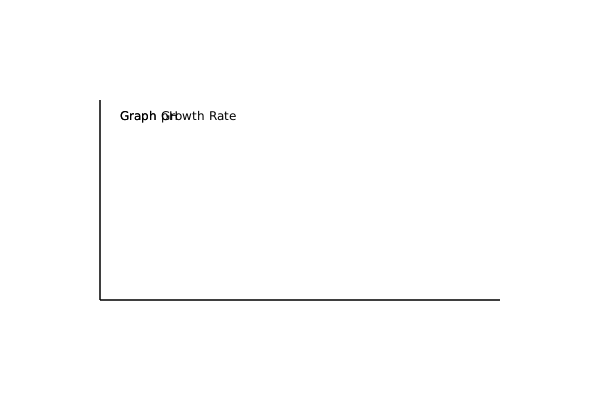
A researcher is studying the effect of pH on the growth of Escherichia coli. The researcher measures the growth rate of the bacteria at different pH levels and obtains the following data:
A. The growth rate increases with increa\sing pH.
B. The growth rate decreases with increa\sing pH.
C. The growth rate remains cons\tant with increa\sing pH.
D. The growth rate is unaffected by pH.
Question 6
In the context of excretion, what is the primary function of the kidneys in maintaining acid-base balance?
A. To regulate the pH of the blood by adjusting the concentration of hydrogen ions
B. To eliminate excess hydrogen ions from the body
C. To maintain the balance of electrolytes in the body
D. To regulate the concentration of oxygen in the blood
Question 7
A genetic cross between two organisms results in a 9:3:3:1 ratio of phenotypes. What is the genotype of the parents?
A. Both parents are homozygous dominant
B. One parent is homozygous dominant and the other is homozygous recessive
C. Both parents are heterozygous
D. One parent is homozygous dominant and the other is heterozygous
Question 8
A researcher is studying the nervous system of a vertebrate animal. Which of the following structures is responsible for transmitting signals from sensory receptors to the central nervous system?
A. D\endrites
B. Axons
C. Synapses
D. Neuroglia
Question 9
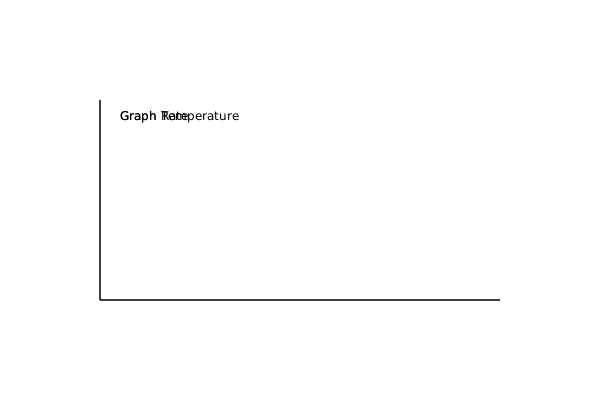
A researcher is studying the effect of temperature on the rate of a chemical reaction. The researcher measures the rate of the reaction at different temperatures and obtains the following data:
A. The rate increases with increa\sing temperature.
B. The rate decreases with increa\sing temperature.
C. The rate remains cons\tant with increa\sing temperature.
D. The rate is unaffected by temperature.
Question 10
In the context of excretion, what is the primary function of the liver in detoxifying the blood?
A. To convert ammonia into urea
B. To convert bilirubin into urobilin
C. To convert glycogen into glu\cose
D. To convert fatty acids into ketone bodies
Question 11
In a eukaryotic cell, the process of mitosis is initiated by the breakdown of the nuclear envelope, which is triggered by the activation of the protein kinase Cdk1. What is the primary function of Cdk1 in this process?
A. To phosphorylate and activate the anaphase-promoting complex (APC)
B. To bind to and inhibit the activity of the nuclear lamina
C. To regulate the activity of the spindle checkpoint
D. To control the condensation of chromatin
Question 12
A researcher is studying the genetic variation in a population of Drosophila melanogaster. Which of the following genetic concepts would be most relevant to this study?
A. Genetic drift
B. Natural selection
C. Gene flow
D. Mutation
Question 13
In the context of eco\logy, what is the term for the process by which plants convert light energy into chemical energy?
A. Photosynthesis
B. Respiration
C. Decomposition
D. Fermentation
Question 14
A plant cell is placed in a solution with a high concentration of sucrose. What will happen to the cell's turgor pressure?
A. It will decrease due to water loss
B. It will increase due to water uptake
C. It will remain the same
D. It will decrease due to solute uptake
Question 15
A diagram of a human eye is shown below. What is the function of the structure labeled 'B'?
A. To focus light on the retina
B. To regulate the amount of light entering the eye
C. To detect color and brightness
D. To move the eye in different directions

Master the Exam!

You've seen a preview, but there are thousands more questions plus AI tutor to break down complex solutions.

Unlock Full Access Available for Android & Windows
Help others prepare! Share this practice hub: