POST UTME VERITAS UNIVERSITY 2020 Chemistry | Objective

Practice these randomly selected questions to test your readiness.

Question 1
The rate of a chemical reaction is influenced by the concentration of the reac\tants. Which of the following equations represents the rate law for a reaction that is first order with respect to the concentration of the reac\tant?
A. \( rate = k[A]^2 \)
B. \( rate = k[A]^1 \)
C. \( rate = k[A]^0 \)
D. \( rate = k[A]^{-1} \)
Question 2
A 2.50 g sample of a compound containing only carbon and hydrogen is found to have a mass of 1.25 g of carbon. What is the empirical formula of the compound?
A. CH2
B. C2H4
C. C3H6
D. C4H8
Question 3
The reaction of hydrogen peroxide with potassium iodide to form potassium iodate and water is an example of a decomposition reaction. What is the balanced chemical equation for this reaction?
A. H2O2 + 2KI → KIO3 + 2H2O
B. H2O2 + 2KI → KI + 2H2O
C. H2O2 + 2KI → KIO3 + 2H2O2
D. H2O2 + 2KI → KI + 2H2O2
Question 4
A 1.0 M solution of a strong acid is mixed with a 1.0 M solution of a strong base. If 50 mL of each solution are mixed, what is the pH of the resulting solution?
A. 0
B. 1
C. 7
D. 14
Question 5
A 2.0 g sample of a metal is heated in a crucible until it is completely melted. The resulting liquid metal is then cooled slowly over a period of several hours. If the metal has a melting point of 800°C, what is the temperature of the metal at the \end of the cooling process?
A. 600°C
B. 700°C
C. 800°C
D. 900°C
Question 6
A 2.50 g sample of a compound containing only carbon and hydrogen is found to have a mass of 1.25 g of carbon. What is the empirical formula of the compound?
A. CH2
B. C2H4
C. C3H6
D. C4H8
Question 7
Determine the pH of a 0.1 M solution of HCl, given that the dissociation cons\tant of HCl is 10^\( -7 \).
A. 1
B. 2
C. 3
D. 4
Question 8
A sample of a non-metallic oxide is heated strongly. The resulting gas is collected over water and found to have a volume of 2.50 dm3 at 20°C and 1.00 atm. Calculate the number of moles of the gas produced.
A. 0.010 mol
B. 0.020 mol
C. 0.030 mol
D. 0.040 mol
Question 9
A 25.0 mL sample of 0.100 M HCl is titrated with 0.100 M NaOH. Calculate the pH of the solution after the addition of 25.0 mL of NaOH.
A. 1.00
B. 2.00
C. 3.00
D. 4.00
Question 10
Determine the number of moles of oxygen gas (O2) produced at STP when 2.5 moles of potassium chlorate (KClO3) decompose according to the equation: 2KClO3(s) → 2KCl(s) + 3O2(g).
A. 1.5 moles
B. 2.5 moles
C. 3.75 moles
D. 4.5 moles
Question 11
A solution of 0.1 M NaOH is titrated with 0.1 M HCl. If 20 mL of the acid is required to reach the equivalence point, what is the volume of the base required to reach the equivalence point?
A. 10 mL
B. 20 mL
C. 30 mL
D. 40 mL
Question 12
A 2.5 g sample of a polymer is dissolved in 50 mL of a solvent. The solution is then diluted to a total volume of 100 mL. If the polymer has a molar mass of 50000 g/mol, what is the concentration of the polymer in the solution in units of g/L?
A. 25 g/L
B. 50 g/L
C. 100 g/L
D. 200 g/L
Question 13
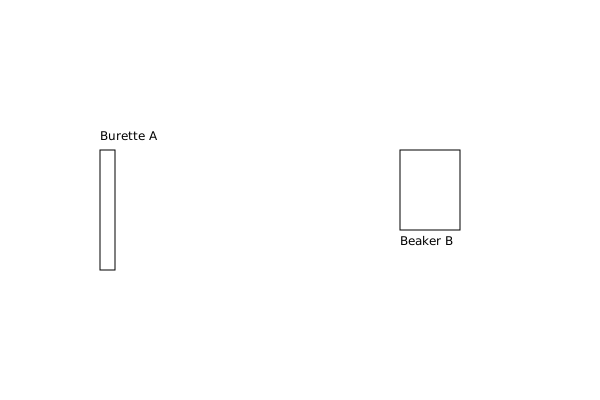
A diagram of a titration setup is shown below. If the burette contains 0.100 M NaOH and the flask contains 50.0 mL of 0.100 M HCl, what is the pH of the solution after the addition of 30.0 mL of NaOH?
A. 1.00
B. 2.00
C. 3.00
D. 4.00
Question 14
A metal oxide, M2O3, is reduced to form a metal, M. If the reduction reaction is as follows: M2O3 + 3C → 2M + 3CO, what is the mass of carbon required to reduce 2.5 g of M2O3?
A. 1.5 g
B. 2.0 g
C. 2.5 g
D. 3.0 g
Question 15
A 50.0 mL sample of 0.100 M HCl is titrated with 0.100 M NaOH. Calculate the number of moles of NaOH required to reach the equivalence point.
A. 0.0050 mol
B. 0.0100 mol
C. 0.0150 mol
D. 0.0200 mol

Master the Exam!

You've seen a preview, but there are thousands more questions plus AI tutor to break down complex solutions.

Unlock Full Access Available for Android & Windows
Help others prepare! Share this practice hub: