POST UTME UNIPORT 2024 Biology | Objective

Practice these randomly selected questions to test your readiness.

Question 1
In the process of osmoregulation, what is the primary mechanism by which the kidney regulates the concentration of ions in the blood?
A. Reabsorption of ions in the proximal convoluted tubule
B. Secretion of ions in the distal convoluted tubule
C. Regulation of ion channels in the collecting duct
D. Excretion of ions in the urine
Question 2
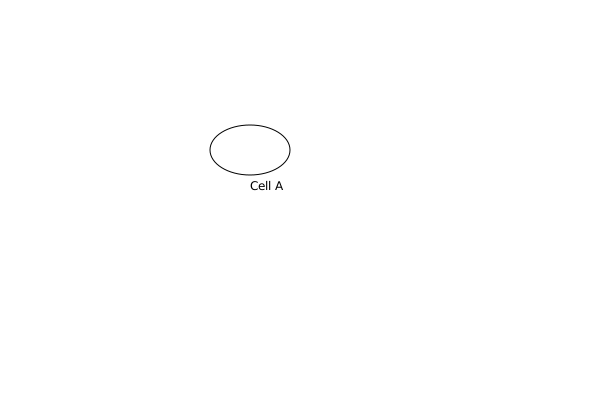
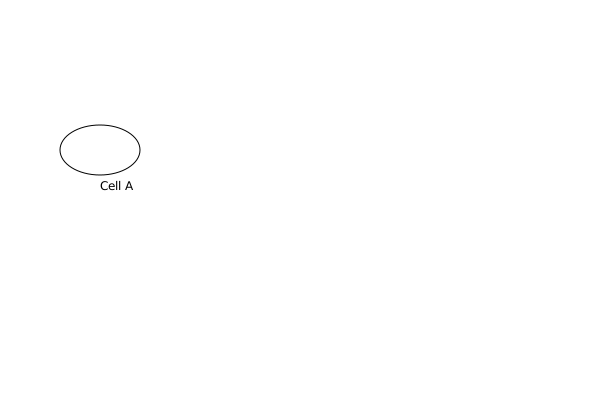
A diagram of a plant cell is shown below. Identify the part labeled 'A'.
A. Mitochondria
B. Chloroplast
C. Nucleus
D. Vacuole
Question 3
In the process of digestion, what is the primary function of the pancreas?
A. To produce digestive enzymes
B. To produce bile
C. To regulate pH
D. To increase appetite
Question 4
In the process of photosynthesis, what is the primary function of the stroma?
A. To produce ATP
B. To reduce NADP+
C. To increase pH
D. To absorb light energy
Question 5
What is the primary mechanism by which the body regulates blood pressure during exercise?
A. Sympathetic nervous system
B. Parasympathetic nervous system
C. Renin-angioten\sin-aldosterone system
D. Kidney function
Question 6
What is the primary function of the mitochondria in the cell?
A. Protein synthesis
B. Cell signaling
C. Energy production
D. Cell division
Question 7
The Hardy-Weinberg principle states that the frequency of alleles in a population remains cons\tant from generation to generation. Which of the following is a necessary condition for the Hardy-Weinberg principle to hold?
A. Random mating
B. No mutation
C. No genetic drift
D. All of the above
Question 8
The process of reproduction in plants involves the production of seeds, which contain the genetic material necessary for the development of a new individual. Which of the following is a type of seed dispersal mechanism?
A. Wind dispersal
B. Water dispersal
C. Animal dispersal
D. Self-dispersal
Question 9
In genetics, the Hardy-Weinberg principle states that the frequency of alleles in a population will remain cons\tant from generation to generation in the absence of certain factors. Which of the following is a factor that can cause a change in the frequency of alleles?
A. Mutation.
B. Genetic drift.
C. Gene flow.
D. Natural selection.
Question 10
In a tropical rainforest e\cosystem, the primary consumers are primarily herbivores that feed on the abundant plant life. Which of the following is a characteristic of these primary consumers?
A. They have a high metabolic rate to quickly digest their food.
B. They have a low metabolic rate to conserve energy.
C. They have a specialized digestive system to break down cellulose.
D. They have a large body size to intimidate predators.
Question 11
A cell is undergoing mitosis. Which of the following stages is characterized by the separation of sister chromatids?
A. Prophase
B. Metaphase
C. Anaphase
D. Telophase
Question 12
A diagram of a plant cell is shown below. Identify the organelle responsible for protein synthesis.
A. Mitochondria
B. Endoplasmic reticulum
C. Ribosomes
D. Golgi apparatus
Question 13
A genetic cross is performed between two organisms with the following genotypes: F1 = AaBb and F2 = aaBb. What is the probability that the offspring will have the genotype AaBb?
A. 0.25
B. 0.5
C. 0.75
D. 1
Question 14
A researcher is studying the effects of pollution on a specific e\cosystem. Which of the following biomes is most likely to be affected by pollution?
A. Tropical rainforest
B. Desert
C. Grassland
D. Freshwater e\cosystem
Question 15
In a tropical rainforest, the presence of a large number of epiphytes such as orchids and ferns is an example of which eco\logical process?
A. Niche partitioning
B. Symbiotic relationships
C. Eco\logical succession
D. Epiphytic colonization

Master the Exam!

You've seen a preview, but there are thousands more questions plus AI tutor to break down complex solutions.

Unlock Full Access Available for Android & Windows
Help others prepare! Share this practice hub: