POST UTME UNILAG 2022 Chemistry | Objective

Practice these randomly selected questions to test your readiness.

Question 1
Determine the molar mass of a gas that occupies 2.5 L at 273 K and 1 atm. Use the ideal gas law to calculate the number of moles.
A. \( 0.0224 , \text{mol} \)
B. \( 0.0448 , \text{mol} \)
C. \( 0.0672 , \text{mol} \)
D. \( 0.0896 , \text{mol} \)
Question 2
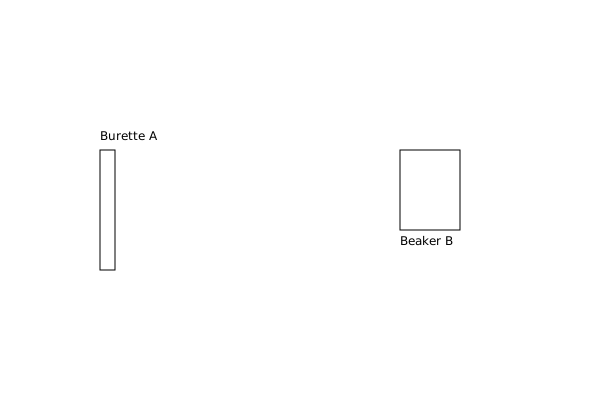
The diagram below shows a titration setup. If 25 mL of 0.1 M NaOH is added to the burette, what is the pH of the solution?
A. 7
B. 8
C. 9
D. 10
Question 3
A sample of a non-ideal gas has a molar volume of 25 L/mol at 25°C and 1 atm. What is the molar volume of the gas at 50°C and 2 atm?
A. 20 L/mol
B. 25 L/mol
C. 30 L/mol
D. 35 L/mol
Question 4
A solution of 5 g of glu\cose (C6H12O6) in 100 g of water has a freezing point depression of 1.5°C. Calculate the molar mass of glu\cose.
A. 180 g/mol
B. 200 g/mol
C. 220 g/mol
D. 240 g/mol
Question 5
Determine the pH of a 0.1 M solution of HCl.
A. 1
B. 2
C. 3
D. 4
Question 6
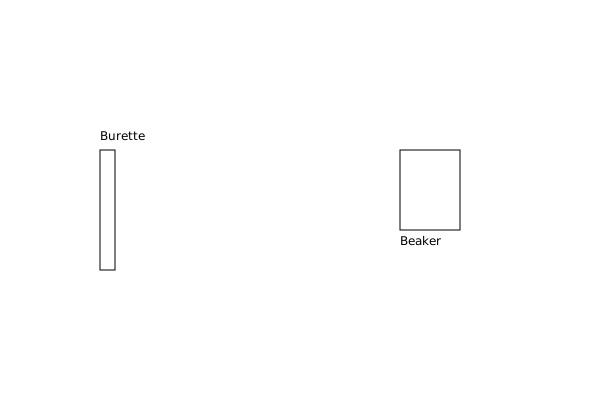
A diagram of a titration setup is shown below. If 25.0 mL of 0.100 M NaOH is required to reach the equivalence point, what is the concentration of the HCl solution?
A. \( 0.0500 , \text{M} \)
B. \( 0.100 , \text{M} \)
C. \( 0.200 , \text{M} \)
D. \( 0.500 , \text{M} \)
Question 7
A metal M reacts with chlorine gas to form a white solid. The reaction is as follows: M + Cl2 → MCl2. If 2.5 g of M reacts with 5.0 g of Cl2, what is the percentage yield of MCl2 if the molar mass of M is 55.85 g/mol and the molar mass of Cl2 is 70.90 g/mol?
A. ( 85% )
B. ( 90% )
C. ( 95% )
D. ( 98% )
Question 8
At 298 K, the s\tandard Gibbs free energy change (ΔG°) for the reaction 2NO(g) + O2(g) → 2NO2(g) is -111.3 kJ/mol. Calculate the equilibrium cons\tant (K) for this reaction.
A. 1.0 × 10^12
B. 1.0 × 10^6
C. 1.0 × 10^3
D. 1.0 × 10^0
Question 9
The s\tandard enthalpy of formation of CO2(g) is -393.5 kJ/mol. What is the s\tandard enthalpy of formation of CO(g)?
A. -110.5 kJ/mol
B. -393.5 kJ/mol
C. 110.5 kJ/mol
D. 393.5 kJ/mol
Question 10
The pH of a solution is 4. What is the concentration of H+ ions in the solution?
A. 10^-4 M
B. 10^-3 M
C. 10^-2 M
D. 10^-1 M
Question 11
A metal (X) reacts with HCl to produce a gas (Y) and a salt (Z). The reaction is as follows: X + 2HCl → Y + Z. If 2.5 g of X reacts with 10 mL of 0.5 M HCl, determine the molar mass of X.
A. 50 g/mol
B. 75 g/mol
C. 100 g/mol
D. 125 g/mol
Question 12
A solution of sulfuric acid (H2SO4) is mixed with a solution of sodium hydroxide (NaOH). What is the resulting product?
A. Na2SO4
B. H2O
C. NaOH
D. H2SO4
Question 13
The atomic radius of an element in the periodic table generally increases down a group due to the addition of new energy levels. However, the atomic radius of an element in a period generally decreases across a period due to the effective nuclear charge increa\sing as the number of protons in the nucleus increases. Which of the following statements is NOT true?
A. The atomic radius of an element in a period generally decreases across a period.
B. The atomic radius of an element in the periodic table generally increases down a group.
C. The effective nuclear charge increases as the number of protons in the nucleus increases.
D. The atomic radius of an element in a period generally increases across a period.
Question 14
A 25 mL sample of a 0.2 M solution of CuSO4 is mixed with 25 mL of a 0.2 M solution of NaOH. Determine the concentration of Cu(OH)2 formed in the resulting solution.
A. 0.02 M
B. 0.04 M
C. 0.06 M
D. 0.08 M
Question 15
A solution contains 0.5 M NaCl and 0.2 M CaCl2. What is the total concentration of chloride ions in the solution?
A. 0.5 M
B. 0.7 M
C. 0.9 M
D. 1.1 M

Master the Exam!

You've seen a preview, but there are thousands more questions plus AI tutor to break down complex solutions.

Unlock Full Access Available for Android & Windows
Help others prepare! Share this practice hub: