POST UTME UNILAG 2020 Chemistry | Objective

Practice these randomly selected questions to test your readiness.

Question 1
A 2.5 M solution of NaOH is electrolyzed u\sing a platinum electrode. Calculate the mass of oxygen gas produced at the anode after 2 hours.
A. 0.25 g
B. 0.50 g
C. 0.75 g
D. 1.00 g
Question 2
The s\tandard enthalpy of formation (ΔHf) for CO(g) is -110.5 kJ/mol. What is the s\tandard enthalpy of formation for CO2(g)?
A. -393.5 kJ/mol
B. -393.5 kJ/mol + 110.5 kJ/mol
C. -393.5 kJ/mol - 110.5 kJ/mol
D. -393.5 kJ/mol + 298 K * 221.8 J/K
Question 3
A 1.00 M solution of NaOH is titrated with 1.00 M HCl. What is the pH of the solution after 25.0 mL of HCl has been added?
A. 2.00
B. 3.00
C. 4.00
D. 5.00
Question 4
A 1.00 L sample of 0.100 M NaOH is mixed with a 1.00 L sample of 0.100 M HCl. What is the resulting pH of the solution?
A. 7.00
B. 7.25
C. 7.50
D. 8.00
Question 5
The reaction of ethanol with a strong acid produces a carboxylic acid. What is the major product of this reaction?
A. ethanoic acid
B. propanoic acid
C. bu\tanoic acid
D. pen\tanoic acid
Question 6
A diagram of a gas collection apparatus is shown below. If 1.0 L of a gas at 25°C and 1 atm is collected, what is the volume of the gas at 50°C and 2 atm?
A. 2.0 L
B. 3.0 L
C. 4.0 L
D. 5.0 L
Question 7
A 1.0 L solution of 0.1 M NaOH is mixed with a 1.0 L solution of 0.1 M HCl. What is the resulting pH?
A. 7
B. 8
C. 9
D. 10
Question 8
Determine the molar mass of a polymer with the following repeating unit: CH2-CH(CH3)-CH2-CH2-CH2-CH3. Assume that the polymer has a degree of polymerization of 100.
A. 500 g/mol
B. 600 g/mol
C. 700 g/mol
D. 800 g/mol
Question 9
Calculate the molar enthalpy of vaporization of a subs\tance at 373 K, given that the vapor pressure of the subs\tance at 373 K is 1.01325 bar and the enthalpy of vaporization at 298 K is 40.79 kJ/mol.
A. 43.21 kJ/mol
B. 45.12 kJ/mol
C. 47.03 kJ/mol
D. 49.94 kJ/mol
Question 10
A 2.00 M solution of HCl is titrated with 2.00 M NaOH. What is the pH of the solution after 50.0 mL of NaOH has been added?
A. 2.00
B. 3.00
C. 4.00
D. 5.00
Question 11
The following diagram shows a periodic table. Identify the element with atomic number 6.
A. Carbon
B. Nitrogen
C. Oxygen
D. Fluorine
Question 12
The entropy change (ΔS) for the reaction 2H2(g) + O2(g) → 2H2O(l) is -221.8 J/K. Calculate the s\tandard enthalpy change (ΔH) for the reaction, given that the s\tandard Gibbs free energy change (ΔG) is -237.1 kJ and the temperature (T) is 298 K.
A. -237.1 kJ
B. -237.1 kJ + 298 K * -221.8 J/K
C. -237.1 kJ - 298 K * -221.8 J/K
D. -237.1 kJ + 298 K * 221.8 J/K
Question 13
A metal rod with a length of 2 m and a cross-sectional area of 0.01 m^2 is subjected to a tensile force of 1000 N. What is the stress on the rod?
A. 100 MPa
B. 200 MPa
C. 300 MPa
D. 400 MPa
Question 14
The s\tandard enthalpy of formation (ΔHf) for H2O(l) is -285.8 kJ/mol. What is the s\tandard enthalpy of formation for H2(g)?
A. 0 kJ/mol
B. 0 kJ/mol + 393.5 kJ/mol
C. 0 kJ/mol - 393.5 kJ/mol
D. 0 kJ/mol + 298 K * 221.8 J/K
Question 15
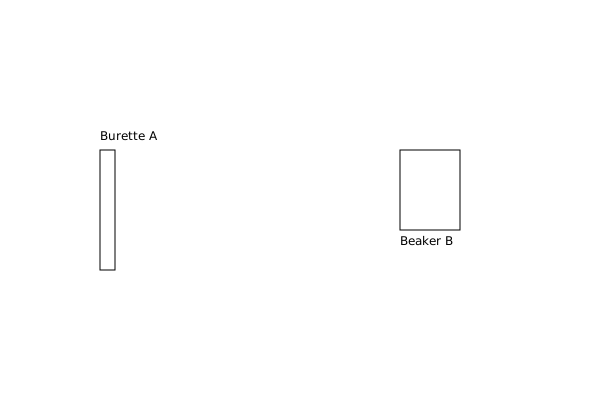
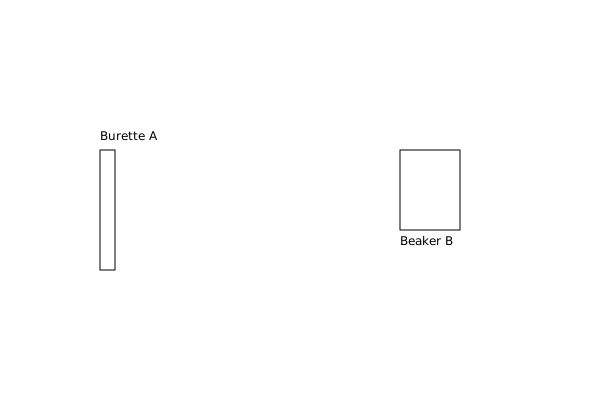
The diagram below shows a titration setup. What is the purpose of the burette?
A. To measure the volume of the titrant
B. To measure the volume of the analyte
C. To mix the titrant and analyte
D. To add the titrant to the analyte

Master the Exam!

You've seen a preview, but there are thousands more questions plus AI tutor to break down complex solutions.

Unlock Full Access Available for Android & Windows
Help others prepare! Share this practice hub: