POST UTME UNILAG 2019 Chemistry | Objective

Practice these randomly selected questions to test your readiness.

Question 1
The atomic number of an element is 26. What is the number of protons in the nucleus of an atom of this element?
A. 25
B. 26
C. 27
D. 28
Question 2
A solution of 0.1 M HCl is titrated with 0.1 M NaOH. What is the pH of the solution after 20 mL of NaOH has been added?
A. 1
B. 7
C. 9
D. 11
Question 3
The pH of a solution is 4. What is the concentration of hydrogen ions in the solution?
A. 10^{-4} M
B. 10^{-3} M
C. 10^{-2} M
D. 10^{-1} M
Question 4
A 25 cm3 sample of 0.1 M HCl is titrated with 0.1 M NaOH. Calculate the pH of the solution after 20 cm3 of NaOH has been added.
A. \( pH = \frac{1}{2} \log \frac{[HCl]_0}{[HCl]_t} \)
B. \( pH = \frac{1}{2} \log \frac{[HCl]_t}{[HCl]_0} \)
C. \( pH = \frac{1}{2} \log \frac{[HCl]_0}{[HCl]_t} + \frac{1}{2} \log \frac{[NaOH]_0}{[NaOH]_t} \)
D. \( pH = \frac{1}{2} \log \frac{[HCl]_t}{[HCl]_0} + \frac{1}{2} \log \frac{[NaOH]_t}{[NaOH]_0} \)
Question 5
A sample of a hydrocarbon has a molecular formula of C_{4}H_{10}. What is the type of hydrocarbon?
A. Alkane
B. Alkene
C. Alkyne
D. Aromatic hydrocarbon
Question 6
A redox reaction involves the oxidation of Fe2+ to Fe3+ and the reduction of MnO4- to Mn2+. What is the half-reaction for the oxidation of Fe2+?
A. Fe^{2+} \rightarrow Fe^{3+}
B. Fe^{2+} \rightarrow Fe^{3+} + e^-
C. Fe^{3+} \rightarrow Fe^{2+}
D. Fe^{3+} \rightarrow Fe^{2+} + e^+
Question 7
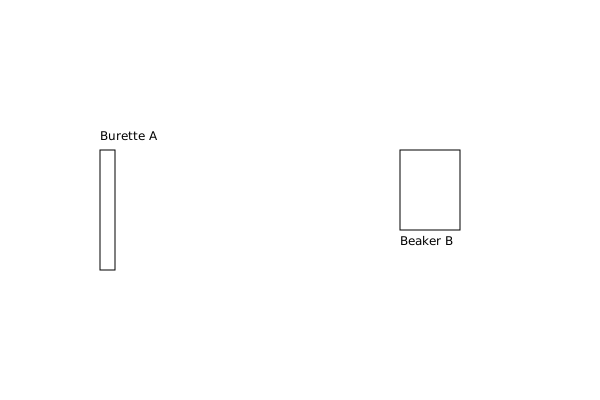
A diagram of a titration setup is shown below. What is the purpose of the burette in this setup?
A. To measure the volume of the analyte
B. To measure the volume of the titrant
C. To mix the analyte and titrant
D. To measure the pH of the solution
Question 8
A polymer has a molecular weight of 100,000 g/mol. If 1 g of the polymer is dissolved in 100 mL of water, what is the concentration of the solution in g/L?
A. 500
B. 1000
C. 2000
D. 5000
Question 9
A 1.0 g sample of a metal is heated in a crucible until it melts. The mass of the crucible and the metal is 1.5 g. The mass of the crucible alone is 0.5 g. Calculate the density of the metal.
A. \( \rho = \frac{m}{V} \)
B. \( \rho = \frac{V}{m} \)
C. \( \rho = \frac{m}{V} \times \frac{V}{m} \)
D. \( \rho = \frac{V}{m} \times \frac{m}{V} \)
Question 10
A solution contains 2.5 g of NaCl in 50 mL of water. What is the molarity of the solution?
A. 0.1 M
B. 0.2 M
C. 0.5 M
D. 1.0 M
Question 11
A solution contains 1.0 g of NaOH in 100 mL of water. What is the concentration of the solution?
A. 0.1 M
B. 0.2 M
C. 0.5 M
D. 1.0 M
Question 12
The solubility of a subs\tance is defined as the maximum amount of the subs\tance that can dissolve in a given amount of solvent at a particular temperature. Which of the following statements is correct regarding the solubility of a subs\tance?
A. The solubility of a subs\tance is directly proportional to the temperature.
B. The solubility of a subs\tance is inversely proportional to the pressure.
C. The solubility of a subs\tance is directly proportional to the volume of the solvent.
D. The solubility of a subs\tance is inversely proportional to the concentration of the solute.
Question 13
The s\tandard electrode potential of the Zn2+/Zn couple is -0.76 V. Calculate the s\tandard electrode potential of the Cu2+/Cu couple if the s\tandard electrode potential of the Cu2+/Cu couple is -0.34 V.
A. \( E^{circ}_{Cu^{2+}/Cu} = E^{circ}_{Zn^{2+}/Zn} - E^{circ}_{Cu^{2+}/Cu} \)
B. \( E^{circ}_{Cu^{2+}/Cu} = E^{circ}_{Zn^{2+}/Zn} + E^{circ}_{Cu^{2+}/Cu} \)
C. \( E^{circ}_{Cu^{2+}/Cu} = E^{circ}_{Zn^{2+}/Zn} - E^{circ}_{Cu^{2+}/Cu} \times \frac{[Zn^{2+}]}{[Cu^{2+}]} \)
D. \( E^{circ}_{Cu^{2+}/Cu} = E^{circ}_{Zn^{2+}/Zn} + E^{circ}_{Cu^{2+}/Cu} \times \frac{[Zn^{2+}]}{[Cu^{2+}]} \)
Question 14
A 2.0 M solution of HCl is titrated with 1.0 M NaOH. Calculate the pH of the solution after 20 cm3 of NaOH has been added.
A. \( pH = \frac{1}{2} \log \frac{[HCl]_0}{[HCl]_t} \)
B. \( pH = \frac{1}{2} \log \frac{[HCl]_t}{[HCl]_0} \)
C. \( pH = \frac{1}{2} \log \frac{[HCl]_0}{[HCl]_t} + \frac{1}{2} \log \frac{[NaOH]_0}{[NaOH]_t} \)
D. \( pH = \frac{1}{2} \log \frac{[HCl]_t}{[HCl]_0} + \frac{1}{2} \log \frac{[NaOH]_t}{[NaOH]_0} \)
Question 15
Determine the rate cons\tant (k) for the reaction: 2NO(g) + O2(g) → 2NO2(g) at 298 K, given that the initial concentration of NO is 0.1 M and the concentration of NO2 is 0.05 M after 10 minutes.
A. \( k = \frac{2.303}{t} \log \frac{[NO]_0}{[NO]_t} \)
B. \( k = \frac{2.303}{t} \log \frac{[NO]_t}{[NO]_0} \)
C. \( k = \frac{2.303}{t} \log \frac{[NO]_0}{[NO]_t} \times \frac{[O_2]_0}{[O_2]_t} \)
D. \( k = \frac{2.303}{t} \log \frac{[NO]_t}{[NO]_0} \times \frac{[O_2]_t}{[O_2]_0} \)

Master the Exam!

You've seen a preview, but there are thousands more questions plus AI tutor to break down complex solutions.

Unlock Full Access Available for Android & Windows
Help others prepare! Share this practice hub: