POST UTME UNILAG 2018 Chemistry | Objective
Practice these randomly selected questions to test your readiness.
Question 1
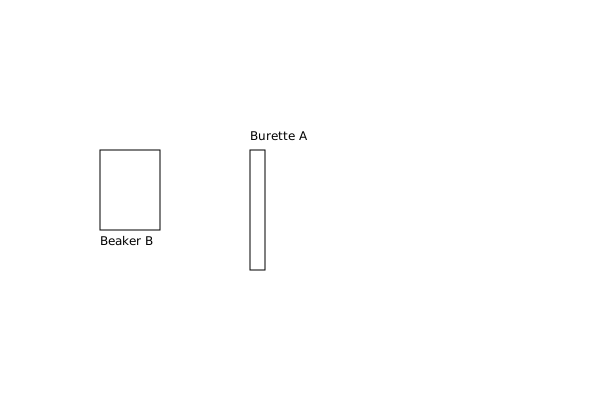
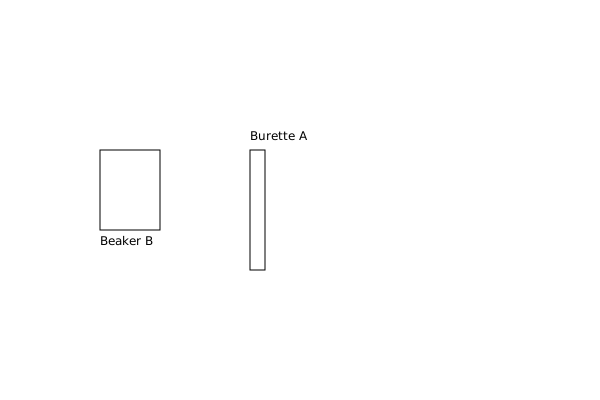
A diagram of a titration setup is shown below. If 25 mL of 0.1 M NaOH is required to reach the equivalence point, what is the concentration of the HCl solution?
Question 2
A 100 mL sample of 0.1 M HCl is titrated with 1 M NaOH. Calculate the pH of the solution at the equivalence point.
Question 3
A solution contains 0.1 M HCl and 0.1 M NaOH. Calculate the concentration of H+ ions in the solution.
Question 4
A sample of a metal is heated in a crucible. What is the expected outcome?
Question 5
A 1.0 M solution of a weak acid (HA) was mixed with a 1.0 M solution of a strong base (NaOH). The resulting solution had a pH of 4.5. What is the value of the acid dissociation cons\tant (Ka) for the weak acid?
Question 6
A solution contains 0.1 M HCl and 0.1 M NaOH. Calculate the concentration of OH- ions in the solution.
Question 7
A sample of a metal oxide is heated in a crucible. What is the expected outcome?
Question 8
Determine the pH of a 0.1 M solution of HCl at 25°C, given that the dissociation cons\tant of HCl is 10^\( -7 \).
Question 9
The reaction of sulfur with oxygen gas produces sulfur dioxide gas. What is the balanced chemical equation for this reaction?
Question 10
In the electrolysis of a molten ionic compound, what is the primary function of the inert electrode?
Question 11
A 0.500 g sample of a polymer is dissolved in 100 mL of a solvent. What is the concentration of the solution?
Question 12
A sample of a non-metallic element was heated in a stream of oxygen gas. The resulting product was a white solid that was soluble in water. What is the identity of the non-metallic element?
Question 13
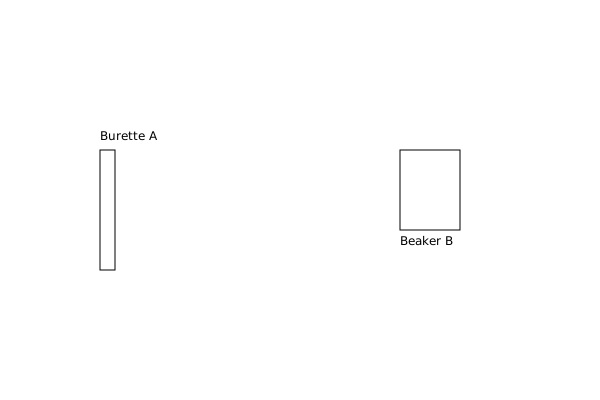
The diagram below shows a titration setup. What is the purpose of the burette?
Question 14
A solution of 0.1 M NaOH is titrated with 0.1 M HCl. The pH of the solution at the equivalence point is 7. What is the pH of the solution at the half-equivalence point?
Question 15
Determine the structure of the compound formed by the reaction of 2-methylpropane with chlorine gas in the presence of light.
Master the Exam!
You've seen a preview, but there are thousands more questions plus AI tutor to break down complex solutions.
Unlock Full Access
Available for Android & Windows