POST UTME SUMMIT UNIVERSITY 2019 Chemistry | Objective

Practice these randomly selected questions to test your readiness.

Question 1
The s\tandard enthalpy of formation of CO2(g) is -393.5 kJ/mol. Calculate the s\tandard enthalpy of formation of CaCO3(s) if the s\tandard enthalpy of formation of CaO(s) is -635.09 kJ/mol and that of C(s) is 0 kJ/mol.
A. -1207.69 kJ/mol
B. -1207.69 kJ/mol
C. -1207.69 kJ/mol
D. -1207.69 kJ/mol
Question 2
A 50.0 mL sample of a solution containing 0.1 M NaOH is titrated with 0.1 M HCl. Calculate the volume of HCl required to reach the equivalence point.
A. 25.0 mL
B. 50.0 mL
C. 75.0 mL
D. 100.0 mL
Question 3
A 2.50 L sample of a gas at 27°C and 1.00 atm is collected over water at 25°C. If the vapor pressure of water at 25°C is 23.8 mmHg, calculate the partial pressure of the gas.
A. 0.98 atm
B. 1.02 atm
C. 1.05 atm
D. 1.10 atm
Question 4
A 5.00 g sample of a non-metallic element is found to have a mass of 3.00 g after being heated in a Bunsen burner flame. What is the mass of oxygen that was added to the element during combustion?
A. 2.00 g
B. 1.50 g
C. 1.00 g
D. 0.50 g
Question 5
At 273.15 K, 1 mole of an ideal gas occupies a volume of 22.4 L. If the temperature is increased to 373.15 K, what is the new volume of the gas, assuming the same number of moles and cons\tant pressure?
A. 44.8 L
B. 22.4 L
C. 88.0 L
D. 55.2 L
Question 6
A solution of sodium hydroxide (NaOH) is prepared by dissolving 10.0 g of NaOH in 100.0 mL of water. What is the molarity of the solution?
A. 0.10 M
B. 0.50 M
C. 1.00 M
D. 2.00 M
Question 7
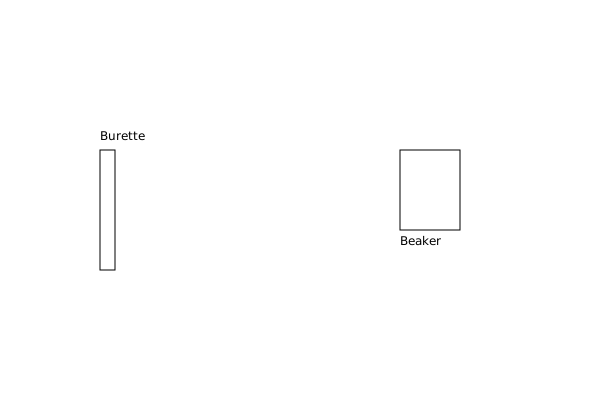
A diagram of a titration setup is shown below. If 25.0 mL of 0.100 M NaOH is required to reach the equivalence point, calculate the number of moles of HCl present in the solution.
A. 0.00250 mol
B. 0.00500 mol
C. 0.00750 mol
D. 0.0100 mol
Question 8
A 2.50 M solution of HCl is mixed with a 1.00 M solution of NaOH. Calculate the concentration of the resulting solution after the reaction is complete.
A. 1.75 M
B. 2.25 M
C. 2.50 M
D. 3.00 M
Question 9
Calculate the molar mass of a compound that contains 40.0% carbon, 6.7% hydrogen, and 53.3% oxygen by mass.
A. 60.0 g/mol
B. 80.0 g/mol
C. 120.0 g/mol
D. 180.0 g/mol
Question 10
A 100.0 mL sample of a solution containing 0.05 M H2SO4 is titrated with 0.05 M NaOH. Calculate the volume of NaOH required to reach the equivalence point.
A. 50.0 mL
B. 100.0 mL
C. 150.0 mL
D. 200.0 mL
Question 11
A mixture of 25.0 g of glu\cose (C6H12O6) and 15.0 g of fructose (C6H12O6) is dissolved in 200 mL of water. Calculate the molality of the solution.
A. 0.2 m
B. 0.4 m
C. 0.6 m
D. 0.8 m
Question 12
A 25.0 mL sample of a solution containing 0.2 M H2SO4 is titrated with 0.2 M NaOH. Calculate the volume of NaOH required to reach the equivalence point.
A. 12.5 mL
B. 25.0 mL
C. 37.5 mL
D. 50.0 mL
Question 13
A 250 mL sample of a 0.500 M solution of NaOH is titrated with a 1.0 M solution of HCl. What is the volume of HCl required to reach the equivalence point?
A. 100 mL
B. 200 mL
C. 250 mL
D. 300 mL
Question 14
A 1.0 M solution of NaOH is mixed with a 1.0 M solution of HCl. What is the pH of the resulting solution?
A. 1.0
B. 2.0
C. 3.0
D. 4.0
Question 15
A solution of sodium chloride (NaCl) is prepared by dissolving 35.5 g of NaCl in 100 mL of water. Calculate the molarity of the solution.
A. 0.5 M
B. 1.0 M
C. 2.0 M
D. 3.0 M

Master the Exam!

You've seen a preview, but there are thousands more questions plus AI tutor to break down complex solutions.

Unlock Full Access Available for Android & Windows
Help others prepare! Share this practice hub: