POST UTME SUMMIT UNIVERSITY 2019 Biology | Objective

Practice these randomly selected questions to test your readiness.

Question 1
A diagram of a plant cell is shown below. What is the function of the cell wall?
A. to provide structural support
B. to regulate the movement of materials
C. to synthesize proteins
D. to store genetic information
Question 2
The process of binary fission in bacteria involves the replication of the bacterial chromosome and the subsequent division of the cell into two daughter cells. Which of the following is a characteristic of the replicated chromosome during binary fission?
A. The replicated chromosome is attached to the cell membrane.
B. The replicated chromosome is attached to the cell wall.
C. The replicated chromosome is not attached to the cell membrane or cell wall.
D. The replicated chromosome is attached to the nucleoid.
Question 3
A diagram of the human eye is shown below. Which part of the eye is responsible for detecting light?
A. Cornea
B. Iris
C. Retina
D. Lens
Question 4
A diagram of a simple harmonic motion is shown below. Calculate the angular frequency (ω) if the period (T) is 2 seconds and the amplitude (A) is 5 meters.
A. 1.57
B. 3.14
C. 6.28
D. 9.42
Question 5
The process of meiosis in eukaryotic cells involves the replication of the chromosomes and the subsequent division of the cell into four daughter cells. Which of the following is a characteristic of the replicated chromosomes during meiosis?
A. The replicated chromosomes are attached to the spindle fibers.
B. The replicated chromosomes are not attached to the spindle fibers.
C. The replicated chromosomes are attached to the cell membrane.
D. The replicated chromosomes are attached to the cell wall.
Question 6
A diagram of a human eye is shown below. What is the function of the lens?
A. to focus light on the retina
B. to regulate the amount of light entering the eye
C. to detect movement
D. to synthesize vision
Question 7
The classification of living organisms into kingdoms is based on the following characteristics. Which of the following is a characteristic of the kingdom Animalia?
A. Multicellularity and heterotrophy.
B. Multicellularity and autotrophy.
C. Unicellularity and heterotrophy.
D. Unicellularity and autotrophy.
Question 8
A diagram of the human respiratory system is shown below. Which part of the system is responsible for exchanging oxygen and carbon dioxide?
A. Lungs
B. Trachea
C. Diaphragm
D. Bronchi
Question 9
A diagram of a plant cell is shown below. Identify the organelle labeled 'X'.
A. lysosome
B. nucleus
C. mitochondria
D. chloroplast
E. vacuole
Question 10
In a population of Drosophila melanogaster, the frequency of the recessive allele 'b' is 0.2. If the population is in Hardy-Weinberg equilibrium, what is the frequency of the homozygous dominant genotype 'BB'?
A. 0.16
B. 0.32
C. 0.36
D. 0.48
Question 11
A plant with the genotype 'Rr' is crossed with a plant with the genotype 'RR'. What is the probability that the offspring will have the genotype 'Rr'?
A. 0.5
B. 0.25
C. 0.75
D. 0.33
Question 12
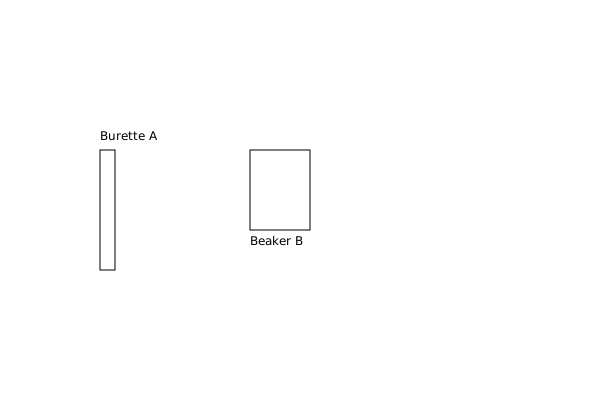
A diagram of a titration setup is shown below. Identify the subs\tance being titrated.
A. titrant
B. analyte
C. pipette
D. burette
E. beaker
Question 13
A plant with the genotype AaBb is crossed with a plant with the genotype AaBb. What is the probability that the offspring will have the genotype AaBb?
A. 0.25
B. 0.5
C. 0.75
D. 0.9
Question 14
In a population of 1000 individuals, the frequency of the dominant allele is 0.6. The frequency of the recessive allele is 0.4. What is the expected frequency of the heterozygous genotype?
A. 0.2
B. 0.4
C. 0.6
D. 0.8
Question 15
The process of mitosis in eukaryotic cells involves the replication of the chromosomes and the subsequent division of the cell into two daughter cells. Which of the following is a characteristic of the replicated chromosomes during mitosis?
A. The replicated chromosomes are attached to the spindle fibers.
B. The replicated chromosomes are not attached to the spindle fibers.
C. The replicated chromosomes are attached to the cell membrane.
D. The replicated chromosomes are attached to the cell wall.

Master the Exam!

You've seen a preview, but there are thousands more questions plus AI tutor to break down complex solutions.

Unlock Full Access Available for Android & Windows
Help others prepare! Share this practice hub: