POST UTME SUMMIT UNIVERSITY 2017 Biology | Objective

Practice these randomly selected questions to test your readiness.

Question 1
A 25-year-old woman is diagnosed with a type of anemia that affects the production of red blood cells. Which of the following is a characteristic of this anemia?
A. Fatigue
B. Shortness of breath
C. Pale skin
D. All of the above
Question 2
A diagram of a plant's root system is shown below. Identify the type of root labeled 'B'.
A. Taproot
B. Fibrous root
C. Adventitious root
D. Root hair
Question 3
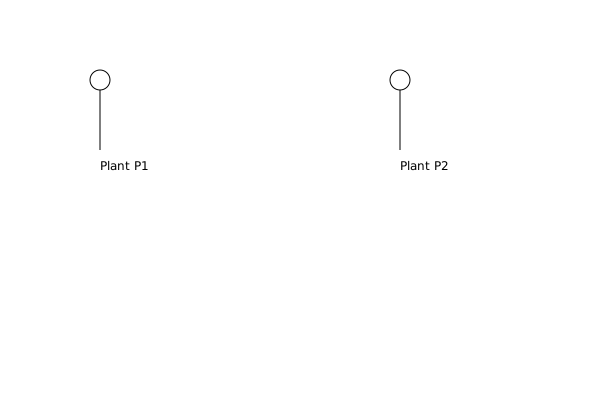
The diagram below shows a cross between two pea plants.
A. The offspring will all be tall.
B. The offspring will all be short.
C. The offspring will be a mix of tall and short.
D. The offspring will not be affected by the trait.
Question 4
A researcher is studying the effect of a new pesticide on the growth of wheat. The pesticide is applied at a concentration of 10 mg/L. What is the concentration of the pesticide in the soil after 5 days of application, given that the half-life of the pesticide is 3 days?
A. 1.25 mg/L
B. 2.5 mg/L
C. 5 mg/L
D. 10 mg/L
Question 5
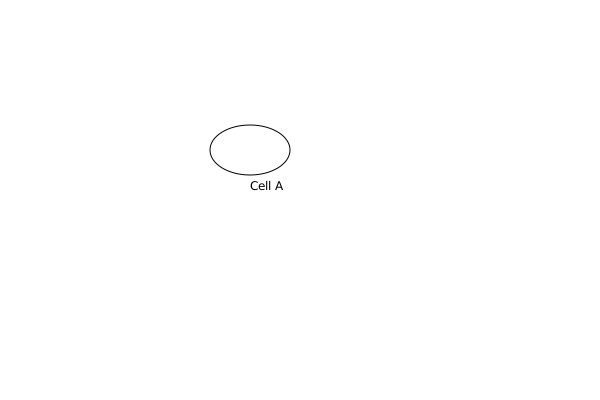
A diagram of a plant cell is shown below. Identify the organelle responsible for protein synthesis.
A. Nucleus
B. Mitochondria
C. Ribosome
D. Lysosome
Question 6
A diagram of a neuron is shown below. What is the function of the d\endrites?
A. To transmit signals to other neurons
B. To receive signals from other neurons
C. To produce neurotransmitters
D. To regulate the heartbeat
Question 7
A diagram of a human eye is shown below. Identify the part responsible for detecting light.
A. Cornea
B. Iris
C. Retina
D. Lens
Question 8
A population of Drosophila melanogaster is being studied for its genetic variation. The frequency of the recessive allele 'a' is 0.2. What is the probability that two randomly selected flies will be homozygous recessive?
A. 0.04
B. 0.08
C. 0.16
D. 0.32
Question 9
What is the process by which an organism's genetic information is passed from one generation to the next?
A. Mutation
B. Genetic drift
C. Natural selection
D. Heredity
Question 10
A diagram of a human eye is shown below. What is the function of the lens?
A. To focus light on the retina
B. To regulate the amount of light entering the eye
C. To produce tears
D. To maintain the shape of the eye
Question 11
A plant cell is placed in a solution with a high concentration of sucrose. What will happen to the cell?
A. The cell will swell and eventually burst
B. The cell will shrink and lose its turgor pressure
C. The cell will remain unchanged
D. The cell will undergo photosynthesis
Question 12
In the context of eco\logy, what is the primary function of a keystone species in a given e\cosystem?
A. To regulate the population of other species
B. To provide a source of food for other species
C. To create a habitat for other species
D. To maintain the balance of the e\cosystem
Question 13
A 25-year-old woman presents with a 2-year history of progressive weakness and fatigue. Her hemoglobin level is 8 g/dL. Which of the following is the most likely diagnosis?
A. Iron deficiency anemia
B. Thalassemia major
C. Sickle cell disease
D. Pernicious anemia
Question 14
A 2.5 g sample of a compound containing only carbon and hydrogen is burned in a combustion apparatus. The volume of carbon dioxide produced is 2.5 liters at 25°C and 1 atm. What is the empirical formula of the compound?
A. CH4
B. C2H6
C. C3H8
D. C4H10
Question 15
A plant has a genotype of BB for the trait of flower color. What is the probability that a seed from this plant will have a genotype of bb?
A. 0%
B. 25%
C. 50%
D. 100%

Master the Exam!

You've seen a preview, but there are thousands more questions plus AI tutor to break down complex solutions.

Unlock Full Access Available for Android & Windows
Help others prepare! Share this practice hub: