POST UTME SKYLINE UNIVERSITY 2017 Geography | Objective

Practice these randomly selected questions to test your readiness.

Question 1
A population of 100,000 people is growing at a rate of 2% per annum. What will be the population after 5 years?
A. 120,000
B. 110,000
C. 105,000
D. 100,000
Question 2
A rock sample from the Benue Trough is analyzed and found to have a high concentration of quartz. What is the likely rock type?
A. Granite
B. Basalt
C. Sandstone
D. Shale
Question 3
A population of 1000 people is growing at a rate of 10% per annum. If the population is currently 1200 people, what was the population 2 years ago?
A. 800
B. 900
C. 1000
D. 1100
Question 4
The diagram below shows a population pyramid for a given country. What is the likely effect of the population pyramid on the country's economy?
A. The country's economy will experience a surplus of labor.
B. The country's economy will experience a shortage of labor.
C. The country's economy will experience a stable labor force.
D. The country's economy will experience a decline in productivity.
Question 5
A diagram shows a cross-section of the Ogun River. What is the likely reason for the meandering of the river?
A. Tectonic activity
B. Volcanic activity
C. River erosion and sedimentation
D. Sea level rise
Question 6
The Benue Trough is a region of significant tectonic activity in Nigeria. What type of faulting is responsible for its formation?
A. Normal faulting
B. Reverse faulting
C. Strike-slip faulting
D. Dextral faulting
Question 7
A diagram of a river system is shown below. What is the correct order of the stages of a river's journey from its source to its mouth?
A. A, B, C, D
B. A, C, B, D
C. B, A, C, D
D. C, B, A, D
Question 8
A soil sample from the Jos Plateau is analyzed and found to have a pH of 6.5. What is the likely soil type?
A. Alkaline soil
B. Acidic soil
C. Neutral soil
D. Sodic soil
Question 9
The Jos Plateau is a region of high relief and diverse landforms. What is the primary reason for its formation?
A. Volcanic activity
B. Tectonic uplift
C. Weathering and erosion
D. Glacial activity
Question 10
The Benue Trough is a region of significant economic importance in Nigeria, with significant oil and gas reserves. What is the primary economic activity that drives the region's economy?
A. Agriculture
B. Mining
C. Manufacturing
D. Services
Question 11
A map of Nigeria shows the location of the Jos Plateau. What is the primary reason for the formation of this plateau?
A. Volcanic activity
B. Tectonic uplift
C. Weathering and erosion
D. Glacial activity
Question 12
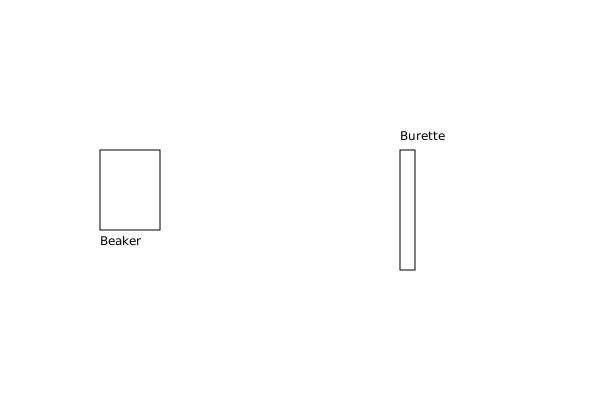
A diagram shows a simple black and white chemistry apparatus showing a titration setup. What is the likely purpose of the titration?
A. To determine the concentration of a solution
B. To determine the pH of a solution
C. To determine the boiling point of a solution
D. To determine the melting point of a solution
Question 13
The Niger Delta region is characterized by a complex network of rivers and creeks. What is the primary reason for this complex network?
A. Tectonic activity
B. Volcanic activity
C. River erosion and sedimentation
D. Sea level rise
Question 14
The Jos Plateau is a region of Nigeria known for its rich mineral resources. What type of rocks are commonly found in this region?
A. Igneous rocks
B. Sedimentary rocks
C. Metamorphic rocks
D. Foliated rocks
Question 15
The diagram below shows a cross-section of the Earth's atmosphere. What is the likely effect of the ozone layer depletion on the surrounding environment?
A. The ozone layer depletion will increase the amount of UV radiation reaching the Earth's surface.
B. The ozone layer depletion will decrease the amount of UV radiation reaching the Earth's surface.
C. The ozone layer depletion will have no effect on the surrounding environment.
D. The ozone layer depletion will increase the amount of greenhouse gases in the atmosphere.

Master the Exam!

You've seen a preview, but there are thousands more questions plus AI tutor to break down complex solutions.

Unlock Full Access Available for Android & Windows
Help others prepare! Share this practice hub: