POST UTME RSU 2024 Biology | Objective

Practice these randomly selected questions to test your readiness.

Question 1
The nervous system is responsible for transmitting and proces\sing information throughout the body. Which of the following is a key type of neuron?
A. Sensory neuron
B. Motor neuron
C. Interneuron
D. All of the above
Question 2
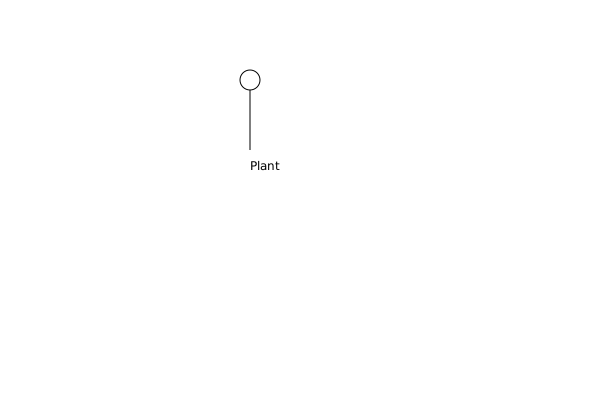
A plant root is shown below. What is the primary function of the xylem tissue in this root?
A. To transport water and minerals from the roots to the leaves
B. To transport sugars and other organic compounds from the leaves to the roots
C. To provide structural support to the root
D. To regulate the rate of transpiration
Question 3
A plant grows in a controlled environment with a cons\tant temperature of 25°C and a photoperiod of 12 hours. What is the expected effect on the plant's growth rate?
A. Increased growth rate
B. Decreased growth rate
C. No effect on growth rate
D. Variable growth rate
Question 4
The reaction below is an example of a biochemical pathway. What is the primary function of the enzyme labeled 'E1'?
A. To catalyze the conversion of A to C
B. To regulate the expression of the gene encoding E1
C. To bind to and inhibit the substrate A
D. To control the synthesis of the product D
Question 5
In a community of 500 individuals, 20% are herbivores, 30% are carnivores, and 50% are omnivores. If 10% of the herbivores, 20% of the carnivores, and 15% of the omnivores are infected with a particular disease, what is the total number of individuals infected with the disease?
A. 50
B. 75
C. 100
D. 125
Question 6
In the process of osmoregulation, what is the primary mechanism by which the kidney regulates the concentration of ions in the blood?
A. Active transport
B. Passive diffusion
C. Osmosis
D. Filtration
Question 7
A diagram shows a simple circuit with a battery, a resistor, and a light bulb. If the battery has a voltage of 9V and the resistor has a resis\tance of 10Ω, what is the current flowing through the light bulb?
A. 0.9A
B. 0.1A
C. 1.0A
D. 9.0A
Question 8
The graph below shows the relationship between the concentration of a substrate and the rate of enzyme activity. What is the primary conclusion that can be drawn from this graph?
A. The enzyme is saturated at high substrate concentrations
B. The enzyme is inhibited at low substrate concentrations
C. The enzyme follows Michaelis-Menten kinetics
D. The enzyme is activated at high substrate concentrations
Question 9
A researcher is studying the effect of temperature on the growth rate of E. coli bacteria. The data collected are as follows: Temperature (°C), Growth Rate \( h-1 \): 20, 0.2; 25, 0.5; 30, 1.0; 35, 1.5. What is the best-fit linear equation for the data?
A. y = 0.05x + 0.1
B. y = 0.1x - 0.5
C. y = 0.05x - 0.1
D. y = 0.1x + 0.5
Question 10
A diagram shows a cross-section of a human heart, showing the atria and ventricles. What is the function of the atrioventricular (AV) valves?
A. To prevent backflow of blood from the ventricles to the atria
B. To prevent backflow of blood from the atria to the ventricles
C. To regulate the flow of blood from the atria to the ventricles
D. To regulate the flow of blood from the ventricles to the atria
Question 11
A researcher studying the effects of climate change on a particular species of bird observes that the birds have a 15% chance of migrating to a new location. If 200 birds are studied, what is the expected number of birds that will migrate?
A. 20
B. 25
C. 30
D. 35
Question 12
The process of natural selection can be described as a mechanism that favors the survival and reproduction of individuals with traits that are better suited to their environment. Which of the following is a key component of this process?
A. Genetic drift
B. Mutation
C. Gene flow
D. Variation in fitness
Question 13
In the process of cellular respiration, what is the primary function of the electron transport chain?
A. To generate ATP through substrate-level phosphorylation
B. To pump protons across the mitochondrial membrane, creating a proton gradient
C. To reduce NADH and FADH2 to their reduced forms
D. To produce water as a byproduct of the citric acid cycle
Question 14
In the context of cellular respiration, what is the primary function of the electron transport chain?
A. To generate ATP
B. To produce NADH and FADH2
C. To transport electrons across the membrane
D. To synthesize glu\cose
Question 15
In a eukaryotic cell, the process of mitosis is initiated by the breakdown of the nuclear envelope, which is mediated by the action of the nuclear lamina. What is the primary function of the nuclear lamina in this process?
A. To provide structural support to the nucleus
B. To regulate the passage of molecules in and out of the nucleus
C. To facilitate the breakdown of the nuclear envelope
D. To control the replication of the genome

Master the Exam!

You've seen a preview, but there are thousands more questions plus AI tutor to break down complex solutions.

Unlock Full Access Available for Android & Windows
Help others prepare! Share this practice hub: