POST UTME PAN-ATLANTIC UNIVERSITY 2018 Chemistry | Objective

Practice these randomly selected questions to test your readiness.

Question 1
A 1.0 L solution contains 0.50 M H2SO4. What is the concentration of H+ ions in the solution?
A. 1.0 M
B. 1.5 M
C. 2.0 M
D. 2.5 M
Question 2
Calculate the s\tandard enthalpy change for the reaction: 2Al(s) + Fe2O3(s) → 2Fe(s) + Al2O3(s).
A. -837 kJ/mol
B. -837 kJ/mol
C. -837 kJ/mol
D. -837 kJ/mol
Question 3
A 2.0 L solution contains 0.20 M NaOH. What is the concentration of OH- ions in the solution?
A. 0.10 M
B. 0.20 M
C. 0.30 M
D. 0.40 M
Question 4
A 2.5 M solution of sulfuric acid (H2SO4) is mixed with a 1.5 M solution of sodium hydroxide (NaOH). Calculate the concentration of the resulting solution after the reaction is complete.
A. 1.0 M
B. 1.5 M
C. 2.0 M
D. 2.5 M
Question 5
The half-life of a radioactive subs\tance is 5 years. If 100 g of the subs\tance is present initially, how much will remain after 15 years?
A. 12.5 g
B. 25 g
C. 50 g
D. 100 g
Question 6
Determine the pH of a 0.1 M solution of HCl.
A. 1
B. 2
C. 3
D. 4
Question 7
A solution contains 0.10 M NaCl. What is the concentration of Cl- ions in the solution?
A. 0.10 M
B. 0.20 M
C. 0.30 M
D. 0.40 M
Question 8
A 1.0 L solution contains 0.50 M HCl. What is the concentration of H+ ions in the solution?
A. 0.50 M
B. 1.0 M
C. 1.5 M
D. 2.0 M
Question 9
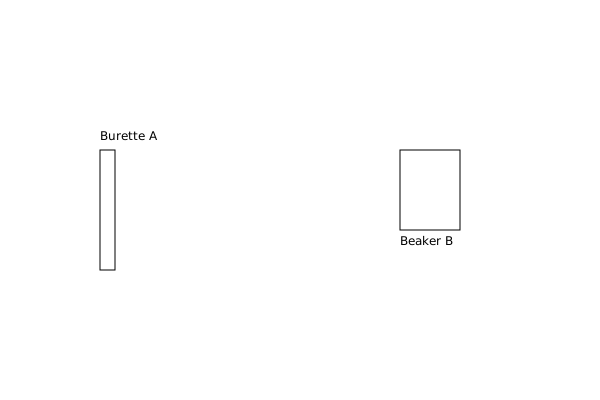
The diagram below shows a titration setup.
A. The burette contains HCl.
B. The burette contains NaOH.
C. The beaker contains HCl.
D. The beaker contains NaOH.
Question 10
The solubility of a sparingly soluble salt, AgCl, in water is 1.2 x 10^-5 mol/L at 25°C. If 2.0 g of AgCl is dissolved in 1.0 L of water, what is the concentration of Ag+ ions in the solution?
A. 1.2 x 10^-5 M
B. 2.4 x 10^-5 M
C. 4.8 x 10^-5 M
D. 6.0 x 10^-5 M
Question 11
The reaction of nitrogen with oxygen to form nitrogen dioxide is highly exothermic. Calculate the s\tandard enthalpy change (ΔH) for this reaction u\sing the following data: ΔHf(N2) = 0 kJ/mol, ΔHf(O2) = 0 kJ/mol, ΔHf(NO2) = 59.2 kJ/mol. Assume that the reaction occurs at 298 K.
A. -59.2 kJ/mol
B. 59.2 kJ/mol
C. -118.4 kJ/mol
D. 118.4 kJ/mol
Question 12
The reaction of hydrogen gas with chlorine gas to form hydrogen chloride is highly exothermic. Calculate the s\tandard enthalpy change (ΔH) for this reaction u\sing the following data: ΔHf(H2) = 0 kJ/mol, ΔHf(Cl2) = 0 kJ/mol, ΔHf(HCl) = -92.3 kJ/mol. Assume that the reaction occurs at 298 K.
A. -92.3 kJ/mol
B. 92.3 kJ/mol
C. -184.6 kJ/mol
D. 184.6 kJ/mol
Question 13
Calculate the molar mass of a compound that contains 40.0% carbon, 6.7% hydrogen, and 53.3% oxygen by mass.
A. 60 g/mol
B. 80 g/mol
C. 100 g/mol
D. 120 g/mol
Question 14
A 1.0 M solution of sodium carbonate (Na2CO3) is mixed with a 2.0 M solution of hydrochloric acid (HCl). Calculate the concentration of the resulting solution after the reaction is complete.
A. 0.5 M
B. 1.0 M
C. 1.5 M
D. 2.0 M
Question 15
A 25.0 mL sample of 0.1 M HCl is titrated with 0.1 M NaOH. Calculate the pH after the addition of 20.0 mL of NaOH.
A. 2
B. 3
C. 4
D. 5

Master the Exam!

You've seen a preview, but there are thousands more questions plus AI tutor to break down complex solutions.

Unlock Full Access Available for Android & Windows
Help others prepare! Share this practice hub: