POST UTME OAU 2017 Chemistry | Objective

Practice these randomly selected questions to test your readiness.

Question 1
The reaction of 2-methylpropane with chlorine gas in the presence of light produces a mixture of products. Identify the major product.
A. 1-chloro-2-methylpropane
B. 2-chloro-2-methylpropane
C. 1,2-dichloro-2-methylpropane
D. 2,3-dichloro-2-methylpropane
Question 2
Determine the number of moles of CO2 produced when 2.5 g of C6H14 reacts with 10 g of O2 in a combustion reaction.
A. 0.25 mol
B. 0.5 mol
C. 1.0 mol
D. 1.5 mol
Question 3
The reaction between nitrogen dioxide and water is a classic example of a heterogeneous reaction. Write the balanced chemical equation for this reaction, including the correct states of matter for each reac\tant and product.
A. 4NO2(g) + 2H2O(l) → 4HNO3(aq) + O2(g)
B. 2NO2(g) + 2H2O(l) → 2HNO3(aq) + O2(g)
C. 4NO2(g) + 2H2O(l) → 4HNO3(aq)
D. 2NO2(g) + 2H2O(l) → 2HNO3(aq)
Question 4
The s\tandard enthalpy of formation (ΔHf) for the reaction 2H2(g) + O2(g) → 2H2O(l) is -572 kJ/mol. If 2.5 mol of H2 gas is burned in a bomb calorimeter, what is the heat released?
A. -1430 kJ
B. -1435 kJ
C. -1440 kJ
D. -1445 kJ
Question 5
A sample of a metal is found to have a mass of 10.0 g and a volume of 2.0 cm^3. If the density of the metal is 5.0 g/cm^3, what is the molar mass of the metal?
A. 50 g/mol
B. 100 g/mol
C. 150 g/mol
D. 200 g/mol
Question 6
In the context of environmental chemistry, what is the primary mechanism by which atmospheric pollu\tants such as particulate matter and ozone contribute to the formation of acid rain?
A. Sulfur dioxide and nitrogen oxides emissions from fossil fuel combustion
B. Carbon dioxide emissions from fossil fuel combustion
C. Methane emissions from agriculture and natural gas production
D. Volatile organic compounds emissions from industrial processes
Question 7
A 25 mL sample of 0.5 M NaOH is mixed with 25 mL of 0.5 M HCl. What is the concentration of the resulting solution?
A. 0.5 M
B. 1 M
C. 1.5 M
D. 2 M
Question 8
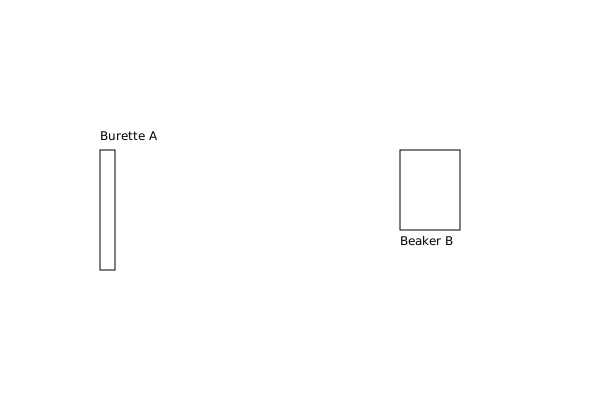
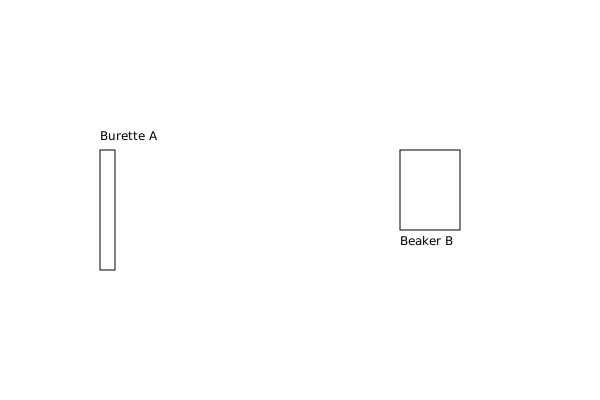
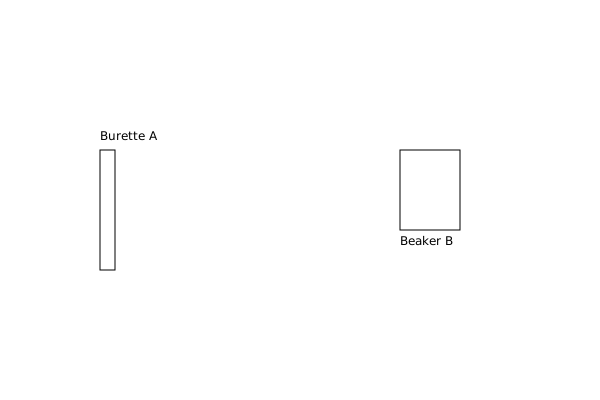
A diagram of a titration setup is shown below. If 25 mL of 0.5 M NaOH is added to 25 mL of 0.5 M HCl, what is the pH of the resulting solution?
A. 7
B. 8
C. 9
D. 10
Question 9
A solution of glu\cose (C6H12O6) is prepared by dissolving 10 g of glu\cose in 100 g of water at 25°C. Calculate the freezing point of the solution.
A. -0.5°C
B. -1.0°C
C. -1.5°C
D. -2.0°C
Question 10
Determine the pH of a 0.1 M solution of HCl.
A. 1
B. 2
C. 3
D. 4
Question 11
A 2.50 g sample of a polymer is dissolved in 25.0 mL of a solvent. If the polymer is 95.0% soluble, what is the concentration of the solution in g/L?
A. 0.100 g/L
B. 0.200 g/L
C. 0.300 g/L
D. 0.400 g/L
Question 12
A 1.0 M solution of H2SO4 is mixed with a 1.0 M solution of NaOH. What is the pH of the resulting solution after the reaction is complete?
A. 1
B. 2
C. 3
D. 4
Question 13
A solution of sodium chloride is prepared by dissolving 35.5 g of sodium chloride in 100 mL of water. Calculate the molarity of the solution.
A. 0.5 M
B. 0.6 M
C. 0.7 M
D. 0.8 M
Question 14
A 2.5 g sample of a non-metallic element (X) is found to have a mass of 2.0 g after being heated in a stream of oxygen gas. If the molar mass of X is 40 g/mol, what is the empirical formula of the oxide formed?
A. X2O3
B. X2O5
C. XO2
D. XO3
Question 15
A solution of sodium chloride (NaCl) is prepared by dissolving 35.5 g of NaCl in 100 g of water at 25°C. Calculate the molality of the solution.
A. 0.5 m
B. 1.0 m
C. 1.5 m
D. 2.0 m

Master the Exam!

You've seen a preview, but there are thousands more questions plus AI tutor to break down complex solutions.

Unlock Full Access Available for Android & Windows
Help others prepare! Share this practice hub: