POST UTME NOUN 2025 Chemistry | Objective

Practice these randomly selected questions to test your readiness.

Question 1
A diagram of a circuit is shown below. What is the purpose of the resistor?
A. To reduce the voltage
B. To increase the current
C. To regulate the flow of electrons
D. To generate electricity
Question 2
A sample of air contains 21% oxygen, 78% nitrogen, and 1% other gases. What is the partial pressure of oxygen in a sample of air at 1 atm total pressure?
A. 0.21 atm
B. 0.21 kPa
C. 0.21 bar
D. 0.21 MPa
Question 3
The rate of a chemical reaction is affected by the concentration of the reac\tants. What is the term for the increase in the rate of reaction with an increase in the concentration of the reac\tants?
A. Catalysis
B. Activation energy
C. Order of reaction
D. Rate cons\tant
Question 4
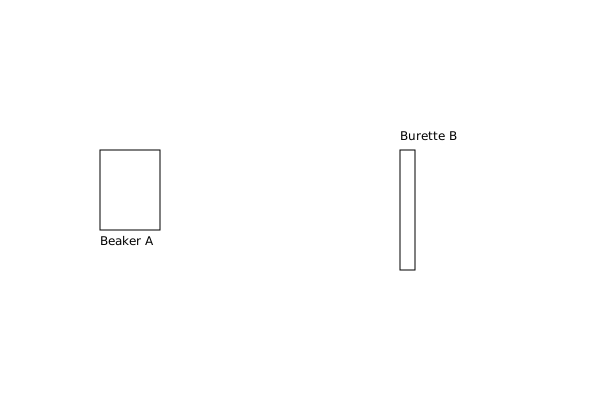
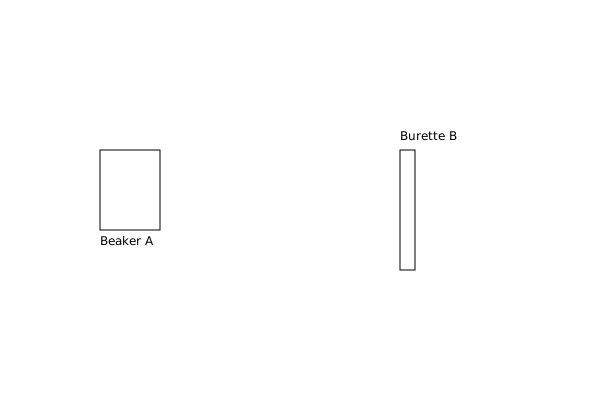
A diagram of a titration setup is shown below. What is the purpose of the pipette?
A. To measure the volume of the titrant
B. To measure the volume of the analyte
C. To mix the titrant and analyte
D. To separate the titrant and analyte
Question 5
Determine the s\tandard enthalpy of formation of NH3(g) from the following data: ΔHf(NH3(g)) = ?; ΔHf(H2(g)) = -285.8 kJ/mol; ΔHf(N2(g)) = 0 kJ/mol.
A. -45.9 kJ/mol
B. -92.1 kJ/mol
C. -45.9 kJ/mol
D. -92.1 kJ/mol
Question 6
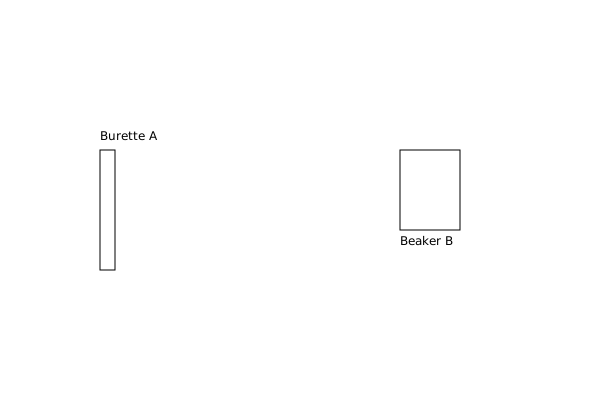
A diagram of a titration setup is shown below.
A. The burette contains NaOH.
B. The beaker contains HCl.
C. The burette contains HCl.
D. The beaker contains NaOH.
Question 7
A 2.5 M solution of HCl is mixed with a 2.5 M solution of NaOH. Calculate the concentration of the resulting solution.
A. 2.5 M
B. 5.0 M
C. 2.5 M
D. 5.0 M
Question 8
The rate cons\tant (k) of a first-order reaction is given by the equation k = Ae^\( -Ea/RT \). If the activation energy (Ea) is 100 kJ/mol, the gas cons\tant (R) is 8.314 J/mol*K, and the temperature (T) is 300 K, what is the value of the rate cons\tant (k)?
A. 1.0 x 10^\( -4 \) s^\( -1 \)
B. 1.0 x 10^\( -3 \) s^\( -1 \)
C. 1.0 x 10^\( -2 \) s^\( -1 \)
D. 1.0 x 10^\( -1 \) s^\( -1 \)
Question 9
A solution contains 2.0 g of NaCl in 100 mL of water. Calculate the molarity of the solution.
A. 0.1 M
B. 0.2 M
C. 0.3 M
D. 0.4 M
Question 10
A 10.0 mL sample of a solution containing 0.5 M HCl is titrated with 0.1 M NaOH. Calculate the volume of NaOH required to reach the equivalence point.
A. 10.0 mL
B. 20.0 mL
C. 30.0 mL
D. 40.0 mL
Question 11
A sample of CO2 gas is collected over water at a temperature of 25°C and a pressure of 1 atm. If the volume of the gas is 2.5 L, what is the partial pressure of CO2?
A. 0.5 atm
B. 0.6 atm
C. 0.7 atm
D. 0.8 atm
Question 12
A 2.5 M solution of sodium hydroxide (NaOH) is prepared by dissolving 12.5 g of NaOH in water to make 250 mL of solution. What is the concentration of the solution in moles per liter?
A. 0.1 M
B. 0.2 M
C. 0.5 M
D. 1.0 M
Question 13
A diagram of a plant cell is shown below. What is the function of the cell wall?
A. To provide structural support
B. To regulate the movement of materials
C. To synthesize proteins
D. To store genetic information
Question 14
A diagram of a graph is shown below. What is the equation of the line?
A. y = 2x + 3
B. y = 3x + 2
C. y = 4x - 1
D. y = 1x + 4
Question 15
Determine the type of reaction that occurs when 1-bu\tanol is heated with a strong base.
A. Substitution reaction
B. Elimination reaction
C. Condensation reaction
D. Addition reaction

Master the Exam!

You've seen a preview, but there are thousands more questions plus AI tutor to break down complex solutions.

Unlock Full Access Available for Android & Windows
Help others prepare! Share this practice hub: