POST UTME NOUN 2024 Biology | Objective

Practice these randomly selected questions to test your readiness.

Question 1
Which of the following tissues is primarily composed of epithelial cells?
A. Connective tissue
B. Muscle tissue
C. Nervous tissue
D. Epithelial tissue
Question 2
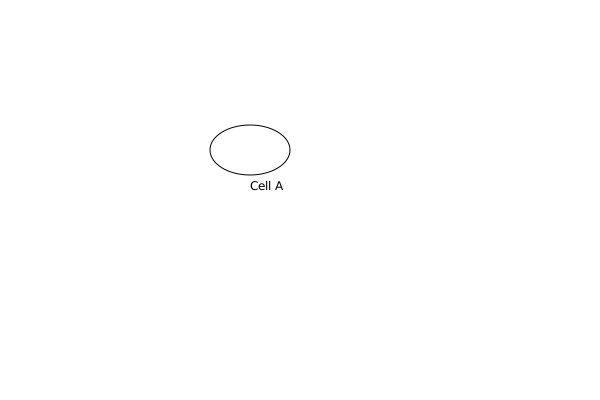
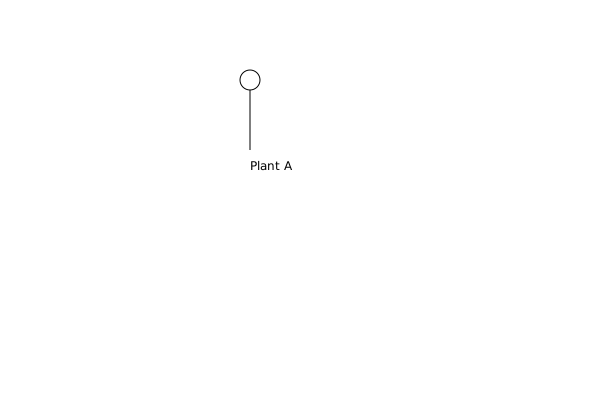
A diagram of a plant cell is shown below. Identify the part labeled 'A'.
A. Nucleus
B. Mitochondria
C. Chloroplast
D. Vacuole
Question 3
A 20-year-old woman presents with symptoms of growth hormone deficiency. Her growth hormone levels are 0.5 ng/mL. What is the expected effect on her growth rate?
A. Increased growth rate
B. Decreased growth rate
C. No effect on growth rate
D. Variable growth rate
Question 4
In the process of osmoregulation, what is the primary mechanism by which the kidneys regulate the concentration of ions in the blood?
A. Active transport of ions across the renal tubular epithelium
B. Passive diffusion of ions through the renal tubular epithelium
C. Reabsorption of ions from the filtrate back into the bloodstream
D. Excretion of ions in the urine
Question 5
A student is studying the transport of subs\tances in plants. Which of the following is a function of the xylem?
A. Transport of water and minerals from roots to leaves
B. Transport of sugars and amino acids from leaves to roots
C. Transport of oxygen and carbon dioxide between leaves and roots
D. Transport of waste products from leaves to roots
Question 6
The Hardy-Weinberg principle states that allele frequencies in a population will remain cons\tant from generation to generation in the absence of other evolutionary influences. Which of the following is a necessary condition for the Hardy-Weinberg principle to hold?
A. Random mating
B. No mutation
C. No gene flow
D. No natural selection
Question 7
What is the primary function of the excretory system in humans?
A. To regulate body temperature
B. To remove waste products from the body
C. To maintain fluid balance
D. To produce hormones
Question 8
Which of the following is an example of a multicellular organism?
A. Bacteria
B. Amoeba
C. Human
D. Fungus
Question 9
The process of photosynthesis in plants involves the conversion of light energy into chemical energy. Which of the following is a byproduct of photosynthesis?
A. Oxygen gas
B. Carbon dioxide gas
C. Water vapor
D. Glu\cose molecule
Question 10
A plant is placed in a solution with a high concentration of sucrose. What is the expected outcome in terms of photosynthesis?
A. Increased rate of photosynthesis
B. Decreased rate of photosynthesis
C. No change in rate of photosynthesis
D. Inhibition of photosynthesis
Question 11
A diagram of the human digestive system is shown below. What is the primary function of the small intestine?
A. Mechanical digestion of food
B. Chemical digestion of proteins
C. Absorption of nutrients
D. Storage of waste
Question 12
A diagram of the xylem and phloem tissues in a plant stem is shown below. What is the primary function of the xylem tissue?
A. Transport of water and minerals
B. Transport of sugars and amino acids
C. Support and structure
D. Storage of food
Question 13
In the context of evolutionary theory, what is the primary mechanism by which species adapt to their environment?
A. Natural Selection
B. Genetic Drift
C. Mutation
D. Gene Flow
Question 14
What is the primary function of the pancreas in the process of digestion?
A. To produce digestive enzymes that break down proteins, carbohydrates, and fats
B. To produce hormones that regulate blood sugar levels
C. To produce bile that emulsifies fats
D. To produce mucus that lubricates the digestive tract
Question 15
In asexual reproduction, what is the primary mechanism by which genetic variation is introduced?
A. Mutation
B. Genetic recombination
C. Gene duplication
D. Gene deletion

Master the Exam!

You've seen a preview, but there are thousands more questions plus AI tutor to break down complex solutions.

Unlock Full Access Available for Android & Windows
Help others prepare! Share this practice hub: