POST UTME MADONNA UNIVERSITY 2019 Biology | Objective

Practice these randomly selected questions to test your readiness.

Question 1
A population of rabbits is growing at a rate of 20% per year. If the population is currently 1000 rabbits, how many rabbits will there be in 5 years?
A. 1628
B. 2000
C. 2500
D. 3125
Question 2
In the context of eco\logy, what is the term for the process by which plants release water vapor into the air?
A. Transpiration
B. Respiration
C. Photosynthesis
D. Evaporation
Question 3
A neuron is stimulated by a sensory receptor. Which of the following types of receptors is most likely responsible for this stimulation?
A. Mechanoreceptors
B. Thermoreceptors
C. Photoreceptors
D. Chemoreceptors
Question 4
A scientist is studying the effect of pH on the growth of a microorganism. If the optimal pH for growth is 7, and the microorganism grows best at a pH of 8, what is the expected growth rate of the microorganism at a pH of 9?
A. 0.5
B. 1
C. 1.5
D. 2
Question 5
A plant has a genotype of BBSS. What is the probability that it will produce a gamete with the genotype SS?
A. 0.25
B. 0.5
C. 0.75
D. 1
Question 6
A plant has a root system that absorbs water and nutrients from the soil. If the plant absorbs 100 mL of water per hour, and the concentration of nutrients in the water is 2 g/L, what is the total amount of nutrients absorbed by the plant in 4 hours?
A. 0.8
B. 1.6
C. 2.4
D. 3.2
Question 7
A gas exchange occurs in the lungs. What is the primary mechanism by which oxygen is transported from the lungs to the body?
A. Diffusion
B. Osmosis
C. Active transport
D. Passive transport
Question 8
In a population of 1000 individuals, the frequency of the recessive allele 'a' is 0.2. If the population is in Hardy-Weinberg equilibrium, what is the frequency of the dominant allele 'A'?
A. 0.8
B. 0.6
C. 0.4
D. 0.2
Question 9
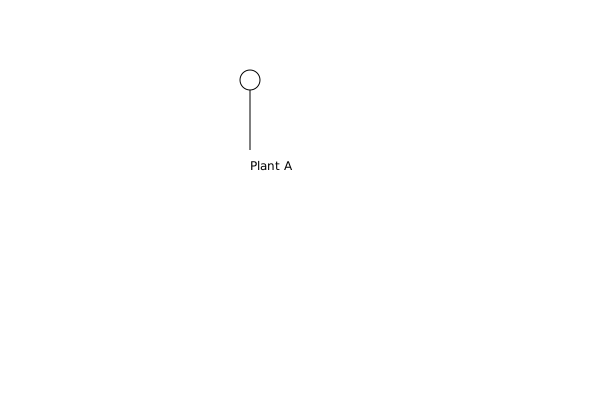
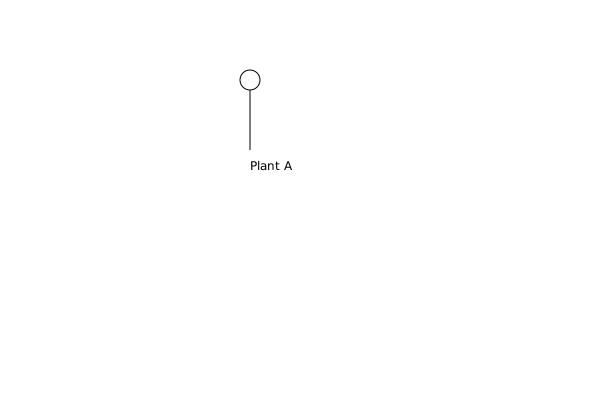
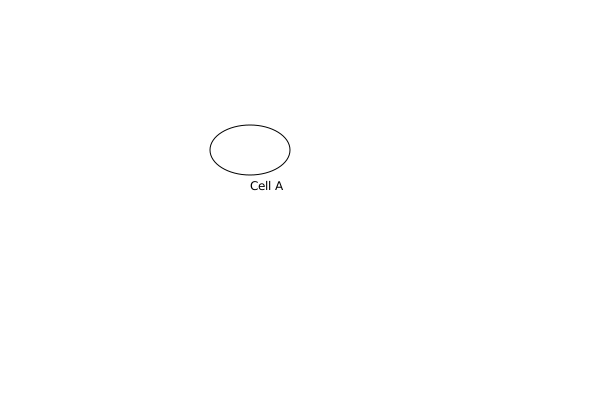
A diagram of a plant cell is shown below. Identify the part labeled 'A'?
A. Nucleus
B. Mitochondria
C. Chloroplast
D. Vacuole
Question 10
In a population of 1000 individuals, 50% are heterozygous for a particular gene, 30% are homozygous dominant, and 20% are homozygous recessive. What is the probability that a randomly selected individual will be homozygous recessive?
A. 0.2
B. 0.3
C. 0.4
D. 0.5
Question 11
A diagram of a human eye is shown below. Identify the part labeled 'B'?
A. Cornea
B. Iris
C. Retina
D. Lens
Question 12
A diagram of a plant cell is shown below. What is the function of the cell wall?
A. To provide structural support to the cell
B. To regulate the movement of materials in and out of the cell
C. To produce hormones that regulate plant growth
D. To store food produced by the plant
Question 13
In a population of 1000 organisms, 200 are infected with a disease. If the disease is caused by a bacterium that has a generation time of 2 hours, and the death rate of the infected organisms is 50% per hour, what is the expected number of infected organisms after 4 hours?
A. 50
B. 100
C. 200
D. 500
Question 14
A diagram of a human digestive system is shown below. What is the function of the structure labeled 'B'?
A. Absorption of nutrients
B. Digestion of proteins
C. Production of bile
D. Storage of waste
Question 15
In the context of growth and regulation, what is the term for the process by which cells divide to form new cells?
A. Mitosis
B. Meiosis
C. Growth
D. Differentiation

Master the Exam!

You've seen a preview, but there are thousands more questions plus AI tutor to break down complex solutions.

Unlock Full Access Available for Android & Windows
Help others prepare! Share this practice hub: