POST UTME LAUTECH 2024 Biology | Objective

Practice these randomly selected questions to test your readiness.

Question 1
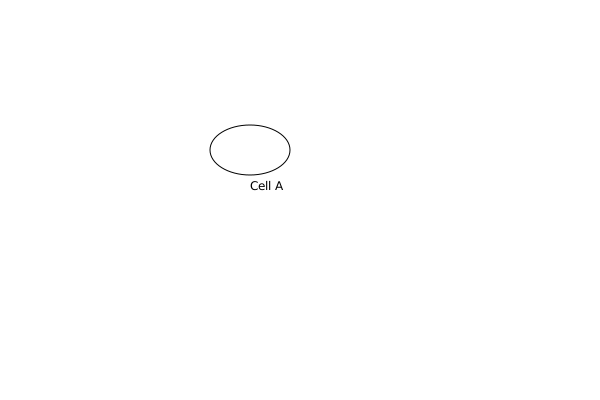
A diagram of a plant cell is shown below. Identify the part labeled A.
A. Mitochondria
B. Chloroplast
C. Vacuole
D. Nucleus
Question 2
What is the primary mechanism by which the heart pumps blood throughout the body?
A. Through the contraction of cardiac muscle fibers
B. Through the relaxation of cardiac muscle fibers
C. Through the regulation of hormone levels
D. Through the transmission of electrical signals along the cardiac conduction system
Question 3
A population of Drosophila melanogaster is being studied for its response to a new mutation. Which of the following is a characteristic of the Hardy-Weinberg principle?
A. The frequency of the dominant allele remains cons\tant from one generation to the next
B. The frequency of the recessive allele remains cons\tant from one generation to the next
C. The frequency of the dominant allele increases from one generation to the next
D. The frequency of the recessive allele decreases from one generation to the next
Question 4
A 5-year-old child is diagnosed with acute lymphoblastic leukemia (ALL). The child's bone marrow biopsy shows a high percentage of blasts. Which of the following is the most likely cause of this child's leukemia?
A. Genetic mutation
B. Viral infection
C. Environmental exposure
D. Family history
Question 5
A genetic cross is performed between two pea plants. One plant is homozygous dominant for the trait and the other plant is homozygous recessive. What is the probability that the offspring will be homozygous dominant?
A. 0.5
B. 0.25
C. 0.75
D. 0.9
Question 6
In a sexual reproduction process, the fusion of gametes results in the formation of a zygote. Which of the following types of genetic variation is responsible for the diversity of offspring?
A. Genetic drift
B. Mutation
C. Gene flow
D. Genetic recombination
Question 7
Asexual reproduction involves the production of offspring without the involvement of gametes. Which of the following types of asexual reproduction involves the production of offspring through the fragmentation of a parent organism?
A. Budding
B. Binary fission
C. Fragmentation
D. Regeneration
Question 8
In a eukaryotic cell, which organelle is responsible for the synthesis of proteins?
A. Mitochondria
B. Chloroplast
C. Endoplasmic reticulum
D. Ribosome
Question 9
The equation \( \frac{dP}{dt} = rP left\( 1 - \frac{P}{K} \right \ \) ) represents the growth of a population. What is the value of K?
A. 10
B. 20
C. 30
D. 40
Question 10
In a tropical rainforest e\cosystem, the primary consumers are primarily composed of what type of organisms?
A. Herbivorous insects
B. Carnivorous mammals
C. Decomposers
D. Fungi
Question 11
A population of bacteria is growing exponentially. If the initial population is 100 and the growth rate is 20% per hour, what is the population after 3 hours?
A. 1000
B. 2000
C. 4000
D. 8000
Question 12
In a population of 1000 individuals, 50% are heterozygous for the sickle cell gene, 30% are homozygous dominant, and 20% are homozygous recessive. What is the expected frequency of the sickle cell allele in this population?
A. 0.25
B. 0.3
C. 0.35
D. 0.4
Question 13
A microorganism is being studied for its ability to cause disease in humans. Which of the following is a characteristic of the pathogenicity of the microorganism?
A. The ability of the microorganism to invade and colonize host tissues
B. The ability of the microorganism to produce toxins that harm the host
C. The ability of the microorganism to evade the host's immune system
D. The ability of the microorganism to cause disease in animals other than humans
Question 14
In a photosynthetic pathway, which of the following is the primary acceptor of light energy?
A. Chlorophyll a
B. Chlorophyll b
C. Pheophytin
D. Plastocyanin
Question 15
A gas exchange system is being studied in a plant. Which of the following is a characteristic of the stomata?
A. The stomata are responsible for the uptake of CO2 from the atmosphere
B. The stomata are responsible for the release of O2 into the atmosphere
C. The stomata are responsible for the regulation of water loss from the plant
D. The stomata are responsible for the regulation of temperature in the plant

Master the Exam!

You've seen a preview, but there are thousands more questions plus AI tutor to break down complex solutions.

Unlock Full Access Available for Android & Windows
Help others prepare! Share this practice hub: