POST UTME LASU 2023 Chemistry | Objective

Practice these randomly selected questions to test your readiness.

Question 1
The reaction of cyclohexane with bromine in the presence of light results in the formation of a cyclic bromohydrocarbon. What is the major product of this reaction?
A. 1-bromocyclohexane
B. trans-1,2-dibromocyclohexane
C. cis-1,2-dibromocyclohexane
D. cyclohexene
Question 2
A 0.1 M solution of sodium hydroxide (NaOH) is mixed with a 0.2 M solution of hydrochloric acid (HCl). Determine the pH of the resulting solution.
A. 1
B. 2
C. 3
D. 4
Question 3
A solution contains 0.1 M NaCl. Calculate the concentration of Cl- ions in the solution.
A. 0.05 M
B. 0.1 M
C. 0.15 M
D. 0.2 M
Question 4
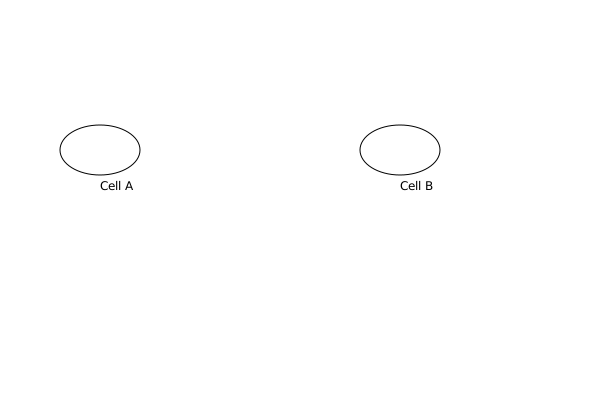
A diagram of a redox reaction is shown below.
A. Oxidation occurs at A
B. Reduction occurs at A
C. Oxidation occurs at B
D. Reduction occurs at B
Question 5
A 0.1 M solution of hydrochloric acid is prepared by dissolving 3.0 g of hydrochloric acid in 100 mL of water. What is the pH of the solution?
A. 1
B. 2
C. 3
D. 4
Question 6
A 10 mL sample of a solution contains 0.5 g of glu\cose. Calculate the molarity of the solution.
A. 0.1 M
B. 0.2 M
C. 0.3 M
D. 0.4 M
Question 7
A non-metal is formed by the reaction between a metal and a non-metal. If the metal has an atomic mass of 24 g/mol and the non-metal has an atomic mass of 32 g/mol, what is the empirical formula of the non-metal?
A. C
B. N
C. O
D. S
Question 8
A solution contains 20 g of glu\cose. If 100 mL of water is added, what is the new concentration in g/L?
A. 0.2 g/L
B. 0.5 g/L
C. 1 g/L
D. 2 g/L
Question 9
The reaction of methane with chlorine in the presence of light results in the formation of a chlorinated hydrocarbon. What is the major product of this reaction?
A. CH3Cl
B. CH2Cl2
C. CHCl3
D. CCl4
Question 10
Determine the s\tandard enthalpy of formation of CaCO3(s) from the following data: ΔHf(CaO(s)) = -635.09 kJ/mol, ΔHf(CO2(g)) = -393.51 kJ/mol.
A. -1206.60 kJ/mol
B. -1206.61 kJ/mol
C. -1206.59 kJ/mol
D. -1206.62 kJ/mol
Question 11
The s\tandard enthalpy of formation of CO2(g) is -393.5 kJ/mol. What is the s\tandard enthalpy of formation of H2O(l) if the s\tandard enthalpy of formation of H2(g) is 0 kJ/mol and the s\tandard enthalpy of formation of O2(g) is 0 kJ/mol?
A. -285.8 kJ/mol
B. -241.8 kJ/mol
C. -393.5 kJ/mol
D. -572.8 kJ/mol
Question 12
A 5 L flask contains 0.5 mol of an ideal gas at 50°C. Calculate the volume of the gas u\sing the ideal gas law.
A. 2.5 L
B. 5 L
C. 7.5 L
D. 10 L
Question 13
A 2.5 M solution of HCl is mixed with a 1.5 M solution of NaOH. What is the concentration of the resulting solution?
A. 1.5 M
B. 2.0 M
C. 2.5 M
D. 3.0 M
Question 14
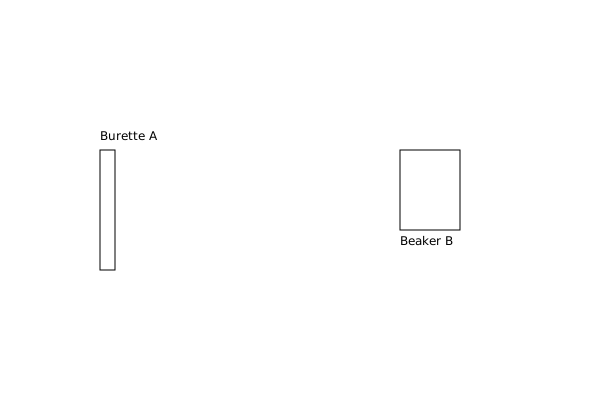
A diagram of a titration setup is shown below.
A. The burette contains the analyte
B. The burette contains the titrant
C. The beaker contains the analyte
D. The beaker contains the titrant
Question 15
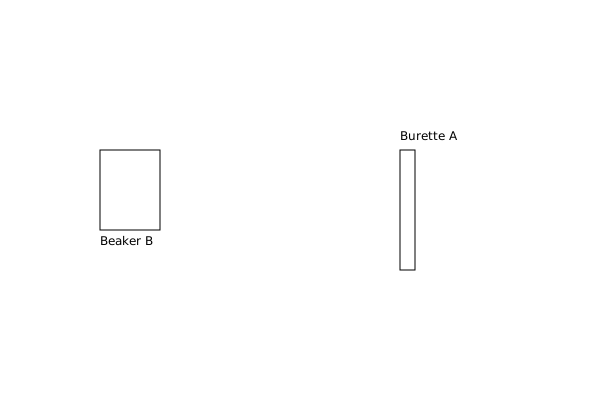
The diagram below shows a titration setup. What is the purpose of the burette?
A. To measure the volume of the titrant
B. To measure the volume of the analyte
C. To mix the titrant and analyte
D. To measure the pH of the solution

Master the Exam!

You've seen a preview, but there are thousands more questions plus AI tutor to break down complex solutions.

Unlock Full Access Available for Android & Windows
Help others prepare! Share this practice hub: