POST UTME LASU 2022 Biology | Objective

Practice these randomly selected questions to test your readiness.

Question 1
The process of cellular respiration in cells involves the breakdown of glu\cose to produce energy. Which of the following is a byproduct of cellular respiration?
A. Carbon dioxide
B. Water
C. Glu\cose
D. ATP
Question 2
In the process of cellular respiration, what is the primary function of the mitochondria?
A. To synthesize ATP from ADP and Pi
B. To break down glu\cose into pyruvate
C. To produce NADH and FADH2 from the citric acid cycle
D. To transport electrons from NADH and FADH2 to oxygen
Question 3
A diagram of the human circulatory system is shown below. What is the primary function of the pulmonary valve?
A. To regulate blood flow from the heart to the lungs
B. To regulate blood flow from the lungs to the heart
C. To regulate blood pressure in the aorta
D. To regulate blood flow from the heart to the aorta
Question 4
The xylem tissue in plants is responsible for transporting water and minerals from the roots to the leaves. Which of the following is a characteristic of xylem tissue?
A. It is composed of dead cells
B. It is composed of living cells
C. It is responsible for transporting sugars
D. It is responsible for transporting amino acids
Question 5
What is the primary mechanism by which the kidneys regulate the concentration of ions in the blood?
A. Hormonal regulation
B. Electrolyte balance
C. Osmoregulation
D. Renal tubular reabsorption
Question 6
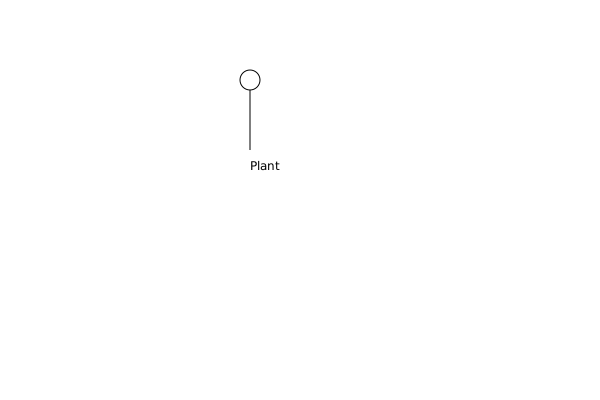
The diagram below shows a simple e\cosystem. Identify the primary producer in this e\cosystem?
A. Plant
B. Animal
C. Decomposer
D. Microorganism
Question 7
A diagram of the human circulatory system is shown below. Which part of the system is responsible for transporting oxygenated blood from the lungs to the heart?
A. Pulmonary Veins
B. Pulmonary Arteries
C. Aorta
D. Superior Vena Cava
Question 8
In a eukaryotic cell, the process of mitosis involves the separation of chromosomes into two daughter cells. Which stage of mitosis is characterized by the condensation of chromatin into visible chromosomes?
A. Prophase
B. Metaphase
C. Anaphase
D. Telophase
Question 9
What is the primary mechanism by which the nervous system regulates the movement of muscles?
A. Electrical impulses
B. Chemical signals
C. Mechanical forces
D. Thermal energy
Question 10
In the context of cell division, what is the primary role of the centrioles in the formation of the spindle fibers?
A. To provide a site for microtubule assembly
B. To anchor the spindle fibers to the centromere
C. To regulate the movement of chromosomes during anaphase
D. To facilitate the separation of sister chromatids
Question 11
The process of photosynthesis in plants involves the conversion of light energy into chemical energy. Which of the following is a byproduct of photosynthesis?
A. Oxygen
B. Carbon dioxide
C. Water
D. Glu\cose
Question 12
A diagram of a plant cell is shown below. What is the primary function of the vacuole?
A. To store water and nutrients
B. To synthesize proteins
C. To regulate pH levels
D. To produce ATP
Question 13
The process by which cells become specialized to perform specific functions is known as
A. Differentiation
B. Mitosis
C. Meiosis
D. Endoreduplication
Question 14
In a eukaryotic cell, the process of cell division that results in the production of four daughter cells is known as
A. Mitosis
B. Meiosis
C. Binary Fission
D. Endoreduplication
Question 15
In the xylem tissue, what is the primary function of the tracheids?
A. Transport of water and minerals from the roots to the leaves
B. Production of sugars through photosynthesis
C. Storage of nutrients and water
D. Support and protection of the plant

Master the Exam!

You've seen a preview, but there are thousands more questions plus AI tutor to break down complex solutions.

Unlock Full Access Available for Android & Windows
Help others prepare! Share this practice hub: