POST UTME LASU 2021 Chemistry | Objective

Practice these randomly selected questions to test your readiness.

Question 1
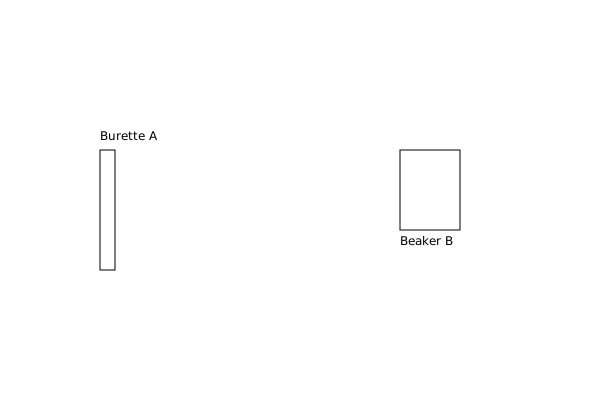
The diagram below shows a titration setup.
A. The burette contains HCl.
B. The beaker contains NaOH.
C. The burette contains NaOH.
D. The beaker contains HCl.
Question 2
A 2.00 L sample of 0.100 M H2SO4 is titrated with 0.100 M NaOH. Calculate the number of moles of H2SO4.
A. 0.0100 mol
B. 0.0200 mol
C. 0.0300 mol
D. 0.0400 mol
Question 3
The rate cons\tant (k) for the decomposition of N2O5 is 2.50 × 10^\( -3 \) s^\( -1 \) at 25°C. Calculate the half-life \( t1/2 \) of N2O5.
A. 1.00 × 10^3 s
B. 1.00 × 10^4 s
C. 1.00 × 10^5 s
D. 1.00 × 10^6 s
Question 4
Determine the number of moles of oxygen gas (O2) that will react with 2.50 moles of propane (C3H8) according to the balanced equation: 2C3H8 + 19O2 → 12CO2 + 14H2O.
A. 0.50 mol
B. 1.00 mol
C. 1.50 mol
D. 2.00 mol
Question 5
A solution containing 0.1 M HCl and 0.1 M NaOH is mixed. Calculate the pH of the resulting solution.
A. 1
B. 2
C. 3
D. 4
Question 6
A 25.0 mL sample of a sulfuric acid solution contains 0.0500 g of sulfuric acid. Calculate the molarity of the solution.
A. 0.100 M
B. 0.200 M
C. 0.500 M
D. 1.00 M
Question 7
A 0.1 M solution of a weak acid HA is titrated with 0.1 M NaOH. If 20 mL of NaOH is required to reach the equivalence point, calculate the initial concentration of the acid.
A. 0.05 M
B. 0.1 M
C. 0.15 M
D. 0.2 M
Question 8
A 2.0 L solution of 0.2 M H2SO4 is mixed with 2.0 L of 0.2 M NaOH. What is the pH of the resulting solution?
A. 2.0
B. 3.0
C. 4.0
D. 5.0
Question 9
A metal is extracted from its ore by the process of electrolysis. What is the purpose of the electrolyte in this process?
A. To conduct electricity
B. To provide a medium for the reaction
C. To purify the metal
D. To increase the temperature
Question 10
A colloidal solution is prepared by mixing 10 mL of a 0.1 M solution of FeCl3 with 10 mL of a 0.1 M solution of NaOH. What is the type of colloid formed?
A. Sol
B. Emulsion
C. Foam
D. Gel
Question 11
A sample of CO2 gas is collected over water at a temperature of 25°C and a pressure of 1 atm. If the volume of the gas is 2 L, what is the partial pressure of CO2?
A. 0.5 atm
B. 0.75 atm
C. 1 atm
D. 1.5 atm
Question 12
A 25 mL sample of 0.5 M H2SO4 is titrated with 0.5 M NaOH. Calculate the volume of NaOH required to reach the equivalence point.
A. 12.5 mL
B. 25 mL
C. 37.5 mL
D. 50 mL
Question 13
A sample of nitrogen gas (N2) has a volume of 2 L at 25°C and 1 atm. If the temperature is increased to 50°C, what is the new volume of the gas, assuming ideal gas behavior?
A. 2 L
B. 4 L
C. 6 L
D. 8 L
Question 14
Determine the rate cons\tant (k) for the reaction: 2NO(g) + O2(g) → 2NO2(g), given that the initial concentration of NO is 0.5 M, the initial concentration of O2 is 0.2 M, and after 10 minutes, the concentration of NO2 is 0.4 M. The rate cons\tant (k) is related to the rate cons\tant (k') by the equation: k = k' / \( 1 + k' * t \), where t is the time in minutes.
A. 0.05 min^-1
B. 0.1 min^-1
C. 0.2 min^-1
D. 0.5 min^-1
Question 15
What is the major difference between primary and secondary alcohols?
A. Primary alcohols have a higher boiling point than secondary alcohols
B. Secondary alcohols have a higher boiling point than primary alcohols
C. Primary alcohols are more soluble in water than secondary alcohols
D. Secondary alcohols are more soluble in water than primary alcohols

Master the Exam!

You've seen a preview, but there are thousands more questions plus AI tutor to break down complex solutions.

Unlock Full Access Available for Android & Windows
Help others prepare! Share this practice hub: