POST UTME LASU 2020 Geography | Objective

Practice these randomly selected questions to test your readiness.

Question 1
A diagram of the Earth's solar system is shown below. Which planet is represented by the label 'A'?
A. Mercury
B. Venus
C. Earth
D. Mars
Question 2
The Niger River is a major river in Nigeria that flows through several states. What is the primary factor responsible for the river's course?
A. Tectonic activity
B. Volcanic activity
C. Sedimentary deposition
D. Weathering and erosion
Question 3
A map shows a mountain range with a height of 1,000 m. If the angle of elevation is 30 degrees, calculate the horizontal distance from the base of the mountain to the point of observation.
A. 500 meters
B. 1,000 meters
C. 2,000 meters
D. 5,000 meters
Question 4
What is the primary economic activity of the Niger Delta region?
A. Agriculture
B. Mining
C. Oil and Gas
D. Manufacturing
Question 5
In the context of population and settlement studies, what is the term for the process by which a population becomes more dispersed and less concentrated over time?
A. Urbanization
B. Ruralization
C. Counterurbanization
D. Suburbanization
Question 6
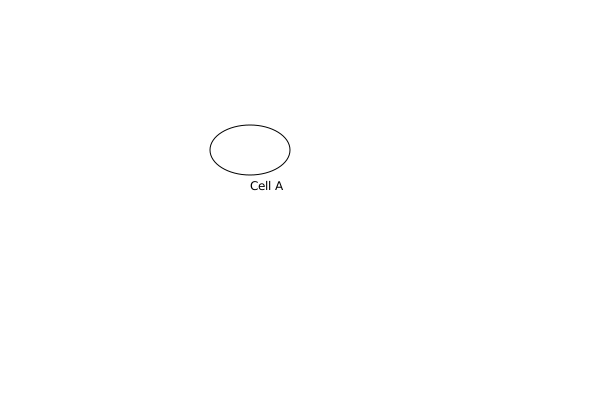
The diagram below shows the structure of a cell. What is the name of the organelle labeled 'A'?
A. Mitochondria
B. Chloroplast
C. Nucleus
D. Ribosome
Question 7
A 1000 km2 area of the Sahara Desert has an average annual rainfall of 25 mm. Assuming a uniform distribution of rainfall, calculate the total volume of rainfall in cubic meters.
A. 100,000 cubic meters
B. 1,000,000 cubic meters
C. 10,000,000 cubic meters
D. 50,000,000 cubic meters
Question 8
The process of soil erosion by water is an example of a _______ process.
A. mechanical
B. chemical
C. biological
D. physical
Question 9
The Benue Trough is a region of Nigeria characterized by a complex geological history. What is the primary factor responsible for the formation of the trough?
A. Tectonic activity
B. Volcanic activity
C. Sedimentary deposition
D. Weathering and erosion
Question 10
The Niger Delta region of Nigeria is characterized by a complex network of distributaries and distributaries. Which of the following is a major factor contributing to this complexity?
A. The presence of numerous oil and gas fields
B. The high sediment load of the Niger River
C. The presence of numerous distributaries and distributaries
D. The presence of numerous wetlands and mangrove forests
Question 11
The diagram below shows a cross-section of a mountain range. Which of the following is a characteristic of the mountain's structure?
A. folded
B. faulted
C. volcanic
D. erosional
Question 12
A population of 100,000 people has a birth rate of 10 per 1,000 people per year and a death rate of 5 per 1,000 people per year. Calculate the population growth rate per year.
A. 0.5% per year
B. 1% per year
C. 2% per year
D. 5% per year
Question 13
The movement of tectonic plates that results in the creation of mountains is known as:
A. Subduction
B. Divergence
C. Convergence
D. Transform faulting
Question 14
What is the name of the largest desert in the world, covering approximately 9,200,000 square kilometers?
A. Sahara Desert
B. Gobi Desert
C. Mojave Desert
D. Atacama Desert
Question 15
What is the primary factor that determines the formation of soil in Nigeria?
A. Climate
B. Topography
C. Vegetation
D. Geology

Master the Exam!

You've seen a preview, but there are thousands more questions plus AI tutor to break down complex solutions.

Unlock Full Access Available for Android & Windows
Help others prepare! Share this practice hub: