POST UTME KSU 2023 Biology | Objective

Practice these randomly selected questions to test your readiness.

Question 1
In the process of cellular respiration, what is the net result of the citric acid cycle?
A. Production of ATP
B. Production of NADH and FADH2
C. Production of CO2 and H2O
D. Production of ATP and NADH
Question 2
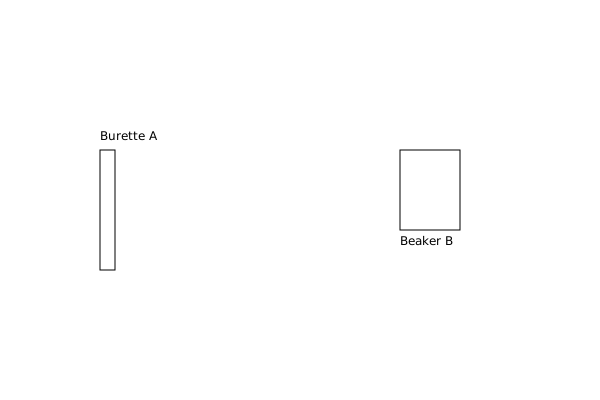
A diagram shows a simple black and white chemistry apparatus showing a titration setup. Which of the following is the purpose of the burette in this setup?
A. To measure the volume of the titrant
B. To measure the volume of the analyte
C. To mix the titrant and analyte
D. To measure the pH of the solution
Question 3
A 2.0 kg object is moving in a circular path with a radius of 1.5 m. If the object has a speed of 4.0 m/s, what is the centripetal acceleration?
A. 2.0 m/s^2
B. 4.0 m/s^2
C. 6.0 m/s^2
D. 8.0 m/s^2
Question 4
A researcher is studying the effects of a new medication on a population of patients. Which of the following statistical tests would be most appropriate for analyzing the data?
A. t-test
B. ANOVA
C. Regression analysis
D. Chi-squared test
Question 5
What is the process by which cells divide to produce two daughter cells?
A. Mitosis
B. Meiosis
C. Binary fission
D. Endoreduplication
Question 6
A diagram shows a cross-section of a plant root. Which of the following structures is responsible for the uptake of water and minerals from the soil?
A. Xylem
B. Phloem
C. Cortex
D. Endodermis
Question 7
A researcher is studying the effects of a new pesticide on a population of insects. Which of the following is a potential confounding variable in this study?
A. Temperature
B. Humidity
C. Pesticide concentration
D. Time of day
Question 8
A 0.5 M solution of NaOH is mixed with a 0.5 M solution of HCl. What is the pH of the resulting solution?
A. 7
B. 8
C. 9
D. 10
Question 9
What is the primary function of the kidneys in the excretory system?
A. Regulation of blood pressure
B. Removal of waste products
C. Regulation of electrolyte balance
D. Regulation of pH
Question 10
A 2.5 kg block is attached to a horizontal, massless spring with a force cons\tant of 100 N/m. The block is displaced by 0.2 m from its equilibrium position and released from rest. Assuming the block undergoes simple harmonic motion, what is the maximum speed of the block?
A. 1.0 m/s
B. 1.5 m/s
C. 2.0 m/s
D. 2.5 m/s
Question 11
What is the primary function of the xylem in plants?
A. Transport of water and minerals
B. Transport of sugars and amino acids
C. Transport of gases
D. Transport of waste products
Question 12
A plant has a root system that consists of 5 main roots, each with 3 secondary roots. If the plant has 5 tertiary roots per secondary root, how many tertiary roots are there in total?
A. 75
B. 100
C. 125
D. 150
Question 13
In a population of 1000 bacteria, 80% are susceptible to antibiotic treatment, 15% are resis\tant, and 5% are in a dormant state. If 200 bacteria are treated with an antibiotic, what is the expected number of bacteria that will be killed?
A. 80
B. 120
C. 160
D. 200
Question 14
What is the process by which the nervous system transmits signals?
A. Synaptic transmission
B. Neurotransmission
C. Electrical conduction
D. Chemical conduction
Question 15
In the context of evolutionary theories, what is the primary mechanism by which natural selection acts on genetic variation?
A. Genetic drift
B. Mutation
C. Gene flow
D. Differential reproduction

Master the Exam!

You've seen a preview, but there are thousands more questions plus AI tutor to break down complex solutions.

Unlock Full Access Available for Android & Windows
Help others prepare! Share this practice hub: