POST UTME KSU 2020 Biology | Objective

Practice these randomly selected questions to test your readiness.

Question 1
A population of bacteria is growing exponentially. If the initial population size is 100 and the growth rate is 0.2 per hour, what is the population size after 5 hours?
A. 1000
B. 2000
C. 4000
D. 8000
Question 2
The Hardy-Weinberg principle states that allele frequencies in a population will remain cons\tant from generation to generation in the absence of other evolutionary influences. Which of the following is a necessary condition for the Hardy-Weinberg principle to hold?
A. Random mating
B. No mutation
C. No gene flow
D. No natural selection
Question 3
A population of rabbits has a birth rate of 0.05 and a death rate of 0.02. What is the growth rate of the population?
A. 0.03
B. 0.05
C. 0.07
D. 0.09
Question 4
In a sexual reproduction process, what is the term for the fusion of two gametes to form a zygote?
A. Meiosis
B. Mitosis
C. Fertilization
D. Syngamy
Question 5
In a eukaryotic cell, the process of mitosis is initiated by the breakdown of the nuclear envelope. Which of the following structures is responsible for this breakdown?
A. Nuclear lamina
B. Nuclear envelope
C. Mitotic spindle
D. Centrioles
Question 6
In a human body, the excretory system is responsible for removing waste products. Which of the following organs is NOT part of the excretory system?
A. Kidneys
B. Liver
C. Pancreas
D. Heart
Question 7
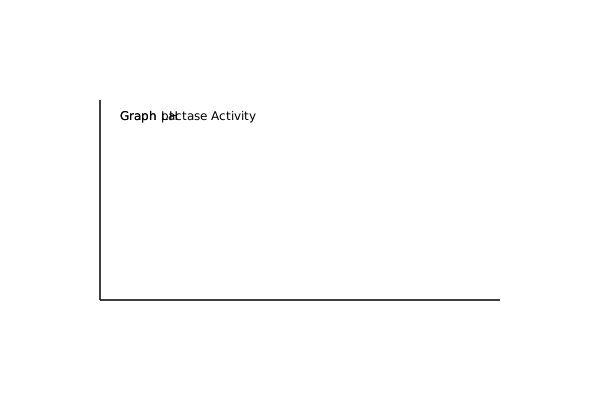
A researcher is studying the effect of pH on the activity of the enzyme lactase. The researcher measures the activity of lactase at different pH levels and plots the data on a graph. Which of the following statements best describes the relationship between the pH and the activity of lactase?
A. The activity of lactase increases as the pH increases.
B. The activity of lactase decreases as the pH decreases.
C. The activity of lactase is highest at a pH of 7.
D. The activity of lactase is unaffected by changes in pH.
Question 8
In a terrestrial e\cosystem, the primary producers are plants that undergo photosynthesis to produce glu\cose and oxygen. Which of the following is a byproduct of photosynthesis?
A. Glu\cose
B. Oxygen
C. Carbon dioxide
D. Water
Question 9
A population of rabbits is growing \logistically according to the equation \( \frac{dP}{dt} = rP \left\( 1 - \frac{P}{K} \right \). If the initial population is 100 and the carrying capacity is 1000, what is the population after 5 years?
A. 500
B. 783.33
C. 1000
D. 2000
Question 10
A 2.5 g sample of a subs\tance is dissolved in 25 mL of water. If the molarity of the solution is 0.5 M, what is the molar mass of the subs\tance?
A. 50 g/mol
B. 100 g/mol
C. 200 g/mol
D. 500 g/mol
Question 11
In a human eye, the retina contains specialized cells called photoreceptors. Which of the following is a characteristic of photoreceptors?
A. They are sensitive to light
B. They are sensitive to sound
C. They are sensitive to touch
D. They are sensitive to smell
Question 12
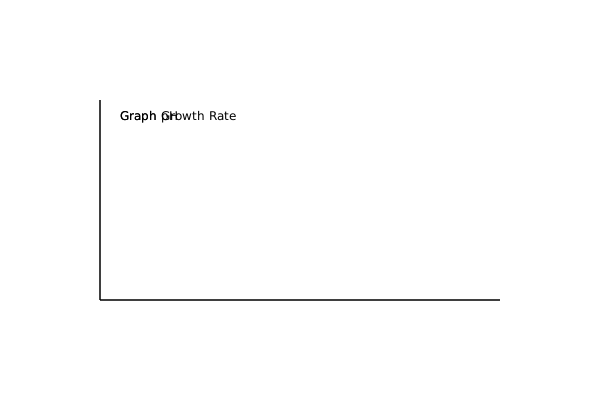
A researcher is studying the effect of pH on the growth of Escherichia coli. The graph below shows the relationship between pH and growth rate.
A. The growth rate is highest at pH 7.
B. The growth rate is highest at pH 5.
C. The growth rate is highest at pH 9.
D. The growth rate is highest at pH 3.
Question 13
A population of rabbits is growing \logistically according to the equation \[ \frac{dP}{dt} = rP\left\( 1 - \frac{P}{K}\right \) \]. If the initial population is 100 rabbits and the carrying capacity is 1000 rabbits, what is the population size after 5 years?
A. 500
B. 750
C. 1000
D. 1200
Question 14
A plant cell is placed in a solution with a higher concentration of solutes than the cell's cytoplasm. What will happen to the cell?
A. The cell will gain water and swell
B. The cell will lose water and shrink
C. The cell will remain unchanged
D. The cell will burst
Question 15
In a population of Drosophila melanogaster, the frequency of the recessive allele 'r' is 0.2. If the population size is 1000, how many individuals are expected to be homozygous recessive?
A. 0
B. 2
C. 200
D. 400

Master the Exam!

You've seen a preview, but there are thousands more questions plus AI tutor to break down complex solutions.

Unlock Full Access Available for Android & Windows
Help others prepare! Share this practice hub: