POST UTME JOSEPH AYO BABALOLA UNIVERSITY 2017 Government | Objective

Practice these randomly selected questions to test your readiness.

Question 1
The United Nations (UN) is an international organization that was established in 1945 with the aim of promoting peace and security, and providing a forum for dialogue and cooperation among nations. Which of the following is a primary function of the UN?
A. To promote economic development and reduce poverty
B. To maintain international peace and security
C. To provide humanitarian aid and disaster relief
D. To promote human rights and social justice
Question 2
The concept of Electoral Systems is essential in a democratic society. Which of the following is a characteristic of a proportional representation electoral system?
A. The number of seats a party wins is directly proportional to the number of votes it receives.
B. The number of seats a party wins is directly proportional to the number of votes it receives, but with a threshold.
C. The number of seats a party wins is directly proportional to the number of votes it receives, but with a quota.
D. The number of seats a party wins is directly proportional to the number of votes it receives, but with a quota and a threshold.
Question 3
Analyze the concept of legitimacy in the context of political power. How does it relate to the authority of a government?
A. Legitimacy is the moral right to govern, while authority is the power to enforce laws.
B. Authority is the source of legitimacy, and legitimacy is the outcome of authority.
C. Legitimacy is the acceptance of authority by the people, while authority is the power to govern.
D. Legitimacy is the power to govern, while authority is the moral right to do so.
Question 4
The concept of federalism is closely related to the idea of decentralization. Discuss the relationship between these two concepts, using examples from the Nigerian Constitution.
A. Federalism is a system of government where power is decentralized and held by the states.
B. Decentralization is a principle that ensures that power is held by the central government.
C. Federalism is a system of government where power is centralized and held by the central government.
D. Decentralization is a principle that ensures that power is held by the states, but federalism is not necessarily a system of government where power is decentralized.
Question 5
The concept of Human Rights is a fundamental principle of democracy. Which of the following is a right that is guaranteed by the constitution?
A. The right to bear arms.
B. The right to freedom of speech.
C. The right to a fair trial.
D. The right to vote.
Question 6
The United Nations has played a crucial role in promoting international cooperation and resolving conflicts between nations. Discuss the role of the UN in promoting peace and security in the world.
A. The UN has been successful in preventing wars and promoting peace in the world.
B. The UN has played a crucial role in promoting economic development and reducing poverty in developing countries.
C. The UN has been effective in promoting human rights and protecting refugees.
D. The UN has failed to prevent conflicts and promote peace in the world.
Question 7
What is the main difference between a pressure group and a political party in a democratic system?
A. A pressure group is a formal organization with a specific agenda, while a political party is an informal coalition of individuals with shared interests.
B. A pressure group is a group of individuals with shared interests, while a political party is a formal organization with a specific agenda.
C. A pressure group is a type of political party, while a political party is a type of pressure group.
D. There is no difference between a pressure group and a political party, as they serve the same purpose.
Question 8
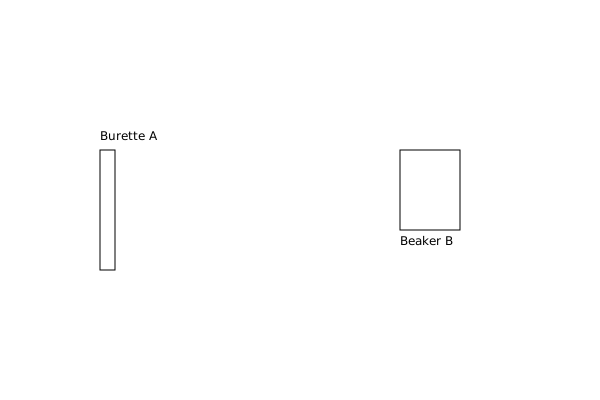
A diagram of a simple titration setup is shown below. What is the purpose of the burette in this setup?
A. To measure the volume of the titrant.
B. To measure the volume of the analyte.
C. To mix the titrant and analyte.
D. To separate the titrant and analyte.
Question 9
What is the primary function of the International Monetary Fund (IMF) in the global economy?
A. To regulate international trade and commerce.
B. To provide financial assistance to countries facing economic difficulties.
C. To promote economic growth and development in member countries.
D. To establish a global currency and monetary policy.
Question 10
A diagram of a simple circuit is shown below. What is the purpose of the resistor in this circuit?
A. To reduce the voltage in the circuit.
B. To increase the current in the circuit.
C. To reduce the current in the circuit.
D. To increase the voltage in the circuit.
Question 11
The United Nations (UN) is an international organization that plays a crucial role in maintaining global peace and security. Describe the structure of the UN and its main organs.
A. The UN has a single organ, the General Assembly, which is responsible for making decisions.
B. The UN has three main organs: the General Assembly, the Security Council, and the Economic and Social Council.
C. The UN has two main organs: the General Assembly and the Security Council.
D. The UN has no main organs, and all decisions are made by the Secretary-General.
Question 12
The concept of Political Parties is essential in a democratic society. Which of the following is a characteristic of a political party?
A. A political party should have a single leader.
B. A political party should have a clear ideology.
C. A political party should have a strong membership base.
D. A political party should have a weak leadership.
Question 13
The concept of Separation of Powers is a fundamental principle of constitutional government. Which of the following is NOT a characteristic of this principle?
A. The legislative, executive, and judicial branches of government should have distinct and separate powers.
B. The president should have the power to appoint judges to the supreme court.
C. The legislative branch should have the power to declare war.
D. The executive branch should have the power to make laws.
Question 14
The 1999 Constitution of the Federal Republic of Nigeria (as amended) provides for the creation of Local Government Areas (LGAs) as the third tier of government. Which of the following is a primary function of LGAs?
A. To collect taxes and provide infrastructure
B. To provide healthcare and education services
C. To maintain law and order and provide security
D. To promote economic development and create jobs
Question 15
The concept of constitutionalism is closely related to the idea of rule of law. Discuss how the rule of law is essential for the protection of individual rights and freedoms in a democratic society.
A. The rule of law ensures that the government and its agencies are accountable to the people.
B. The rule of law provides a framework for the protection of individual rights and freedoms.
C. The rule of law promotes social justice and equality.
D. The rule of law is a means of controlling the behavior of citizens.

Master the Exam!

You've seen a preview, but there are thousands more questions plus AI tutor to break down complex solutions.

Unlock Full Access Available for Android & Windows
Help others prepare! Share this practice hub: