POST UTME IMS U 2021 Chemistry | Objective

Are you preparing for POST UTME IMS U exams? Reviewing past questions is one of the most effective ways to guarantee a high score. This practice hub features authentic 2021 Chemistry (Objective) questions designed to simulate the real exam environment.

Practice these randomly selected questions to test your readiness.

Question 1
In a redox reaction, what is the role of the catalyst in the Haber-Bosch process?
A. To increase the rate of reaction
Correct B. To decrease the activation energy
C. To increase the yield of ammonia
D. To decrease the temperature of the reaction

Correct Answer: B

Want to see the full step-by-step solution? Unlock AI Explanation & Analytics
Question 2
A solution of 0.1 M NaOH is mixed with a solution of 0.1 M HCl. What is the resulting pH?
Correct A. 7
B. 10
C. 14
D. 12

Correct Answer: A

Want to see the full step-by-step solution? Unlock AI Explanation & Analytics
Question 3
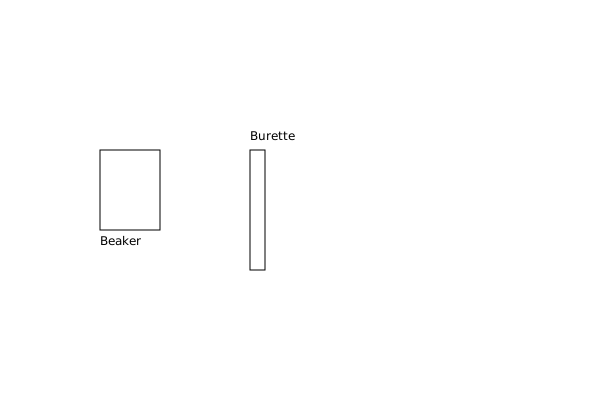
A diagram of a titration setup is shown below. What is the purpose of the burette?
Correct A. To measure the volume of the titrant
B. To measure the volume of the analyte
C. To mix the titrant and analyte
D. To measure the pH of the solution

Correct Answer: A

Want to see the full step-by-step solution? Unlock AI Explanation & Analytics
Question 4
A solution of 0.1 M HCl is mixed with a solution of 0.1 M NaOH. What is the resulting pH?
Correct A. 7
B. 10
C. 14
D. 12

Correct Answer: A

Want to see the full step-by-step solution? Unlock AI Explanation & Analytics
Question 5
A diagram of a cell is shown below. What is the purpose of the cathode?
Correct A. To receive electrons
B. To release electrons
C. To conduct electricity
D. To generate heat

Correct Answer: A

Want to see the full step-by-step solution? Unlock AI Explanation & Analytics
Question 6
Determine the molar mass of a polymer with the repeating unit [C6H5CH=CH2]n. The molar mass of the monomer unit is 106.17 g/mol.
A. 106.17 g/mol
Correct B. 212.34 g/mol
C. 318.51 g/mol
D. 424.68 g/mol

Correct Answer: B

Want to see the full step-by-step solution? Unlock AI Explanation & Analytics
Question 7
A 25.0 mL sample of 0.100 M HCl is titrated with 0.100 M NaOH. Calculate the pH of the solution after the addition of 25.0 mL of NaOH.
A. 2.00
Correct B. 3.00
C. 4.00
D. 5.00

Correct Answer: B

Want to see the full step-by-step solution? Unlock AI Explanation & Analytics
Question 8
A solution contains 0.0500 M CaCl2 and 0.0500 M Na2SO4. Determine the molar solubility of CaSO4.
Correct A. 0.0100 M
B. 0.0200 M
C. 0.0300 M
D. 0.0400 M

Correct Answer: A

Want to see the full step-by-step solution? Unlock AI Explanation & Analytics
Question 9
The atomic radius of an element is 100 pm. If the element is in group 1A, what is its atomic number?
A. 3
Correct B. 11
C. 19
D. 37

Correct Answer: B

Want to see the full step-by-step solution? Unlock AI Explanation & Analytics
Question 10
A 2.00 L sample of 0.100 M HCl is titrated with 0.100 M NaOH. Calculate the number of moles of HCl.
Correct A. 0.0100 mol
B. 0.0200 mol
C. 0.0300 mol
D. 0.0400 mol

Correct Answer: A

Want to see the full step-by-step solution? Unlock AI Explanation & Analytics
Question 11
Determine the solubility of AgCl in a 0.1 M NaCl solution at 25°C, given that the solubility product cons\tant (Ksp) for AgCl is 1.8 × 10^-10.
A. 1.0 × 10^-5 M
Correct B. 1.5 × 10^-5 M
C. 2.0 × 10^-5 M
D. 3.0 × 10^-5 M

Correct Answer: B

Want to see the full step-by-step solution? Unlock AI Explanation & Analytics
Question 12
A 2.5 g sample of a metal (M) is dissolved in 50 mL of 1.0 M HCl. The resulting solution is then titrated with 1.0 M NaOH. If 25 mL of NaOH is required to reach the equivalence point, what is the molar mass of M?
A. 50 g/mol
B. 75 g/mol
Correct C. 100 g/mol
D. 125 g/mol

Correct Answer: C

Want to see the full step-by-step solution? Unlock AI Explanation & Analytics
Question 13
A 0.1 M solution of Fe2+ ions is electrolyzed at a cons\tant current of 1.0 A for 10 minutes. If the electrolysis is carried out in a 1.0 M NaCl solution, what is the mass of Cl2 gas produced?
A. 0.25 g
Correct B. 0.50 g
C. 0.75 g
D. 1.0 g

Correct Answer: B

Want to see the full step-by-step solution? Unlock AI Explanation & Analytics
Question 14
A 1.0 M solution of H2SO4 is mixed with a 1.0 M solution of NaOH. If the resulting solution is then titrated with 1.0 M NaOH, what is the pH of the solution at the equivalence point?
A. 1.0
B. 2.0
C. 3.0
Correct D. 4.0

Correct Answer: D

Want to see the full step-by-step solution? Unlock AI Explanation & Analytics
Question 15
A 0.1 M solution of CuSO4 is electrolyzed at a cons\tant current of 1.0 A for 10 minutes. If the electrolysis is carried out in a 1.0 M NaCl solution, what is the mass of Cu deposited?
A. 0.25 g
B. 0.50 g
Correct C. 0.75 g
D. 1.0 g

Correct Answer: C

Want to see the full step-by-step solution? Unlock AI Explanation & Analytics
Question 16
Determine the pH of a 0.1 M solution of HCl.
A. 1
B. 2
C. 3
Correct D. 4

Correct Answer: D

Want to see the full step-by-step solution? Unlock AI Explanation & Analytics
Question 17
Calculate the enthalpy change for the reaction: 2Na(s) + Cl2(g) → 2NaCl(s). The s\tandard enthalpy of formation of NaCl is -411 kJ/mol.
Correct A. -822 kJ
B. -411 kJ
C. -411 kJ/mol
D. -822 kJ/mol

Correct Answer: A

Want to see the full step-by-step solution? Unlock AI Explanation & Analytics
Question 18
A 25 mL sample of a 0.1 M solution of NaOH is titrated with 0.1 M HCl. Calculate the number of moles of HCl required to reach the equivalence point.
Correct A. 0.0025 mol
B. 0.005 mol
C. 0.01 mol
D. 0.02 mol

Correct Answer: A

Want to see the full step-by-step solution? Unlock AI Explanation & Analytics
Question 19
A solution contains 0.1 M NaCl and 0.1 M CaCl2. Calculate the molar conductivity of the solution at 25°C.
A. 0.01 S cm^2/mol
Correct B. 0.1 S cm^2/mol
C. 1 S cm^2/mol
D. 10 S cm^2/mol

Correct Answer: B

Want to see the full step-by-step solution? Unlock AI Explanation & Analytics
Question 20
A 10 mL sample of a 0.1 M solution of H2SO4 is titrated with 0.1 M NaOH. Calculate the pH of the solution at the equivalence point.
Correct A. 7
B. 8
C. 9
D. 10

Correct Answer: A

Want to see the full step-by-step solution? Unlock AI Explanation & Analytics
Question 21
The atomic radius of an element decreases across a period in the periodic table. Which of the following is a correct explanation for this tr\end?
A. The atomic radius decreases due to the decrease in the number of energy levels across a period.
Correct B. The atomic radius decreases due to the increase in the effective nuclear charge across a period.
C. The atomic radius decreases due to the decrease in the atomic mass across a period.
D. The atomic radius decreases due to the increase in the number of protons across a period.

Correct Answer: B

Want to see the full step-by-step solution? Unlock AI Explanation & Analytics
Question 22
The reaction between nitrogen and oxygen to form nitrogen dioxide is an example of a reaction that involves the formation of a covalent bond. What is the type of bond that is formed between the nitrogen and oxygen atoms?
A. Ionic bond
Correct B. Covalent bond
C. Hydrogen bond
D. Van der Waals force

Correct Answer: B

Want to see the full step-by-step solution? Unlock AI Explanation & Analytics
Question 23
The boiling point of a subs\tance is a measure of the energy required to change the state of the subs\tance from liquid to gas. Which of the following is a correct explanation for the boiling point of a subs\tance?
A. The boiling point is a measure of the energy required to change the state of the subs\tance from solid to liquid.
Correct B. The boiling point is a measure of the energy required to change the state of the subs\tance from liquid to gas.
C. The boiling point is a measure of the energy required to change the state of the subs\tance from gas to liquid.
D. The boiling point is a measure of the energy required to change the state of the subs\tance from liquid to solid.

Correct Answer: B

Want to see the full step-by-step solution? Unlock AI Explanation & Analytics
Question 24
The periodic table is a tabular arrangement of the elements in order of increa\sing atomic number. Which of the following is a correct explanation for the arrangement of the elements in the periodic table?
A. The elements are arranged in order of increa\sing atomic mass.
Correct B. The elements are arranged in order of increa\sing atomic number.
C. The elements are arranged in order of decrea\sing atomic mass.
D. The elements are arranged in order of decrea\sing atomic number.

Correct Answer: B

Want to see the full step-by-step solution? Unlock AI Explanation & Analytics
Question 25
The reaction between methane and oxygen to form carbon dioxide and water is an example of a reaction that involves the formation of a covalent bond. What is the type of bond that is formed between the carbon and oxygen atoms?
A. Ionic bond
Correct B. Covalent bond
C. Hydrogen bond
D. Van der Waals force

Correct Answer: B

Want to see the full step-by-step solution? Unlock AI Explanation & Analytics

Master the Exam!

You've seen a preview, but there are thousands more questions plus AI tutor to break down complex solutions.

Unlock Full Access Available for Android & Windows
Help others prepare! Share this practice hub:
Chat with Support