POST UTME IGBINEDION UNIVERSITY 2023 Chemistry | Objective

Practice these randomly selected questions to test your readiness.

Question 1
The diagram below shows the structure of a polymer.
A. A linear polymer
B. A branched polymer
C. A cross-linked polymer
D. A cyclic polymer
Question 2
A 50 mL sample of a 0.1 M solution of a weak base B is titrated with 1 M HCl. If the pH of the solution after the addition of 20 mL of HCl is 4.5, what is the concentration of the base?
A. 0.05 M
B. 0.075 M
C. 0.1 M
D. 0.125 M
Question 3
A 2.5 g sample of a polymer is dissolved in 50 mL of a solvent. If the density of the solution is 1.2 g/mL, what is the molar mass of the polymer?
A. 500 g/mol
B. 750 g/mol
C. 1000 g/mol
D. 1500 g/mol
Question 4
A 10.0 mL sample of 0.500 M NaOH is titrated with 1.00 M HCl. Calculate the pH of the solution after the equivalence point.
A. \( pH = -\log[H^+] \)
B. \( pH = \log[H^+] \)
C. \( pH = -\log[OH^-] \)
D. \( pH = \log[OH^-] \)
Question 5
A polymer 'P' is prepared by polymerizing 100 g of monomer 'M'. If the molecular weight of 'M' is 50 g/mol, calculate the number of moles of 'M' used.
A. 2 mol
B. 4 mol
C. 6 mol
D. 8 mol
Question 6
Determine the rate cons\tant (k) for the first-order reaction: A → B, given that the initial concentration of A is 0.1 M and the concentration of A after 2 hours is 0.05 M.
A. \( k = \frac{2.303}{t} \log \frac{[A]_0}{[A]_t} \)
B. \( k = \frac{[A]_t}{[A]_0} \)
C. \( k = \frac{2.303}{t} \log \frac{[A]_t}{[A]_0} \)
D. \( k = \frac{[A]_0 - [A]_t}{t} \)
Question 7
A 25.0 mL sample of 0.500 M HCl is titrated with 1.00 M NaOH. Calculate the volume of NaOH required to reach the equivalence point.
A. \( V_{NaOH} = \frac{M_{HCl} \times V_{HCl}}{M_{NaOH}} \)
B. \( V_{NaOH} = \frac{M_{NaOH} \times V_{HCl}}{M_{HCl}} \)
C. \( V_{NaOH} = \frac{M_{HCl} \times V_{HCl}}{M_{NaOH} - M_{HCl}} \)
D. \( V_{NaOH} = \frac{M_{NaOH} \times V_{HCl}}{M_{HCl} + M_{NaOH}} \)
Question 8
The diagram below shows the structure of a biomolecule.
A. A protein
B. A carbohydrate
C. A lipid
D. A nucleic acid
Question 9
The rate of a reaction is affected by the concentration of the reac\tants. Which of the following best describes the relationship between the rate of reaction and the concentration of the reac\tants?
A. The rate of reaction is directly proportional to the concentration of the reac\tants.
B. The rate of reaction is inversely proportional to the concentration of the reac\tants.
C. The rate of reaction is indep\endent of the concentration of the reac\tants.
D. The rate of reaction is proportional to the square of the concentration of the reac\tants.
Question 10
The reaction of sodium with water is an example of a
A. \single displacement reaction
B. double displacement reaction
C. synthesis reaction
D. decomposition reaction
Question 11
A 2.00 g sample of a metal is heated in a crucible until it reaches a temperature of 1000°C. If the specific heat capacity of the metal is 0.100 J/g°C, calculate the energy required to heat the metal.
A. \( Q = mcDelta T \)
B. \( Q = mc^2 Delta T \)
C. \( Q = \frac{mcDelta T}{t} \)
D. \( Q = \frac{mcDelta T}{Delta t} \)
Question 12
A 25 mL sample of a 0.1 M solution of a strong acid HCl is titrated with 1 M NaOH. If the pH of the solution after the addition of 15 mL of NaOH is 7.5, what is the concentration of the acid?
A. 0.05 M
B. 0.075 M
C. 0.1 M
D. 0.125 M
Question 13
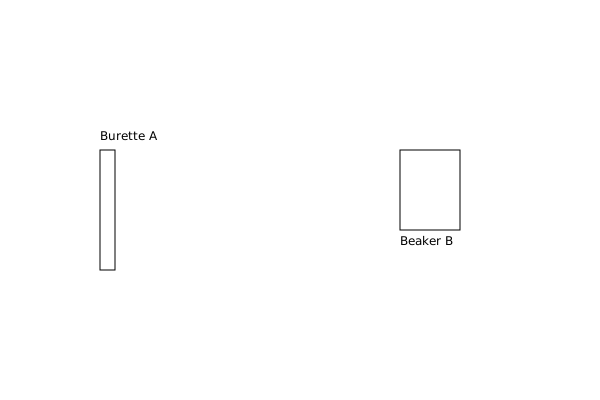
The diagram below shows a titration setup. Identify the part labeled 'A'.
A. Burette
B. Beaker
C. Conical Flask
D. Pipette
Question 14
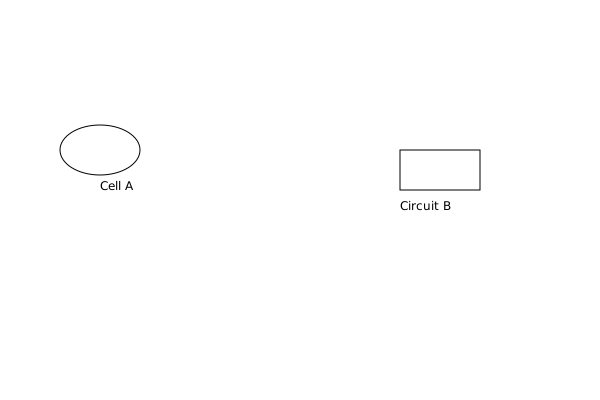
The diagram below shows a circuit setup. Identify the part labeled 'B'.
A. Cell
B. Circuit
C. Switch
D. Resistor
Question 15
A metal 'M' reacts with dilute hydrochloric acid to produce a gas 'G'. The reaction is as follows: M + 2HCl → MG + H2↑. If 2.5 g of M reacts with 10 mL of 2 M HCl, calculate the volume of H2 gas produced at STP.
A. 0.5 L
B. 1.0 L
C. 1.5 L
D. 2.0 L

Master the Exam!

You've seen a preview, but there are thousands more questions plus AI tutor to break down complex solutions.

Unlock Full Access Available for Android & Windows
Help others prepare! Share this practice hub: