POST UTME IGBINEDION UNIVERSITY 2020 Biology | Objective
Practice these randomly selected questions to test your readiness.
Question 1
The diagram below represents a cross-section of a plant root. Identify the type of tissue labeled 'A'?
Question 2
A diagram of the human kidney is shown below. What is the function of the part labeled 'B'?
Question 3
In a population of 1000 individuals, 50% are homozygous dominant (BB), 40% are heterozygous (Bb), and 10% are homozygous recessive (bb). What is the frequency of the recessive allele (b) in this population?
Question 4
What is the term for the process by which a cell becomes specialized to perform a specific function?
Question 5
A 45-year-old man is diagnosed with hypertension. His blood pressure is 160/100 mmHg, and his heart rate is 80 beats/min. Which of the following is the most appropriate treatment option?
Question 6
A population of bacteria is growing exponentially. If the initial population size is 100 and the growth rate is 0.5 per hour, what is the population size after 3 hours?
Question 7
A population of bacteria is growing exponentially. If the initial population is 1000 and the population doubles every 2 hours, what is the population after 6 hours?
Question 8
The process of osmoregulation in plants involves the movement of water from the roots to the xylem. Which of the following statements is true about the xylem?
Question 9
The following diagram shows a cross-section of a plant root. Which part of the root is responsible for absorbing water and minerals from the soil?
Question 10
A bacterium has a mutation in its DNA that causes it to produce a toxin. The toxin is encoded by a gene that is located on a plasmid. If the plasmid is 5 kb in size and the gene is 2 kb in size, what is the percentage of the plasmid that is occupied by the gene?
Question 11
The diagram below represents a cross-section of the human eye. Identify the part labeled 'B'?
Question 12
A study on the genetic variation of a population found that the frequency of the recessive allele 'a' is 0.2. If the population is in Hardy-Weinberg equilibrium, what is the frequency of the dominant allele 'A'?
Question 13
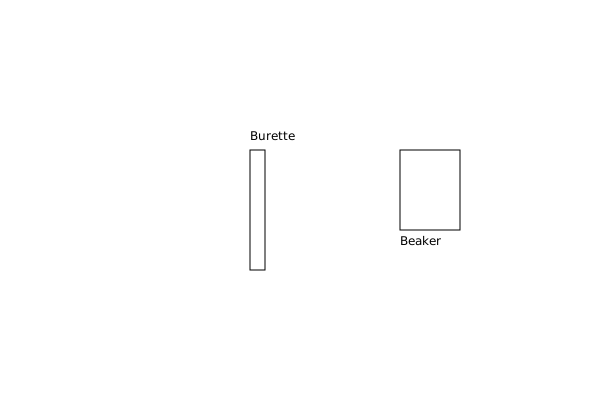
The following diagram shows a titration setup. What is the purpose of the burette?
Question 14
A researcher is studying the effect of a new pesticide on a population of insects. The pesticide is applied to the insects at a concentration of 10 mg/L. What is the expected effect of this pesticide on the population of insects?
Question 15
A 30-year-old woman is diagnosed with a rare disease that affects the kidneys. The disease is caused by a mutation in a gene that codes for a protein involved in the regulation of blood pressure. What is the likely effect of this mutation on the woman's blood pressure?
Master the Exam!
You've seen a preview, but there are thousands more questions plus AI tutor to break down complex solutions.
Unlock Full Access
Available for Android & Windows