POST UTME FUTO 2022 Biology | Objective

Practice these randomly selected questions to test your readiness.

Question 1
The diagram below represents a cross-section of a plant root. Which of the following is the function of the labeled region?
A. Transport of water and minerals
B. Transport of sugars and amino acids
C. Storage of nutrients
D. Support and structure
Question 2
A cell's plasma membrane is selectively permeable due to the presence of specific proteins embedded within it. Which of the following types of proteins is primarily responsible for the regulation of the movement of subs\tances across the membrane?
A. Channel proteins
B. Carrier proteins
C. Receptor proteins
D. Transport proteins
Question 3
A population of rabbits is growing exponentially. Which of the following statements is true about the population growth rate?
A. The population growth rate is cons\tant over time
B. The population growth rate is proportional to the current population size
C. The population growth rate is inversely proportional to the current population size
D. The population growth rate is indep\endent of the current population size
Question 4
In a closed e\cosystem, the rate of respiration in a population of organisms is directly proportional to the population size. If the population size doubles, what happens to the rate of respiration?
A. It remains the same
B. It increases by a factor of 2
C. It increases by a factor of 4
D. It decreases by a factor of 2
Question 5
A 10 g sample of a subs\tance is dissolved in 100 mL of water. What is the concentration of the solution in g/L?
A. 0.01 g/L
B. 0.1 g/L
C. 1 g/L
D. 10 g/L
Question 6
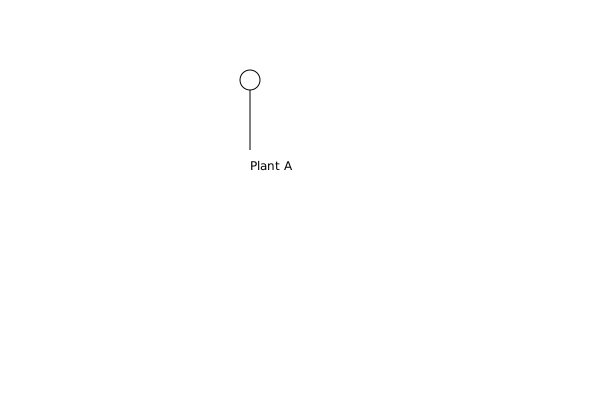
The diagram below represents a simple food chain. Which of the following is the primary producer in the e\cosystem?
A. Herbivore
B. Carnivore
C. Decomposer
D. Plant
Question 7
The Hardy-Weinberg principle states that the frequency of alleles in a population will remain cons\tant from generation to generation if
A. There is no mutation or genetic drift
B. There is no gene flow or natural selection
C. The population is infinite and randomly mating
D. All of the above
Question 8
A population of bacteria is growing exponentially with a growth rate of 0.05 h^-1. If the initial population is 100 cells, what is the population after 2 hours?
A. 200 cells
B. 400 cells
C. 600 cells
D. 800 cells
Question 9
A species of bird has a beak shape that is well-suited for eating seeds. Which of the following evolutionary pressures is most likely responsible for the development of this trait?
A. Natural selection acting on beak shape
B. Genetic drift cau\sing random changes in beak shape
C. Gene flow introducing new beak shapes from other species
D. Artificial selection by humans for desirable beak shape
Question 10
A 2.5 L solution of 0.1 M NaCl is diluted to 5 L. What is the concentration of NaCl in the final solution?
A. 0.02 M
B. 0.01 M
C. 0.005 M
D. 0.002 M
Question 11
In a population of Drosophila melanogaster, the frequency of the recessive allele 'b' is 0.2. If the population is in Hardy-Weinberg equilibrium, what is the frequency of the homozygous dominant genotype?
A. 0.4
B. 0.2
C. 0.6
D. 0.8
Question 12
A diagram of a plant's transport system is shown below. Which of the following is a function of the Xylem tissue?
A. Transport of water and minerals
B. Transport of sugars and amino acids
C. Transport of ions and hormones
D. Transport of gases and waste products
Question 13
The process of mitosis results in the production of two daughter cells that are genetically identical to the parent cell. Which of the following stages of mitosis is characterized by the separation of sister chromatids?
A. Prophase
B. Metaphase
C. Anaphase
D. Telophase
Question 14
A population of birds has a mean wing length of 10 cm. If the s\tandard deviation of wing length is 2 cm, what is the probability that a randomly selected bird will have a wing length greater than 12 cm?
A. 0.1587
B. 0.3413
C. 0.5000
D. 0.8413
Question 15
In the context of excretion and osmoregulation, what is the primary function of the kidneys in maintaining electrolyte balance?
A. Regulation of blood pH
B. Maintenance of electrolyte balance
C. Regulation of blood pressure
D. Removal of waste products

Master the Exam!

You've seen a preview, but there are thousands more questions plus AI tutor to break down complex solutions.

Unlock Full Access Available for Android & Windows
Help others prepare! Share this practice hub: