POST UTME FUTA 2023 Chemistry | Objective

Practice these randomly selected questions to test your readiness.
Question 1
The reaction of cyclohexane with bromine in the presence of light produces a mixture of 1,2-dibromocyclohexane and 1,4-dibromocyclohexane. What is the major product of this reaction?
A. 1,2-dibromocyclohexane
B. 1,4-dibromocyclohexane
C. cis-1,2-dibromocyclohexane
D. trans-1,4-dibromocyclohexane
Question 2
A solution contains 0.2 mol of a weak acid (HA) and 0.1 mol of its conjugate base \( A- \). Calculate the pH of the solution.
A. 3.5
B. 4.5
C. 5.5
D. 6.5
Question 3
A 25 mL sample of a solution containing 0.5 M NaCl is diluted to 100 mL. What is the new concentration of the solution?
A. 0.05 M
B. 0.1 M
C. 0.25 M
D. 0.5 M
Question 4
The s\tandard enthalpy of formation of H2O is ______ kJ/mol.
A. -285.8
B. -285.5
C. -286.0
D. -286.5
Question 5
Calculate the s\tandard enthalpy change (ΔH°) for the reaction: 2Al(s) + 6HCl(aq) → 2AlCl3(aq) + 3H2(g). Given that the s\tandard enthalpy of formation (ΔHf°) for AlCl3(aq) is -704.2 kJ/mol and for H2(g) is 0 kJ/mol. The s\tandard enthalpy of formation for Al(s) is 0 kJ/mol and for HCl(aq) is -167.2 kJ/mol.
A. -1668.4 kJ/mol
B. -1668.8 kJ/mol
C. -1668.2 kJ/mol
D. -1668.6 kJ/mol
Question 6
A 2.0 L flask contains 1.0 mol of CO2(g) at 30°C. Calculate the pressure of the gas u\sing the ideal gas law.
A. 1.01 x 10^5 Pa
B. 2.02 x 10^5 Pa
C. 3.03 x 10^5 Pa
D. 4.04 x 10^5 Pa
Question 7
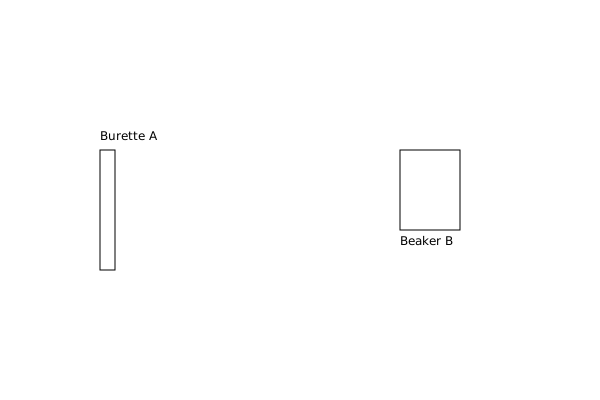
A diagram of a titration setup is shown below. Identify the type of titration being performed.
A. Acid-base titration
B. Redox titration
C. Complexation titration
D. Precipitation titration
Question 8
The reaction between sodium hydroxide and hydrochloric acid is a classic example of a ______ reaction.
A. neutralization
B. oxidation
C. reduction
D. precipitation
Question 9
The atomic radius of an element in a period increases as you move from left to right, but decreases as you move down a group. Explain this periodic tr\end.
A. Due to the increase in nuclear charge, the electrons are pulled closer to the nucleus.
B. As you move down a group, the number of energy levels increases, resulting in a larger atomic radius.
C. The atomic radius increases as you move down a group due to the increase in the number of energy levels.
D. The atomic radius decreases as you move down a group due to the increase in nuclear charge.
Question 10
The s\tandard entropy of formation of H2O is ______ J/mol·K.
A. 69.95
B. 69.90
C. 69.85
D. 69.80
Question 11
A 25.0 mL sample of a solution containing 0.100 M HCl is titrated with 0.100 M NaOH. Calculate the volume of NaOH required to reach the equivalence point.
A. 12.5 mL
B. 25.0 mL
C. 37.5 mL
D. 50.0 mL
Question 12
The reaction 2Al(s) + Fe2O3(s) → Al2O3(s) + 2Fe(s) is an example of a ______ reaction.
A. synthesis
B. decomposition
C. \single displacement
D. double displacement
Question 13
A solution contains 2.5 g of NaCl in 100 mL of water. Calculate the molarity of the solution.
A. 0.00025 M
B. 0.0025 M
C. 0.025 M
D. 0.25 M
Question 14
A solution contains 0.1 mol of a strong acid (HCl) and 0.2 mol of its conjugate base \( Cl- \). Calculate the pH of the solution.
A. 1.0
B. 2.0
C. 3.0
D. 4.0
Question 15
A 25.0 mL sample of 0.100 M HCl is mixed with a 25.0 mL sample of 0.100 M NaOH. Calculate the pH of the resulting solution.
A. 1.0
B. 2.0
C. 3.0
D. 4.0

Master the Exam!

You've seen a preview, but there are thousands more questions plus AI tutor to break down complex solutions.

Unlock Full Access Available for Android & Windows
Help others prepare! Share this practice hub: