POST UTME FUTA 2018 Biology | Objective

Practice these randomly selected questions to test your readiness.

Question 1
In the context of hormonal coordination, what is the primary function of the hypothalamus in regulating the pituitary gland?
A. To produce hormones that stimulate the pituitary gland
B. To produce hormones that inhibit the pituitary gland
C. To regulate the release of hormones from the pituitary gland
D. To produce hormones that stimulate the thyroid gland
Question 2
A 2.5 cm long muscle fibre is stretched to a length of 3.5 cm. If the Young's modulus of the muscle fibre is 1.2 x 10^5 N/m^2, what is the tension in the muscle fibre?
A. 1.5 x 10^-3 N
B. 1.8 x 10^-3 N
C. 2.1 x 10^-3 N
D. 2.5 x 10^-3 N
Question 3
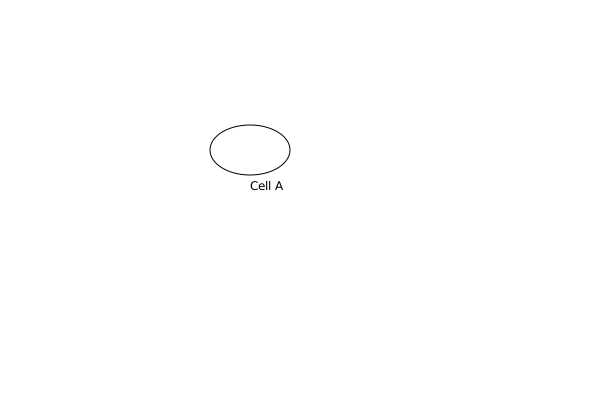
The diagram below shows a cross-section of a root hair cell. Which of the following structures is responsible for the uptake of water and minerals from the soil?
A. A
B. B
C. C
D. D
Question 4
The process by which plants convert light energy into chemical energy is known as
A. Photosynthesis
B. Respiration
C. Transpiration
D. Translocation
Question 5
What is the process by which a cell divides into two daughter cells, each with the same number of chromosomes as the parent cell?
A. Mitosis
B. Meiosis
C. Binary fission
D. Endoreduplication
Question 6
The Hardy-Weinberg principle states that the frequency of alleles in a population will remain cons\tant from generation to generation if five certain conditions are met. Which of the following is NOT one of the conditions?
A. Random mating
B. No mutation
C. No gene flow
D. No natural selection
Question 7
A solution of glu\cose is prepared by dissolving 20 g of glu\cose in 100 mL of water. What is the concentration of the solution in g/L?
A. 0.02 g/L
B. 0.2 g/L
C. 2 g/L
D. 20 g/L
Question 8
The type of respiration that occurs in the absence of oxygen is known as
A. Aerobic Respiration
B. Anaerobic Respiration
C. Fermentation
D. Photosynthesis
Question 9
The diagram below shows the structure of a system. Which of the following is a characteristic of this system?
A. It is a circulatory system
B. It is a nervous system
C. It is a digestive system
D. It is a respiratory system
Question 10
In a eukaryotic cell, the process of cell division that results in the production of four daughter cells is known as
A. Mitosis
B. Meiosis
C. Binary Fission
D. Endoreduplication
Question 11
In a population of 1000 bacteria, 50% are resis\tant to a particular antibiotic. If 200 bacteria are randomly selected for treatment, what is the probability that at least 10 of them will be resis\tant to the antibiotic?
A. 0.05
B. 0.10
C. 0.15
D. 0.20
Question 12
The diagram below shows the structure of a xylem vessel. Which of the following is a characteristic of xylem vessels?
A. They are dead, hollow cells
B. They are living cells
C. They are found in the phloem
D. They are responsible for transporting sugars
Question 13
A diagram of the human circulatory system is shown below. What is the primary function of the coronary arteries?
A. To supply oxygenated blood to the heart muscle
B. To regulate the pH of the blood
C. To produce surfac\tant
D. To transport sugars and other organic compounds from the liver to the muscles
Question 14
What is the term for the process by which an organism's genetic information is passed from one generation to the next?
A. Heritability
B. Genetic drift
C. Mutation
D. Evolution
Question 15
In a eukaryotic cell, what is the primary function of the Golgi apparatus?
A. Protein synthesis
B. Cell signaling
C. Lipid modification
D. Protein transport

Master the Exam!

You've seen a preview, but there are thousands more questions plus AI tutor to break down complex solutions.

Unlock Full Access Available for Android & Windows
Help others prepare! Share this practice hub: