POST UTME ELIZADE UNIVERSITY 2025 Chemistry | Objective

Practice these randomly selected questions to test your readiness.

Question 1
A 2.5 L flask contains 0.15 mol of an ideal gas at 25°C. Calculate the pressure of the gas u\sing the ideal gas law.
A. 1.01 atm
B. 1.02 atm
C. 1.03 atm
D. 1.04 atm
Question 2
A sample of gas occupies a volume of 2.5 L at a temperature of 300 K and a pressure of 1 atm. What is the new volume of the gas when the temperature is increased to 400 K and the pressure is decreased to 0.5 atm?
A. \( V_1 P_1 / T_1 = V_2 P_2 / T_2 \)
B. \( V_1 P_2 / T_2 = V_2 P_1 / T_1 \)
C. \( V_1 P_1 T_2 = V_2 P_2 T_1 \)
D. \( V_1 P_2 T_1 = V_2 P_1 T_2 \)
Question 3
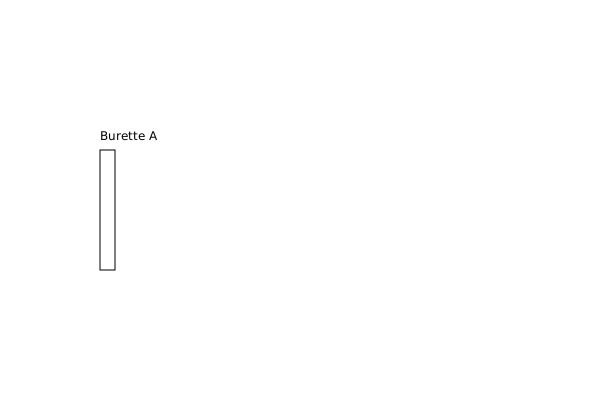
A diagram of the apparatus for the reaction is shown below. Identify the part labeled A.
A. The burette
B. The test tube
C. The thermometer
D. The stirrer
Question 4
Calculate the number of moles of chlorine gas required to react with 2.5 moles of sodium bromide in the following reaction: 2NaBr + Cl2 → 2NaCl + Br2.
A. 1.25
B. 2.5
C. 5
D. 10
Question 5
A sample of sulfur (S8) has a mass of 25 grams. Calculate the number of moles of sulfur present.
A. 0.25 mol
B. 0.50 mol
C. 0.75 mol
D. 1.00 mol
Question 6
A sample of nitrogen gas (N2) has a volume of 2.5 liters at a pressure of 750 mmHg and a temperature of 25°C. Calculate the number of moles of nitrogen gas present.
A. 0.05 mol
B. 0.10 mol
C. 0.15 mol
D. 0.20 mol
Question 7
Determine the major product of the reaction between 2-methyl-2-propanol and acetic anhydride.
A. 2-methyl-2-propyl acetate
B. 2-methyl-2-propanol
C. 2-methyl-2-propanone
D. 2-methyl-2-propanoic acid
Question 8
Determine the pH of a 0.1 M solution of HCl in water at 25°C. Assume that the dissociation of HCl is complete.
A. 1
B. 2
C. 3
D. 4
Question 9
A sample of a non-metallic element has a mass of 2.5 g and a volume of 1.0 L. What is the density of the element?
A. \( \rho = \frac{m}{V} \)
B. \( \rho = \frac{V}{m} \)
C. \( \rho = mV \)
D. \( \rho = \frac{1}{mV} \)
Question 10
Determine the pH of a 0.1 M solution of acetic acid (CH3COOH) at 25°C, given that the dissociation cons\tant (Ka) of acetic acid is 1.8 × 10^-5.
A. 3.0
B. 3.5
C. 4.0
D. 4.5
Question 11
The polymerization of ethylene to form polyethylene is represented by the equation: nC2H4 → [-CH2-CH2-]n. If 2.5 mol of C2H4 is polymerized, what is the number of moles of polyethylene produced?
A. 1.25 mol
B. 2.5 mol
C. 3.75 mol
D. 5.0 mol
Question 12
The reaction between H2(g) and Cl2(g) produces HCl(g). If 1.5 mol of H2(g) reacts with 1.5 mol of Cl2(g), what is the limiting reac\tant?
A. H2(g)
B. Cl2(g)
C. HCl(g)
D. Neither H2(g) nor Cl2(g) is the limiting reac\tant.
Question 13
The diagram below shows a redox reaction. Identify the oxidizing agent.
A. Cu
B. Ag
C. Fe
D. Zn
Question 14
Determine the pH of a 0.1 M solution of hydrochloric acid (HCl).
A. 1
B. 2
C. 3
D. 4
Question 15
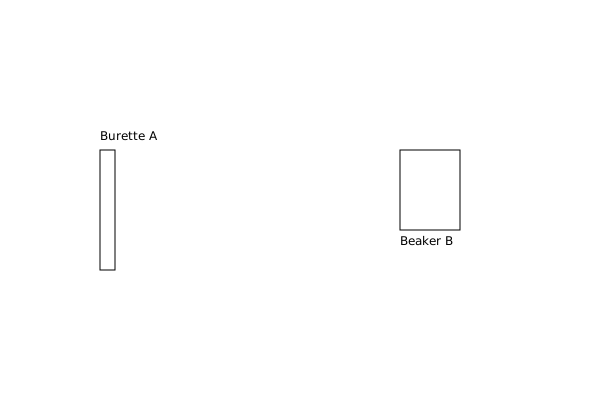
The diagram below shows a titration setup.
A. The burette contains NaOH.
B. The beaker contains HCl.
C. The burette contains HCl.
D. The beaker contains NaOH.

Master the Exam!

You've seen a preview, but there are thousands more questions plus AI tutor to break down complex solutions.

Unlock Full Access Available for Android & Windows
Help others prepare! Share this practice hub: