POST UTME EKSU 2024 Biology | Objective

Practice these randomly selected questions to test your readiness.

Question 1
A diagram of the human circulatory system is shown below. Which part of the circulatory system is responsible for transporting oxygen to the body?
A. Heart
B. Arteries
C. Veins
D. Capillaries
Question 2
A 30-year-old woman presents to the emergency department with a severe headache and fever. She has a history of migraines but this episode is different. What is the most likely diagnosis?
A. Migraine
B. Cluster headache
C. Trigeminal neuralgia
D. Subarachnoid hemorrhage
Question 3
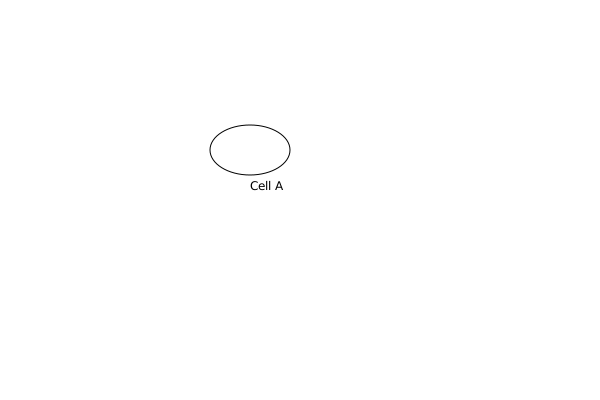
A diagram of a plant cell is shown below. What is the function of the structure labeled 'A'?
A. Photosynthesis
B. Respiration
C. Cell division
D. Cell signaling
Question 4
A plant's growth is limited by the availability of a specific nutrient. Which of the following is the most likely explanation for this observation?
A. The plant has a mutation in the gene that codes for the nutrient
B. The plant has a deficiency in the enzyme that absorbs the nutrient
C. The plant's roots are unable to absorb the nutrient from the soil
D. The plant's leaves are unable to use the nutrient for growth
Question 5
A 2.5 kg block is attached to a horizontal, massless spring with a force cons\tant of 100 N/m. The block is displaced by 0.25 m from its equilibrium position and released from rest. Assuming the block undergoes simple harmonic motion, what is the maximum speed of the block?
A. 0.5 m/s
B. 1.0 m/s
C. 1.5 m/s
D. 2.0 m/s
Question 6
A solution of 0.1 M NaOH is added to a solution of 0.1 M HCl. What is the pH of the resulting solution?
A. 1
B. 2
C. 7
D. 14
Question 7
A patient has been diagnosed with a bacterial infection. Which of the following antibiotics is most likely to be effective against this type of infection?
A. Penicillin
B. Erythromycin
C. Ciprofloxacin
D. Vancomycin
Question 8
A person has a genetic disorder that affects their ability to digest lactose. Which of the following is the most likely explanation for this condition?
A. The person has a mutation in the gene that codes for lactase
B. The person has a deficiency in the enzyme lactase
C. The person has a problem with the small intestine's ability to absorb lactose
D. The person has a food intolerance to lactose
Question 9
A diagram of the human brain is shown below. Which part of the brain is responsible for controlling movement?
A. Cerebrum
B. Cerebellum
C. Medulla
D. Pons
Question 10
A 5 kg object is moving in a circular path with a radius of 2 m. If the object has a speed of 4 m/s, what is the centripetal force acting on the object?
A. 10 N
B. 20 N
C. 30 N
D. 40 N
Question 11
A diagram of the human heart is shown below. Which part of the heart is responsible for pumping blood to the lungs?
A. Ventricle
B. Atrium
C. Pulmonary artery
D. Aorta
Question 12
In a population of 1000 individuals, 70% are heterozygous for the gene controlling the flower color, 20% are homozygous dominant, and 10% are homozygous recessive. What is the expected frequency of the recessive allele?
A. 0.15
B. 0.20
C. 0.25
D. 0.30
Question 13
A diagram of the human digestive system is shown below.
A. The mouth is responsible for mechanical digestion
B. The esophagus transports food to the stomach
C. The stomach secretes digestive enzymes
D. The small intestine absorbs nutrients
Question 14
A 10 kg object is moving in a straight line with a velocity of 5 m/s. If the object is acted upon by a force of 20 N, what is the acceleration of the object?
A. 1 m/s^2
B. 2 m/s^2
C. 3 m/s^2
D. 4 m/s^2
Question 15
The diagram below shows a cross-section of a tree trunk. What is the function of the xylem tissue?
A. To transport water and minerals from the roots to the leaves
B. To transport sugars and other organic compounds from the leaves to the roots
C. To provide structural support to the tree
D. To regulate the rate of transpiration

Master the Exam!

You've seen a preview, but there are thousands more questions plus AI tutor to break down complex solutions.

Unlock Full Access Available for Android & Windows
Help others prepare! Share this practice hub: