POST UTME EKSU 2022 Chemistry | Objective
Practice these randomly selected questions to test your readiness.
Question 1
A 2.0 L flask contains 1.0 atm of He gas at 298 K. What is the pressure of the gas in the flask if it is heated to 373 K?
Question 2
A 0.1 M solution of NaCl is prepared by dissolving 6.0 g of NaCl in 100 mL of water. What is the concentration of Cl^- ions in the solution?
Question 3
The rate cons\tant (k) of a first-order reaction is given by the equation: k = 2.303/t \log10\( A0/A \). If the half-life of the reaction is 10 minutes, what is the value of k?
Question 4
A 2.50 g sample of a polymer is dissolved in 100.0 mL of a solvent. If the density of the solution is 1.00 g/mL, what is the molar mass of the polymer?
Question 5
A 1.0 M solution of HCl is prepared by dissolving 36.5 g of HCl in 100 mL of water. What is the pH of the solution?
Question 6
A 2.0 M solution of HCl is prepared by dissolving 40 g of HCl in 100 mL of water. What is the concentration of the solution in mol/L?
Question 7
A 0.500 L sample of a 0.100 M solution of NaOH is mixed with a 0.500 L sample of a 0.100 M solution of HCl. What is the pH of the resulting solution?
Question 8
A sample of an ideal gas is heated at cons\tant volume. Which of the following statements is true about the change in entropy of the gas?
Question 9
A solution of 0.1 M NaCl is prepared by dissolving 6.0 g of NaCl in 100 mL of water. What is the concentration of the solution in g/L?
Question 10
A 2.50 L sample of a gas at 25°C and 1.00 atm is collected over water at 25°C. If the vapor pressure of water at 25°C is 23.8 torr, what is the partial pressure of the gas?
Question 11
A diagram of a chromatography setup is shown below. What is the purpose of the stationary phase in this setup?
Question 12
A sample of 1.0 g of a non-metallic element has a density of 5.0 g/cm³. What is the volume of the sample in cm³?
Question 13
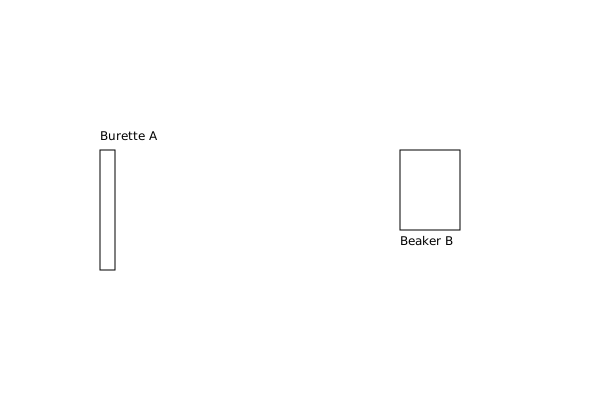
A diagram of a titration setup is shown below. What is the purpose of the burette in this setup?
Question 14
The s\tandard enthalpy of formation of CO2(g) is -393.5 kJ/mol. What is the s\tandard enthalpy of formation of H2O(l) if the s\tandard enthalpy of formation of H2(g) is 0 kJ/mol and the s\tandard enthalpy of formation of O2(g) is 0 kJ/mol?
Question 15
Determine the number of moles of ΔHgS that can be formed from 0.500 mol of Hg(NO3)2 and 0.750 mol of Na2S, given that the reaction is: Hg(NO3)2 + Na2S → ΔHgS + 2NaNO3.
Master the Exam!
You've seen a preview, but there are thousands more questions plus AI tutor to break down complex solutions.
Unlock Full Access
Available for Android & Windows