POST UTME EKSU 2017 Chemistry | Objective

Practice these randomly selected questions to test your readiness.

Question 1
A 2.0 M solution of ammonia (NH3) is titrated with a 1.0 M solution of hydrochloric acid (HCl). If 20 cm^3 of the acid is required to reach the equivalence point, calculate the number of moles of NH3 present in 100 cm^3 of the solution.
A. 0.01 moles
B. 0.02 moles
C. 0.03 moles
D. 0.04 moles
Question 2
A 25.0 mL sample of 0.100 M HCl is titrated with 0.100 M NaOH. Calculate the pH of the solution after the addition of 25.0 mL of NaOH.
A. 1.00
B. 2.00
C. 3.00
D. 4.00
Question 3
A 1.0 M solution of HCl is prepared by dissolving 36.5 g of HCl in 1000 mL of water. What is the concentration of H+ ions in the solution?
A. 0.1 M
B. 0.5 M
C. 1 M
D. 2 M
Question 4
A 1.00 L solution of 0.100 M NaOH is mixed with 1.00 L of 0.100 M HCl. What is the pH of the resulting solution?
A. 7.00
B. 7.50
C. 8.00
D. 9.00
Question 5
The solubility of a gas in a liquid is given by the equation: \( S = \frac{P}{k} \), where S is the solubility, P is the partial pressure of the gas, and k is a cons\tant. If the partial pressure of a gas is 2 atm and the cons\tant k is 0.5 atm, what is the solubility of the gas in the liquid?
A. 4 atm
B. 2 atm
C. 1 atm
D. 0.5 atm
Question 6
A sample of a polymer contains 25% by mass of carbon, 60% by mass of hydrogen, and 15% by mass of oxygen. If the total mass of the sample is 100 g, calculate the mass of carbon present in the sample.
A. 10 g
B. 20 g
C. 30 g
D. 40 g
Question 7
A 1.00 M solution of HCl is mixed with a 1.00 M solution of NaOH. Calculate the number of moles of HCl that react with NaOH.
A. 1.00 mol
B. 2.00 mol
C. 3.00 mol
D. 4.00 mol
Question 8
The atomic radius of an element is 100 pm. If the element has an electron configuration of [Ar] 4s^2 3d^5, what is the expected oxidation state of the element?
A. +2
B. +3
C. +4
D. +5
Question 9
The reaction of chlorine gas with sodium hydroxide solution is a classic example of a redox reaction. Write the balanced chemical equation for this reaction.
A. 2NaOH + Cl2 → NaCl + NaClO + H2O
B. 2NaOH + Cl2 → NaClO + NaCl + H2O
C. 2NaOH + Cl2 → NaCl + NaClO3 + H2O
D. 2NaOH + Cl2 → NaClO + NaOH + H2O
Question 10
A 2.50 g sample of a non-metallic element is heated in a crucible until it reaches a temperature of 2500°C. If the element has a molar mass of 40.0 g/mol, what is the number of moles of the element present?
A. 0.0625 mol
B. 0.125 mol
C. 0.250 mol
D. 0.500 mol
Question 11
The atomic radius of an element increases down a group in the periodic table. Explain why this is the case.
A. Due to the increase in the number of energy levels
B. Due to the decrease in the effective nuclear charge
C. Due to the increase in the atomic mass
D. Due to the decrease in the atomic number
Question 12
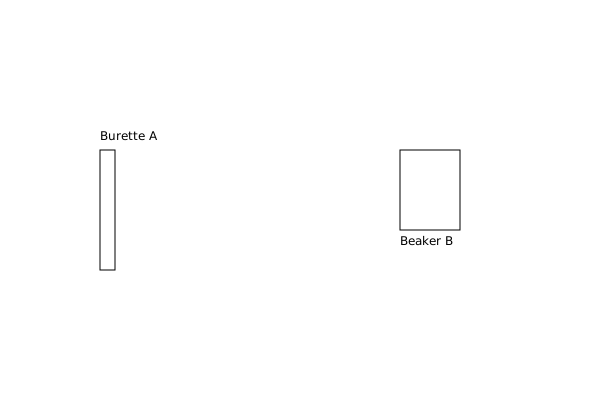
The diagram below shows a simple black and white chemistry apparatus showing a titration setup. Identify the part labeled A.
A. The burette
B. The beaker
C. The pipette
D. The flask
Question 13
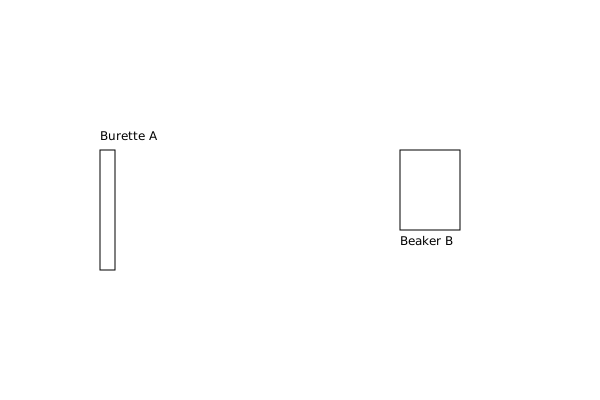
The diagram below shows a titration setup. Identify the part labeled A.
A. The burette
B. The beaker
C. The pipette
D. The flask
Question 14
A 2.0 M solution of NaOH is prepared by dissolving 40 g of NaOH in 1000 mL of water. What is the concentration of OH- ions in the solution?
A. 0.1 M
B. 0.5 M
C. 1 M
D. 2 M
Question 15
A 1.5 M solution of H2SO4 is prepared by dissolving 49 g of H2SO4 in 1000 mL of water. What is the concentration of H+ ions in the solution?
A. 0.1 M
B. 0.5 M
C. 1 M
D. 2 M

Master the Exam!

You've seen a preview, but there are thousands more questions plus AI tutor to break down complex solutions.

Unlock Full Access Available for Android & Windows
Help others prepare! Share this practice hub: