POST UTME COVENANT UNIVERSITY 2025 Biology | Objective

Practice these randomly selected questions to test your readiness.

Question 1
In the context of evolutionary theory, what is the primary mechanism driving the adaptation of species to their environments?
A. Natural Selection
B. Genetic Drift
C. Gene Flow
D. Mutation
Question 2
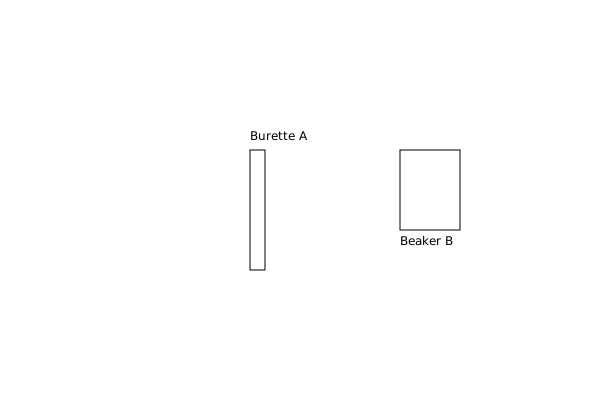
The diagram below represents a simple black and white chemistry apparatus showing a titration setup. Identify the part labeled A.
A. burette
B. beaker
C. pipette
D. dropper
Question 3
A 50-year-old patient presents with symptoms of hypertension. Blood pressure is measured at 180/100 mmHg. Which of the following is the most likely cause of this patient's hypertension?
A. Kidney disease
B. Heart disease
C. Diabetes
D. Obesity
Question 4
A population of 1000 individuals has a birth rate of 0.05 and a death rate of 0.02. What is the expected population size after 10 years?
A. 1200
B. 1500
C. 1800
D. 2000
Question 5
A diagram of a human kidney is shown below. Identify the structure labeled 'B'.
A. Nephron
B. Renal Pelvis
C. Ureter
D. Bladder
Question 6
The Hardy-Weinberg principle states that the frequency of alleles in a population will remain cons\tant if
A. the population is large and randomly mating
B. the population is small and randomly mating
C. the population is large and non-randomly mating
D. the population is small and non-randomly mating
Question 7
A researcher studying the eco\logy of a freshwater lake observes that the water level fluctuates seasonally. What is the most likely explanation for this phenomenon?
A. Changes in precipitation patterns
B. Evaporation due to increased temperature
C. Inflow of water from surrounding land
D. Outflow of water through a natural outlet
Question 8
A physio\logist is studying the structure and function of the human nervous system. Which of the following is a characteristic of the autonomic nervous system?
A. Regulation of voluntary movements
B. Control of involuntary functions such as heart rate and digestion
C. Transmission of sensory information from the environment
D. Modulation of the immune response
Question 9
The process of gas exchange in the human body occurs in the lungs, where oxygen from the air is transferred into the bloodstream and carbon dioxide is removed. Which of the following best describes the mechanism of gas exchange?
A. Diffusion
B. Osmosis
C. Active transport
D. Passive transport
Question 10
A 2.5 g sample of a compound is dissolved in 25 mL of water. The molarity of the solution is 0.1 M. What is the molar mass of the compound?
A. 10000
B. 25000
C. 50000
D. 75000
Question 11
A 30-year-old patient presents with symptoms of depression. Which of the following is the most effective treatment for this patient?
A. Selective serotonin reuptake inhibitors (SSRIs)
B. Tricyclic antidepressants (TCAs)
C. Monoamine oxidase inhibitors (MAOIs)
D. Lithium
Question 12
Asexual reproduction involves the production of offspring without the involvement of gametes. Which of the following organisms reproduces asexually?
A. Bread mold
B. Fruit fly
C. Human
D. Bacteria
Question 13
In a population of Drosophila melanogaster, the frequency of the recessive allele 'a' is 0.2. If the population is in Hardy-Weinberg equilibrium, what is the frequency of the homozygous dominant genotype 'AA'?
A. 0.36
B. 0.64
C. 0.16
D. 0.44
Question 14
In a typical e\cosystem, the producers (plants and algae) form the base of the food web. Which of the following best describes the role of producers in the e\cosystem?
A. Consumers
B. Decomposers
C. Producers
D. Scavengers
Question 15
A 2.0 L flask contains 0.50 M NaCl. If 0.10 M NaOH is added to the flask, what is the resulting concentration of NaCl?
A. 0.40 M
B. 0.50 M
C. 0.60 M
D. 0.70 M

Master the Exam!

You've seen a preview, but there are thousands more questions plus AI tutor to break down complex solutions.

Unlock Full Access Available for Android & Windows
Help others prepare! Share this practice hub: