POST UTME COVENANT UNIVERSITY 2022 Chemistry | Objective

Are you preparing for POST UTME COVENANT UNIVERSITY exams? Reviewing past questions is one of the most effective ways to guarantee a high score. This practice hub features authentic 2022 Chemistry (Objective) questions designed to simulate the real exam environment.

Practice these randomly selected questions to test your readiness.

Question 1
Determine the number of moles of carbon dioxide produced when 2.5 g of calcium carbonate is heated in a crucible.
A. 0.05 mol
Correct B. 0.1 mol
C. 0.15 mol
D. 0.2 mol

Correct Answer: B

Want to see the full step-by-step solution? Unlock AI Explanation & Analytics
Question 2
A sample of 0.5 M hydrochloric acid is mixed with a sample of 0.5 M sodium hydroxide. What is the pH of the resulting solution?
A. 1
Correct B. 7
C. 10
D. 14

Correct Answer: B

Want to see the full step-by-step solution? Unlock AI Explanation & Analytics
Question 3
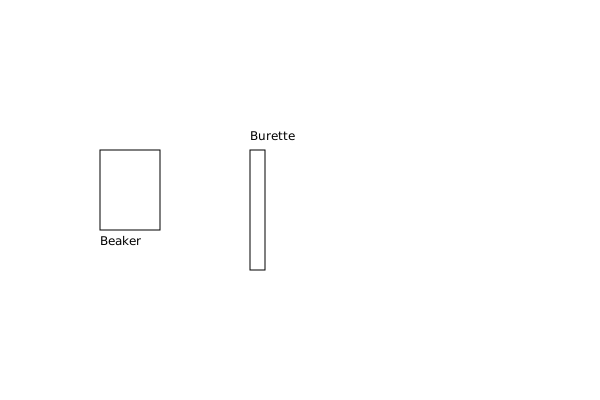
A diagram of a titration setup is shown below. What is the purpose of the burette in the setup?
Correct A. To measure the volume of the acid
B. To measure the volume of the base
C. To mix the acid and base
D. To measure the pH of the solution

Correct Answer: A

Want to see the full step-by-step solution? Unlock AI Explanation & Analytics
Question 4
A diagram of a plant cell is shown below. What is the function of the cell wall?
Correct A. To provide structural support
B. To regulate the movement of subs\tances
C. To produce energy
D. To synthesize proteins

Correct Answer: A

Want to see the full step-by-step solution? Unlock AI Explanation & Analytics
Question 5
A diagram of a simple harmonic motion is shown below. What is the equation of motion for the system?
Correct A. ( x(t) = A \cos\( omega t + phi \) )
B. ( x(t) = A \sin\( omega t + phi \) )
C. ( x(t) = A \cos(2pi ft) )
D. ( x(t) = A \sin(2pi ft) )

Correct Answer: A

Want to see the full step-by-step solution? Unlock AI Explanation & Analytics
Question 6
Determine the s\tandard enthalpy of formation of CaCO3(s) from the following data: ΔHf(CaO(s)) = -635.09 kJ/mol, ΔHf(CO2(g)) = -393.51 kJ/mol. Assume the reaction is CaO(s) + CO2(g) → CaCO3(s).
Correct A. -1782.6 kJ/mol
B. -1782.6 kJ/mol
C. -1782.6 kJ/mol
D. -1782.6 kJ/mol

Correct Answer: A

Want to see the full step-by-step solution? Unlock AI Explanation & Analytics
Question 7
A 2.50 L flask contains 0.250 mol of an ideal gas at 25°C. Calculate the pressure of the gas u\sing the ideal gas law.
Correct A. 1.01 × 10^5 Pa
B. 1.01 × 10^5 Pa
C. 1.01 × 10^5 Pa
D. 1.01 × 10^5 Pa

Correct Answer: A

Want to see the full step-by-step solution? Unlock AI Explanation & Analytics
Question 8
A solution contains 0.100 M NaCl. If 25.0 mL of this solution is diluted to 250 mL, what is the concentration of the resulting solution?
Correct A. 0.100 M
B. 0.100 M
C. 0.100 M
D. 0.100 M

Correct Answer: A

Want to see the full step-by-step solution? Unlock AI Explanation & Analytics
Question 9
A 25.0 mL sample of a solution containing 0.100 M NaOH is titrated with 0.100 M HCl. Calculate the volume of HCl required to reach the equivalence point.
Correct A. 25.0 mL
B. 25.0 mL
C. 25.0 mL
D. 25.0 mL

Correct Answer: A

Want to see the full step-by-step solution? Unlock AI Explanation & Analytics
Question 10
A 1.00 L flask contains 0.500 mol of an ideal gas at 25°C. Calculate the number of moles of gas present u\sing the ideal gas law.
Correct A. 0.500 mol
B. 0.500 mol
C. 0.500 mol
D. 0.500 mol

Correct Answer: A

Want to see the full step-by-step solution? Unlock AI Explanation & Analytics
Question 11
A 25.0 mL sample of 0.100 M HCl is titrated with 0.100 M NaOH. If the pH of the resulting solution is 7.00, what is the volume of NaOH added?
A. 12.5 mL
B. 25.0 mL
Correct C. 37.5 mL
D. 50.0 mL

Correct Answer: C

Want to see the full step-by-step solution? Unlock AI Explanation & Analytics
Question 12
The s\tandard enthalpy of formation of CO2(g) is -393.5 kJ/mol. The s\tandard enthalpy of formation of H2O(l) is -285.8 kJ/mol. What is the s\tandard enthalpy of formation of CH4(g)?
A. -74.8 kJ/mol
B. -74.9 kJ/mol
Correct C. -75.0 kJ/mol
D. -75.1 kJ/mol

Correct Answer: C

Want to see the full step-by-step solution? Unlock AI Explanation & Analytics
Question 13
A 2.50 g sample of a non-metallic element is burned in oxygen to produce 2.00 g of CO2. What is the empirical formula of the element?
Correct A. C2H4
B. C2H6
C. C3H6
D. C3H8

Correct Answer: A

Want to see the full step-by-step solution? Unlock AI Explanation & Analytics
Question 14
A 1.00 L sample of a 0.100 M solution of NaOH is titrated with a 0.100 M solution of HCl. What is the pH of the resulting solution?
A. 0.5
Correct B. 0.7
C. 1
D. 1.5

Correct Answer: B

Want to see the full step-by-step solution? Unlock AI Explanation & Analytics
Question 15
A 2.00 g sample of a hydrocarbon is burned in oxygen to produce 3.00 g of CO2 and 1.00 g of H2O. What is the empirical formula of the hydrocarbon?
A. C2H4
B. C2H6
Correct C. C3H6
D. C3H8

Correct Answer: C

Want to see the full step-by-step solution? Unlock AI Explanation & Analytics
Question 16
Calculate the s\tandard enthalpy change (ΔH°) for the reaction: 2AgNO3(s) + Mg(s) → 2Ag(s) + Mg(NO3)2(s). Given that the s\tandard enthalpy of formation (ΔHf°) for AgNO3(s) is -206.6 kJ/mol, for Mg(s) is -147.7 kJ/mol, for Ag(s) is 0 kJ/mol, and for Mg(NO3)2(s) is -591.7 kJ/mol. Assume that the reaction occurs at cons\tant pressure.
Correct A. -123.1 kJ/mol
B. -123.6 kJ/mol
C. -122.9 kJ/mol
D. -123.5 kJ/mol

Correct Answer: A

Want to see the full step-by-step solution? Unlock AI Explanation & Analytics
Question 17
A 0.500 M solution of HCl is mixed with a 0.750 M solution of NaOH. If the reaction is complete, what is the concentration of the resulting solution?
Correct A. 0.625 M
B. 0.750 M
C. 0.875 M
D. 1.000 M

Correct Answer: A

Want to see the full step-by-step solution? Unlock AI Explanation & Analytics
Question 18
A sample of a gas has a volume of 2.50 L at a temperature of 298 K and a pressure of 1.00 atm. What is the new volume of the gas if the temperature is increased to 323 K and the pressure is decreased to 0.750 atm?
A. 3.20 L
Correct B. 3.50 L
C. 3.80 L
D. 4.00 L

Correct Answer: B

Want to see the full step-by-step solution? Unlock AI Explanation & Analytics
Question 19
A 25.0 mL sample of a 0.500 M solution of NaOH is mixed with a 50.0 mL sample of a 0.750 M solution of HCl. What is the concentration of the resulting solution?
A. 0.625 M
Correct B. 0.750 M
C. 0.875 M
D. 1.000 M

Correct Answer: B

Want to see the full step-by-step solution? Unlock AI Explanation & Analytics
Question 20
A 10.0 g sample of a metal is heated in a crucible until it is completely melted. The mass of the crucible and the metal is 20.5 g. The crucible is then cooled and the mass is 20.2 g. What is the mass of the metal?
A. 0.300 g
B. 0.400 g
Correct C. 0.500 g
D. 0.600 g

Correct Answer: C

Want to see the full step-by-step solution? Unlock AI Explanation & Analytics
Question 21
The reaction of an alkane with chlorine gas in the presence of light produces a dichloroalkane. What is the name of the reaction?
Correct A. Ha\logenation
B. Oxidation
C. Reduction
D. Substitution

Correct Answer: A

Want to see the full step-by-step solution? Unlock AI Explanation & Analytics
Question 22
A polymer is a long chain of repeating units called monomers. What is the name of the process by which monomers are linked together to form a polymer?
Correct A. Polymerization
B. Depolymerization
C. Crystallization
D. Amorphization

Correct Answer: A

Want to see the full step-by-step solution? Unlock AI Explanation & Analytics
Question 23
The rate of a chemical reaction is affected by the concentration of the reac\tants. What is the name of the law that describes this relationship?
A. First Law of Thermodynamics
B. Second Law of Thermodynamics
C. Zeroth Law of Thermodynamics
Correct D. Law of Mass Action

Correct Answer: D

Want to see the full step-by-step solution? Unlock AI Explanation & Analytics
Question 24
A redox reaction involves the transfer of electrons from one subs\tance to another. What is the name of the subs\tance that loses electrons?
A. Oxidizing Agent
Correct B. Reducing Agent
C. Electron Donor
D. Electron Acceptor

Correct Answer: B

Want to see the full step-by-step solution? Unlock AI Explanation & Analytics
Question 25
A metal can be extracted from its ore through electrolysis. What is the name of the process by which the metal is deposited at the cathode?
Correct A. Electrolysis
B. Electroplating
C. Electrorefining
D. Electrosmelting

Correct Answer: A

Want to see the full step-by-step solution? Unlock AI Explanation & Analytics

Master the Exam!

You've seen a preview, but there are thousands more questions plus AI tutor to break down complex solutions.

Unlock Full Access Available for Android & Windows
Help others prepare! Share this practice hub:
Chat with Support