POST UTME COVENANT UNIVERSITY 2019 Chemistry | Objective

Practice these randomly selected questions to test your readiness.

Question 1
A sample of an ideal gas is heated from 300 K to 400 K at cons\tant volume. Calculate the change in internal energy (ΔU) of the gas.
A. 0 J
B. 1000 J
C. 2000 J
D. 3000 J
Question 2
A polymer is a large molecule composed of many smaller molecules called monomers. Which of the following is an example of a polymer?
A. DNA
B. Protein
C. Starch
D. Cellulose
Question 3
The diagram below shows the atomic structure of a metal atom.
A. The metal atom has 2 valence electrons.
B. The metal atom has 3 valence electrons.
C. The metal atom has 4 valence electrons.
D. The metal atom has 5 valence electrons.
Question 4
The reaction between zinc metal and copper(II) sulfate solution is represented by the equation: Zn(s) + CuSO4(aq) → ZnSO4(aq) + Cu(s). If 25.0 g of zinc metal is added to 250 mL of 0.100 M CuSO4 solution, what is the limiting reac\tant?
A. Zn
B. CuSO4
C. ZnSO4
D. Cu
Question 5
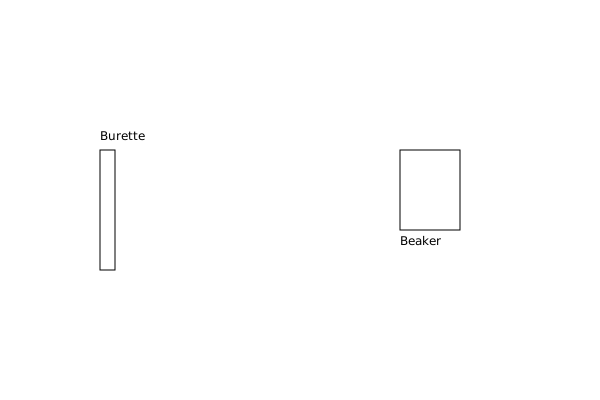
The diagram below shows a titration setup.
A. The burette contains the acid.
B. The burette contains the base.
C. The beaker contains the acid.
D. The beaker contains the base.
Question 6
A 2.5 M solution of sodium hydroxide (NaOH) is mixed with a 1.5 M solution of hydrochloric acid (HCl). Determine the pH of the resulting solution.
A. 1
B. 2
C. 3
D. 4
Question 7
Determine the number of moles of $\text{O}_2$ produced when 2.50 g of $\text{KClO}_3$ is decomposed according to the equation: $\text{KClO}_3(s) \rightarrow \text{KCl}(s) + \frac{3}{2}\text{O}_2(g)$
A. 0.0100 mol
B. 0.0150 mol
C. 0.0200 mol
D. 0.0250 mol
Question 8
A 2.0 M solution of sodium hydroxide (NaOH) is mixed with a 1.0 M solution of hydrochloric acid (HCl). If 50 mL of the NaOH solution is added to 100 mL of the HCl solution, what is the pH of the resulting solution?
A. 2
B. 3
C. 4
D. 5
Question 9
The reaction between sulfuric acid and sodium hydroxide is represented by the equation: H2SO4 + 2NaOH → Na2SO4 + 2H2O. If 25.0 g of H2SO4 is added to 100.0 mL of 0.100 M NaOH, what is the limiting reac\tant?
A. H2SO4
B. NaOH
C. Na2SO4
D. H2O
Question 10
A 250 mL sample of a 0.5 M solution of potassium nitrate (KNO3) is diluted to a total volume of 1 L. Determine the number of moles of potassium nitrate (KNO3) in the resulting solution.
A. 0.125 moles
B. 0.25 moles
C. 0.5 moles
D. 1.0 moles
Question 11
A solution of sulfuric acid (H2SO4) is prepared by dissolving 50 g of the acid in 100 mL of water. Calculate the molarity of the solution.
A. 1.0 M
B. 2.0 M
C. 3.0 M
D. 4.0 M
Question 12
A metal, M, reacts with oxygen to form a metal oxide, MO. If 2.5 g of M is obtained from 3.2 g of MO, calculate the percentage yield of the reaction.
A. 60%
B. 70%
C. 80%
D. 90%
Question 13
A solution of NaOH is prepared by dissolving 25 g of NaOH in 100 g of water. Calculate the molarity of the solution.
A. 0.5 M
B. 1.0 M
C. 1.5 M
D. 2.0 M
Question 14
The reaction of an alkanol with a strong acid produces a salt and water. Write the balanced chemical equation for the reaction between ethanol (C2H5OH) and hydrochloric acid (HCl).
A. C2H5OH + HCl → C2H5Cl + H2O
B. C2H5OH + HCl → C2H5OHCl + H2
C. C2H5OH + HCl → C2H5OH2 + HCl
D. C2H5OH + HCl → C2H5Cl2 + H2O
Question 15
A 0.1 M solution of a weak acid HA is titrated with 0.1 M NaOH. If the initial volume of the acid solution is 50 mL and the equivalence point is reached at 100 mL, calculate the pH of the solution at the equivalence point.
A. 7
B. 10
C. 14
D. 12

Master the Exam!

You've seen a preview, but there are thousands more questions plus AI tutor to break down complex solutions.

Unlock Full Access Available for Android & Windows
Help others prepare! Share this practice hub: