POST UTME COAL CITY UNIVERSITY 2020 Biology | Objective

Practice these randomly selected questions to test your readiness.

Question 1
The sense organ responsible for detecting changes in sound pressure is the
A. Ear
B. Eye
C. Nose
D. Mouth
Question 2
A researcher studying the population dynamics of a species of rabbit in a controlled environment observes that the population grows exponentially. Which of the following mathematical models best describes this growth?
A. ( P(t) = P_0 e^{kt} )
B. ( P(t) = P_0 + kt )
C. ( P(t) = P_0 e^{-kt} )
D. ( P(t) = P_0 - kt )
Question 3
A 10-year-old child is diagnosed with a rare genetic disorder that affects the production of a specific enzyme. The child's parents are both carriers of the mutated gene. What is the probability that their next child will be affected by the disorder?
A. 0.25
B. 0.5
C. 0.75
D. 0.9
Question 4
The process of evolution by natural selection can be described by the following equation: \( Delta W = \frac{dW}{dt} \). What does this equation represent?
A. The rate of change of the population size over time.
B. The rate of change of the fitness of the population over time.
C. The rate of change of the genetic diversity of the population over time.
D. The rate of change of the environmental conditions over time.
Question 5
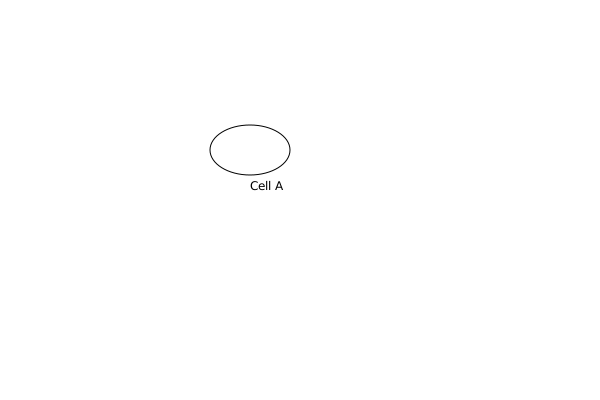
A diagram of a plant cell is shown below. What is the function of the part labeled 'A'?
A. To synthesize proteins
B. To store genetic information
C. To regulate cell growth
D. To transport materials
Question 6
A microorganism that causes disease in humans is an example of what type of microorganism?
A. pathogen
B. symbiont
C. mu\tant
D. variant
Question 7
The process by which plants release water vapor into the air is known as
A. Transpiration
B. Respiration
C. Photosynthesis
D. Evaporation
Question 8
A population of rabbits is growing at a rate of 20% per year. If the initial population is 100 rabbits, what will be the population after 5 years?
A. 1000
B. 500
C. 2000
D. 3000
Question 9
The process by which an organism's genetic information is modified is called:
A. Mutation
B. Genetic drift
C. Natural selection
D. Gene expression
Question 10
A 5-year-old child is diagnosed with a rare genetic disorder that affects the production of a specific enzyme. The child's parents are both carriers of the mutated gene. What is the probability that their next child will be affected by the disorder?
A. 0.25
B. 0.5
C. 0.75
D. 0.9
Question 11
In a eukaryotic cell, the \endoplasmic reticulum (ER) is involved in the synthesis of proteins that are destined for secretion or for use within the cell. Which of the following statements about the ER is correct?
A. The ER is a type of lysosome.
B. The ER is a type of mitochondrion.
C. The ER is a type of smooth \endoplasmic reticulum.
D. The ER is involved in the synthesis of proteins that are destined for secretion or for use within the cell.
Question 12
A diagram of a bacterial cell is shown below. What is the function of the cell wall?
A. To synthesize proteins
B. To store genetic information
C. To maintain cell shape
D. To regulate cell growth
Question 13
A researcher is studying the effect of a new pesticide on a population of insects. The pesticide kills 20% of the insects in the first week, 30% in the second week, and 40% in the third week. What is the total percentage of insects killed after three weeks?
A. 60
B. 70
C. 80
D. 90
Question 14
A patient with a rare genetic disorder has a mutation in the HFE gene. Which of the following is a possible consequence of this mutation?
A. Increased risk of developing hemochromatosis
B. Decreased risk of developing hemochromatosis
C. Increased risk of developing thalassemia
D. Decreased risk of developing sickle cell anemia
Question 15
In a eukaryotic cell, the process of photosynthesis occurs in the mitochondria. Which of the following statements is correct?
A. The mitochondria is the site of photosynthesis in eukaryotic cells.
B. The mitochondria is the site of cellular respiration in eukaryotic cells.
C. The mitochondria is the site of protein synthesis in eukaryotic cells.
D. The mitochondria is the site of DNA replication in eukaryotic cells.

Master the Exam!

You've seen a preview, but there are thousands more questions plus AI tutor to break down complex solutions.

Unlock Full Access Available for Android & Windows
Help others prepare! Share this practice hub: