POST UTME CALEB UNIVERSITY 2020 Chemistry | Objective

Practice these randomly selected questions to test your readiness.

Question 1
A 1.0 L flask contains 0.5 mol of CO2 at 298 K. What is the partial pressure of CO2 in the flask?
A. 0.5 atm
B. 1.0 atm
C. 2.0 atm
D. 5.0 atm
Question 2
A solution of 0.1 M HCl is titrated with 0.1 M NaOH. The initial pH of the solution is 1. If 25 mL of NaOH is added, the pH increases to 2. What is the pH of the solution after the addition of 50 mL of NaOH?
A. 3
B. 4
C. 5
D. 6
Question 3
A 2.0 M solution of H2SO4 is prepared by dissolving 40.0 g of H2SO4 in 100 mL of water. What is the concentration of H+ ions in the solution?
A. 2.0 M
B. 1.0 M
C. 0.5 M
D. 0.25 M
Question 4
A 2.5 g sample of a metal carbonate is heated to produce a metal oxide and carbon dioxide gas. If the mass of the metal oxide produced is 1.8 g, calculate the percentage yield of the metal oxide.
A. 40%
B. 50%
C. 60%
D. 70%
Question 5
A solution of 0.1 M HCl is titrated with 0.1 M NaOH. The initial pH of the solution is 1. If 25 mL of NaOH is added, the pH increases to 2. What is the pH of the solution after the addition of 50 mL of NaOH?
A. 3
B. 4
C. 5
D. 6
Question 6
The solubility of a salt, AB, in water is 0.1 g/100 mL at 25°C. If 1 g of the salt is dissolved in 100 mL of water, what is the concentration of the solution in terms of molarity?
A. 0.01 M
B. 0.1 M
C. 1 M
D. 10 M
Question 7
A sample of nitrogen gas is collected over water at a temperature of 25°C and a pressure of 1 atm. What is the partial pressure of the nitrogen gas?
A. 0.95 atm
B. 0.99 atm
C. 1.01 atm
D. 1.05 atm
Question 8
The polymerization of styrene to polystyrene involves the addition of a monomer to a growing polymer chain. Which of the following is the most likely mechanism for this reaction?
A. Free radical polymerization
B. Cationic polymerization
C. Anionic polymerization
D. Coordination polymerization
Question 9
The s\tandard enthalpy of formation of CO2(g) is -393.5 kJ/mol. Calculate the s\tandard enthalpy of combustion of 1.5 mol of C6H12O6(s) at 298 K.
A. -1764.75 kJ
B. -1764.85 kJ
C. -1764.95 kJ
D. -1765.05 kJ
Question 10
A catalyst is added to a reaction mixture containing 1 M H2 and 1 M I2. The reaction is first-order with respect to H2 and second-order with respect to I2. If the initial rate of reaction is 0.1 M/s, what is the rate of reaction after 10 minutes?
A. 0.05 M/s
B. 0.1 M/s
C. 0.2 M/s
D. 0.5 M/s
Question 11
A 0.1 M solution of NaOH is titrated with 0.1 M HCl. If 25 mL of HCl is required to reach the equivalence point, calculate the volume of NaOH required to reach the equivalence point.
A. 25 mL
B. 50 mL
C. 75 mL
D. 100 mL
Question 12
The s\tandard entropy of formation of CO2(g) is 213.8 J/mol·K. What is the s\tandard entropy of combustion of 1.0 mol of C(s) to form CO2(g)?
A. 213.8 J/mol·K
B. 213.8 J/mol·K + 1.0 J/mol·K
C. 213.8 J/mol·K - 1.0 J/mol·K
D. 213.8 J/mol·K + 2.0 J/mol·K
Question 13
The rate of diffusion of a gas in a liquid is given by ______ equation.
A. Fick's first law
B. Fick's second law
C. Henry's law
D. Avogadro's law
Question 14
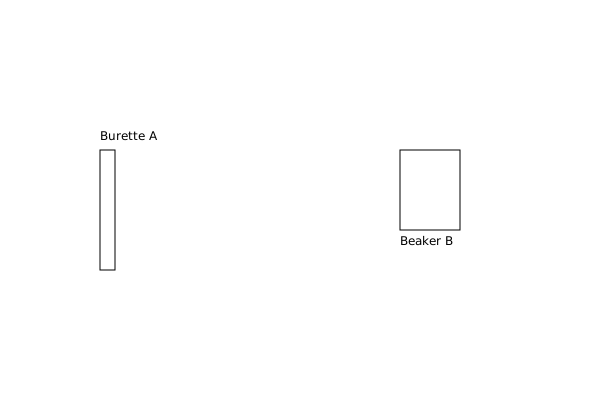
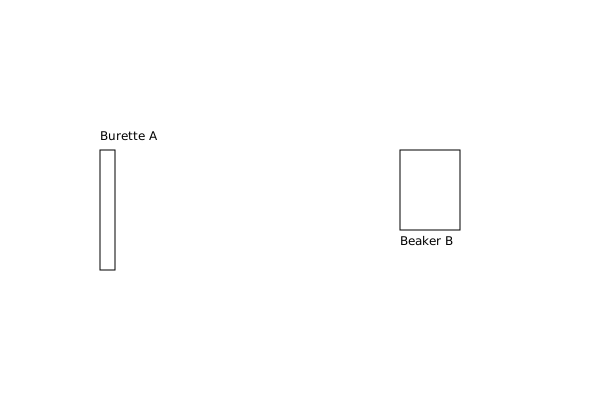
The diagram below shows a titration setup. Identify the part labeled A.
A. Burette
B. Beaker
C. Conical flask
D. Burette and beaker
Question 15
The rate cons\tant for a first-order reaction is 0.05 min^-1. If the initial concentration of the reac\tant is 0.1 M, what is the concentration after 10 minutes?
A. 0.005 M
B. 0.010 M
C. 0.015 M
D. 0.020 M

Master the Exam!

You've seen a preview, but there are thousands more questions plus AI tutor to break down complex solutions.

Unlock Full Access Available for Android & Windows
Help others prepare! Share this practice hub: