POST UTME BABCOCK UNIVERSITY 2025 Biology | Objective

Practice these randomly selected questions to test your readiness.

Question 1
The structure that connects the heart to the lungs is known as?
A. Trachea
B. Esophagus
C. Pulmonary artery
D. Aorta
Question 2
A bio\logist observes a population of rabbits in a forest. The population grows according to the \logistic growth model: dP/dt = rP\( 1-P/K \). If the initial population is 100, the carrying capacity is 1000, and the growth rate is 0.2, what is the population size after 5 years?
A. 820.92
B. 850.92
C. 880.92
D. 910.92
Question 3
The process by which plants convert light energy into chemical energy is known as?
A. Respiration
B. Photosynthesis
C. Transpiration
D. Osmosis
Question 4
A 50-g sample of a subs\tance is dissolved in 100 mL of water. The resulting solution has a pH of 3.5. What is the concentration of the subs\tance in moles per liter?
A. 0.01 M
B. 0.02 M
C. 0.03 M
D. 0.04 M
Question 5
In a tropical rainforest e\cosystem, the primary consumers are primarily composed of which of the following groups?
A. Herbivorous insects
B. Fruit-eating birds
C. Small mammals
D. Carnivorous fish
Question 6
A diagram of the human circulatory system shows the following components: heart, arteries, veins, and capillaries. Which of the following is the primary function of the capillaries?
A. transporting oxygen to the body
B. transporting carbon dioxide from the body
C. regulating blood pressure
D. exchanging oxygen and carbon dioxide with the body
Question 7
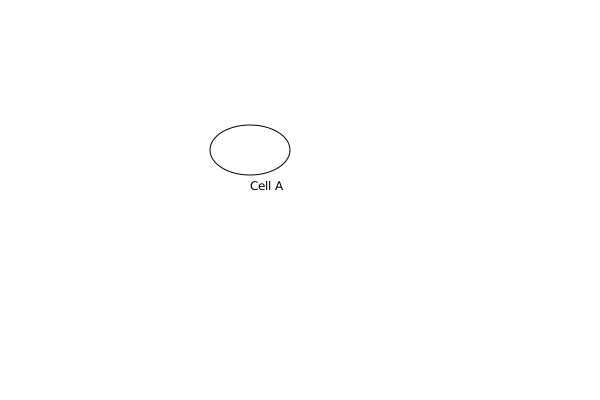
A diagram of a plant cell is shown below. Identify the part labeled 'A'.
A. Mitochondria
B. Chloroplast
C. Nucleus
D. Vacuole
Question 8
The xylem tissue in plants is responsible for transporting water and minerals from the roots to the leaves. Which of the following statements about xylem tissue is correct?
A. Xylem tissue is composed of dead cells.
B. Xylem tissue is responsible for transporting sugars and amino acids.
C. Xylem tissue is composed of living cells.
D. Xylem tissue is responsible for transporting water and minerals from the leaves to the roots.
Question 9
In the context of evolutionary theory, what is the term for the process by which a new species emerges from an existing one?
A. Speciation
B. Adaptation
C. Mutation
D. Genetic drift
Question 10
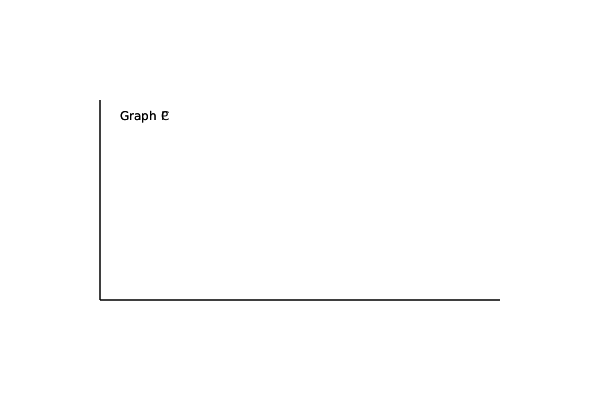
The graph below shows the relationship between the concentration of a solution and its osmotic pressure. What is the equation of the line of best fit?
A. \( P = \frac{nRT}{V} \)
B. \( P = \frac{V}{nRT} \)
C. \( P = \frac{nRT}{V^2} \)
D. \( P = \frac{V^2}{nRT} \)
Question 11
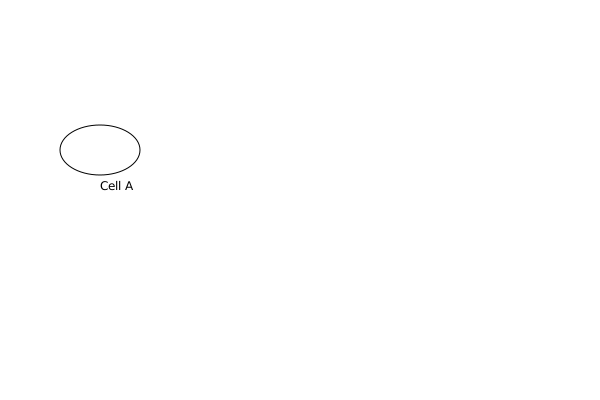
A diagram of a plant cell is shown below. What is the function of the structure labeled 'A'?
A. To synthesize proteins
B. To store genetic information
C. To regulate cell growth
D. To transport materials
Question 12
In a population of Drosophila melanogaster, the frequency of the recessive allele 'b' for black eyes is 0.2. If the population is in Hardy-Weinberg equilibrium, what is the frequency of the homozygous dominant genotype 'B'B'?
A. 0.36
B. 0.64
C. 0.8
D. 0.92
Question 13
A 25-year-old man presents to the genetic counselor with a family history of a genetic disorder. He reports that his parents are both carriers of the disorder and that he has a 25% chance of inheriting the disorder. Which of the following modes of inheri\tance is most likely responsible for this disorder?
A. Autosomal dominant
B. Autosomal recessive
C. X-linked dominant
D. X-linked recessive
Question 14
A study on the genetic variation of a population found that the frequency of the recessive allele 'a' is 0.2. If the population is in Hardy-Weinberg equilibrium, what is the frequency of the dominant allele 'A'?
A. 0.8
B. 0.6
C. 0.4
D. 0.2
Question 15
In the context of osmoregulation, what is the primary function of the kidneys in maintaining electrolyte balance?
A. To regulate blood pH levels
B. To maintain electrolyte balance
C. To regulate water balance
D. To regulate blood pressure

Master the Exam!

You've seen a preview, but there are thousands more questions plus AI tutor to break down complex solutions.

Unlock Full Access Available for Android & Windows
Help others prepare! Share this practice hub: