POST UTME AL-HIKMAH UNIVERSITY 2019 Biology | Objective

Practice these randomly selected questions to test your readiness.

Question 1
A diagram of the human respiratory system is shown below. Which part of the diagram is responsible for the exchange of oxygen and carbon dioxide?
A. The trachea
B. The diaphragm
C. The lungs
D. The bronchi
Question 2
A diagram of the human respiratory system is shown below. What is the primary function of the alveoli?
A. Exchange of oxygen and carbon dioxide
B. Filtering of dust and debris
C. Production of mucus
D. Regulation of body temperature
Question 3
A researcher is studying the effect of pH on the growth of a microorganism. If the optimal pH for growth is 7 and the pH of the medium is 5, what is the expected growth rate?
A. 50% of the maximum growth rate
B. 75% of the maximum growth rate
C. 90% of the maximum growth rate
D. 95% of the maximum growth rate
Question 4
A plant has a photosynthetic rate of 10 mg CO2/h. If the plant is exposed to light for 8 hours, how much CO2 is absorbed?
A. 60
B. 80
C. 100
D. 120
Question 5
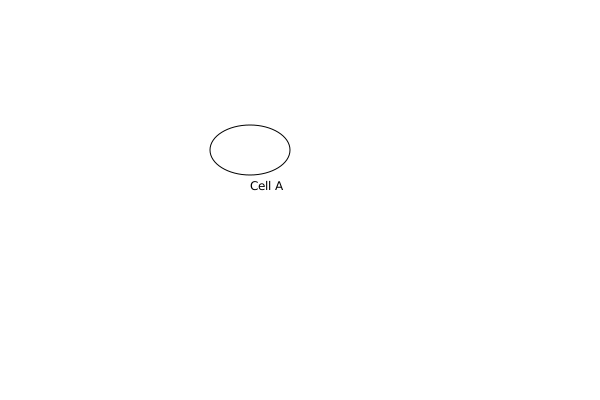
The diagram below shows the structure of a plant cell. Identify the part labeled A.
A. cell wall
B. cell membrane
C. vacuole
D. chloroplast
Question 6
In the context of xylem transport, what is the primary function of the xylem parenchyma cells?
A. Storage of water and nutrients
B. Transport of water and minerals
C. Production of ethylene
D. Regulation of stomatal aperture
Question 7
A diagram of the human skeletal system is shown below. Which part of the diagram is responsible for supporting the body?
A. The vertebrae
B. The ribs
C. The pelvis
D. The sternum
Question 8
In the context of evolutionary theory, what is the primary mechanism driving the adaptation of populations to changing environments?
A. Natural Selection
B. Genetic Drift
C. Gene Flow
D. Mutation
Question 9
The Hardy-Weinberg principle states that the frequency of a gene in a population will remain cons\tant if
A. There is no mutation or genetic drift
B. The population is large and randomly mating
C. The population is isolated and has no gene flow
D. All of the above
Question 10
A patient is experiencing difficulty breathing due to a blockage in the airway. Which of the following medical procedures is most likely to be performed to relieve this blockage?
A. Endotracheal intubation
B. Tracheostomy
C. Thoracotomy
D. Laryngoscopy
Question 11
The process of mitosis in animal cells results in the production of
A. 2 daughter cells with the same number of chromosomes
B. 4 daughter cells with the same number of chromosomes
C. 1 daughter cell with the same number of chromosomes
D. No change in the number of chromosomes
Question 12
In the context of the human visual system, what is the primary function of the optic nerve?
A. To transmit visual information from the retina to the brain
B. To regulate the amount of light entering the eye
C. To focus light onto the retina
D. To detect color and brightness
Question 13
A plant cell is placed in a solution with a high concentration of sucrose. What will happen to the cell's turgor pressure?
A. Increase
B. Decrease
C. Remain the same
D. Become negative
Question 14
A patient is diagnosed with a rare genetic disorder characterized by an inability to synthesize the amino acid phenylalanine. Which of the following enzymes is deficient in this disorder?
A. Phenylalanine hydroxylase
B. Tyro\sine aminotransferase
C. Alanine transaminase
D. Aspartate transaminase
Question 15
A diagram of the human respiratory system is shown below. Which part of the system is responsible for exchanging oxygen and carbon dioxide?
A. Trachea
B. Bronchi
C. Lungs
D. Diaphragm

Master the Exam!

You've seen a preview, but there are thousands more questions plus AI tutor to break down complex solutions.

Unlock Full Access Available for Android & Windows
Help others prepare! Share this practice hub: