POST UTME AFE BABALOLA UNIVERSITY 2023 Chemistry | Objective

Practice these randomly selected questions to test your readiness.

Question 1
A polymer has a molecular weight of 100,000 g/mol. If 10 g of the polymer is dissolved in 100 mL of water, what is the concentration of the solution in g/L?
A. 100 g/L
B. 200 g/L
C. 500 g/L
D. 1000 g/L
Question 2
A 2.50 L flask contains 0.250 mol of N2 gas at 25°C. What is the pressure of the gas in the flask?
A. 0.500 atm
B. 0.750 atm
C. 1.00 atm
D. 1.25 atm
Question 3
The reaction of cyclohexane with bromine in the presence of light produces a mixture of 1,2-dibromocyclohexane and 1,4-dibromocyclohexane. What is the major product of this reaction?
A. 1,2-dibromocyclohexane
B. 1,4-dibromocyclohexane
C. cis-1,2-dibromocyclohexane
D. trans-1,4-dibromocyclohexane
Question 4
A 1 M solution of a weak acid HA is mixed with a 1 M solution of a strong base B. The resulting solution is a solution with a pH of 7. If 10 mL of 1 M HCl is added to the solution, what is the new pH?
A. 6.5
B. 7.5
C. 8.5
D. 9.5
Question 5
The reaction of ethanol with hydrogen in the presence of a catalyst produces ethane. What is the balanced equation for this reaction?
A. \( C_2H_5OH + H_2 \rightarrow C_2H_6 + H_2O \)
B. \( C_2H_5OH + H_2O \rightarrow C_2H_6 + H_2 \)
C. \( C_2H_5OH + O_2 \rightarrow C_2H_6 + H_2O \)
D. \( C_2H_5OH + H_2 \rightarrow C_2H_6 + CO_2 \)
Question 6
A 1 M solution of a non-electrolyte solute is mixed with a 1 M solution of a strong electrolyte solute. The resulting solution is a solution with a colligative property of 10. What is the molality of the solution?
A. 0.1 m
B. 0.5 m
C. 1.0 m
D. 5.0 m
Question 7
A sample of hydrogen gas (H2) is collected over water at 25°C and 1 atm. The volume of the gas is 2.50 L. Calculate the number of moles of hydrogen gas collected.
A. 0.010 mol
B. 0.020 mol
C. 0.030 mol
D. 0.040 mol
Question 8
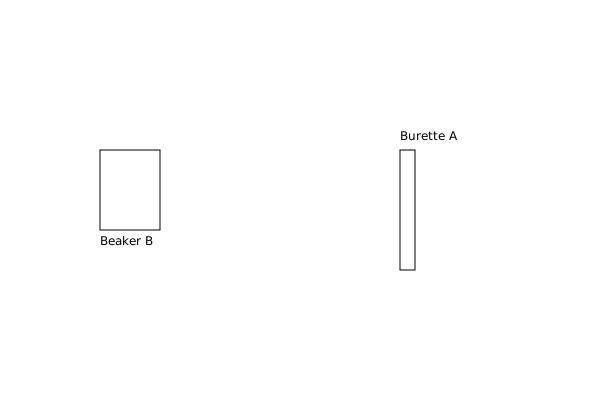
The diagram below shows a titration setup. What is the purpose of the burette?
A. To measure the volume of the titrant
B. To measure the volume of the analyte
C. To mix the titrant and analyte
D. To measure the pH of the solution
Question 9
The diagram below shows a circuit with a battery, a resistor, and a light bulb. What is the purpose of the resistor?
A. To reduce the current flowing through the circuit
B. To increase the voltage of the battery
C. To decrease the resis\tance of the circuit
D. To increase the brightness of the light bulb
Question 10
The reaction of cyclohexane with bromine in the presence of light produces a mixture of 1,2-dibromocyclohexane and 1,4-dibromocyclohexane. What is the major product of this reaction?
A. 1,2-dibromocyclohexane
B. 1,4-dibromocyclohexane
C. cis-1,2-dibromocyclohexane
D. trans-1,2-dibromocyclohexane
Question 11
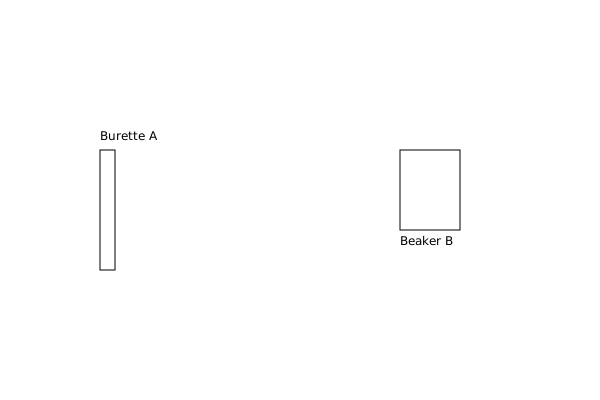
The diagram below shows a titration setup. What is the purpose of the burette in this setup?
A. To measure the volume of the titrant
B. To measure the volume of the analyte
C. To mix the titrant and analyte
D. To separate the titrant and analyte
Question 12
A 1 L solution of a gas at 25°C and 1 atm is compressed to 10 atm at cons\tant temperature. What is the new volume of the gas?
A. 0.1 L
B. 0.5 L
C. 1.0 L
D. 5.0 L
Question 13
The s\tandard enthalpy of formation of CO2(g) is -393.5 kJ/mol. What is the s\tandard enthalpy of formation of CO(g)?
A. -110.5 kJ/mol
B. -110.5 kJ/mol
C. -110.5 kJ/mol
D. -110.5 kJ/mol
Question 14
Determine the number of moles of oxygen gas (O2) produced at STP when 2.5 g of potassium chlorate (KClO3) is decomposed according to the equation: 2KClO3(s) → 2KCl(s) + 3O2(g).
A. 0.06 mol
B. 0.08 mol
C. 0.10 mol
D. 0.12 mol
Question 15
A 2.50 L flask contains 0.150 mol of an ideal gas at 298 K. What is the pressure of the gas?
A. 1.01 x 10^2 Pa
B. 1.01 x 10^3 Pa
C. 1.01 x 10^4 Pa
D. 1.01 x 10^5 Pa

Master the Exam!

You've seen a preview, but there are thousands more questions plus AI tutor to break down complex solutions.

Unlock Full Access Available for Android & Windows
Help others prepare! Share this practice hub: