POST UTME ABU 2023 Chemistry | Objective

Practice these randomly selected questions to test your readiness.

Question 1
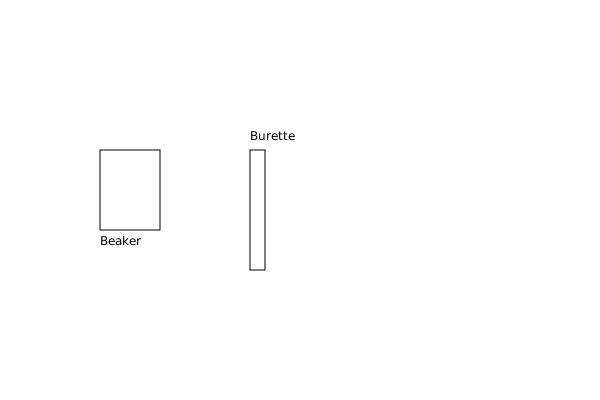
A diagram of a titration setup is shown below. What is the purpose of the burette in this setup?
A. To measure the volume of the titrant
B. To measure the volume of the analyte
C. To mix the titrant and analyte
D. To add the titrant to the analyte
Question 2
A solution contains 5.0 g of NaOH. If 10 mL of water is added to the solution, what is the concentration of the solution in g/L?
A. 0.5 g/L
B. 1 g/L
C. 2 g/L
D. 5 g/L
Question 3
The following diagram shows a periodic table. Identify the group number of the element with atomic number 12.
A. Group 1
B. Group 2
C. Group 13
D. Group 14
Question 4
The diagram below shows a simple black and white chemistry apparatus showing a titration setup.
A. The burette contains the acid.
B. The beaker contains the acid.
C. The burette contains the base.
D. The beaker contains the base.
Question 5
The reaction between sulfur dioxide and oxygen to form sulfur trioxide is a classic example of a redox reaction. Write the balanced chemical equation for this reaction, including the correct coefficients and state symbols.
A. \text{SO}_2 + \text{O}_2 \rightarrow \text{SO}_3
B. \text{SO}_2 + \frac{1}{2}\text{O}_2 \rightarrow \text{SO}_3
C. \text{SO}_2 + \text{O}_2 \rightarrow \text{SO}_4
D. \text{SO}_2 + \frac{1}{2}\text{O}_2 \rightarrow \text{SO}_4
Question 6
The following equation represents a chemical equilibrium. Write the equilibrium cons\tant expression.
A. K = \\frac{[\\text{CaO}][\\text{CO}_2]}{[\\text{CaCO}_3]}
B. K = \\frac{[\\text{CaCO}_3]}{[\\text{CaO}][\\text{CO}_2]}
C. K = \\frac{[\\text{CaO}]}{[\\text{CaCO}_3][\\text{CO}_2]}
D. K = \\frac{[\\text{CO}_2]}{[\\text{CaO}][\\text{CaCO}_3]}
Question 7
A 25 mL sample of a 0.5 M solution of sodium hydroxide (NaOH) is titrated with a 1 M solution of hydrochloric acid (HCl). Calculate the number of moles of HCl required to neutralize the NaOH.
A. 0.0125 mol
B. 0.015 mol
C. 0.0175 mol
D. 0.02 mol
Question 8
A solution contains 2.5 g of NaCl. If 10 mL of water is added to the solution, what is the concentration of the solution in g/L?
A. 0.25 g/L
B. 0.5 g/L
C. 1 g/L
D. 2 g/L
Question 9
The reaction between nitrogen and oxygen to form nitrogen dioxide is a classic example of a reaction that involves the formation of a new bond. Which of the following is the correct equation for this reaction?
A. \boxed{2NO + O_2 \rightarrow 2NO_2}
B. \boxed{4NO + O_2 \rightarrow 2N_2O_4}
C. \boxed{2NO + O_2 \rightarrow NO_2}
D. \boxed{4NO + O_2 \rightarrow 2NO_3}
Question 10
The boiling point of a solution containing 10 g of glu\cose (C6H12O6) in 100 g of water is 102.5°C. Calculate the molality of the solution.
A. 0.5 m
B. 0.7 m
C. 0.9 m
D. 1.1 m
Question 11
A 100 mL sample of a 0.5 M solution of sodium chloride (NaCl) is diluted to 500 mL. Calculate the new concentration of the solution.
A. 0.05 M
B. 0.07 M
C. 0.09 M
D. 0.11 M
Question 12
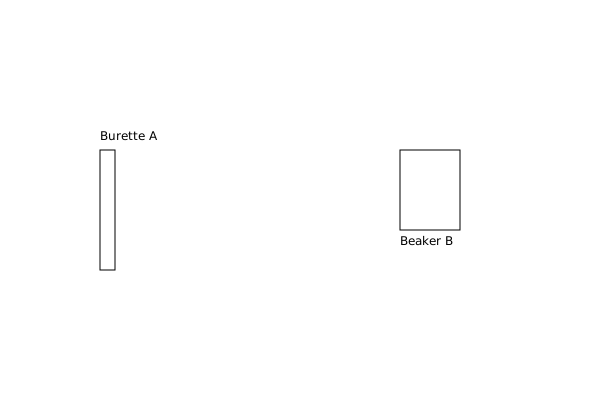
The following diagram shows a titration setup. Identify the part labeled A.
A. Burette
B. Beaker
C. Conical Flask
D. Pipette
Question 13
A sample of an ideal gas at 25°C and 1 atm is compressed to half its original volume. What is the new pressure of the gas?
A. 0.5 atm
B. 1 atm
C. 2 atm
D. 4 atm
Question 14
A sample of a polymer has a molecular weight of 50000 g/mol. If the polymer is composed of 80% by mass of carbon and 20% by mass of hydrogen, calculate the number of moles of carbon atoms in 1 g of the polymer.
A. \text{Number of moles of carbon} = \frac{80 \text{ g}}{12.01 \text{ g/mol}} \times \frac{1 \text{ mol}}{6.022 \times 10^{23} \text{ atoms}}
B. \text{Number of moles of carbon} = \frac{80 \text{ g}}{12.01 \text{ g/mol}} \times \frac{1 \text{ mol}}{6.022 \times 10^{23} \text{ atoms}} \times \frac{1 \text{ atom}}{1 \text{ mol}}
C. \text{Number of moles of carbon} = \frac{80 \text{ g}}{12.01 \text{ g/mol}} \times \frac{1 \text{ mol}}{6.022 \times 10^{23} \text{ atoms}} \times \frac{1 \text{ atom}}{1 \text{ mol}} \times \frac{1 \text{ mol}}{1 \text{ g}}
D. \text{Number of moles of carbon} = \frac{80 \text{ g}}{12.01 \text{ g/mol}} \times \frac{1 \text{ mol}}{6.022 \times 10^{23} \text{ atoms}} \times \frac{1 \text{ atom}}{1 \text{ mol}} \times \frac{1 \text{ mol}}{1 \text{ g}} \times \frac{1 \text{ g}}{1 \text{ mol}}
Question 15
The diagram below shows a titration setup.
A. The burette contains the acid.
B. The beaker contains the acid.
C. The burette contains the base.
D. The beaker contains the base.

Master the Exam!

You've seen a preview, but there are thousands more questions plus AI tutor to break down complex solutions.

Unlock Full Access Available for Android & Windows
Help others prepare! Share this practice hub: