POST UTME AAUA 2022 Biology | Objective

Practice these randomly selected questions to test your readiness.

Question 1
The process of genetic drift can lead to which of the following?
A. Increased genetic variation
B. Decreased genetic variation
C. No change in genetic variation
D. Increased mutation rate
Question 2
A population of rabbits is introduced to a new island. The population grows exponentially at first, but eventually levels off. Which of the following is a possible explanation for this phenomenon?
A. The rabbits are competing for resources
B. The rabbits are being preyed upon by predators
C. The rabbits are adapting to their environment
D. The rabbits are experiencing genetic drift
Question 3
A diagram of the human eye is shown below. What is the function of the part labeled 'C'?
A. To focus light
B. To re\fract light
C. To regulate light entry
D. To detect light
Question 4
A scientist is studying the effect of a certain chemical on the growth of plants. The scientist measures the growth of the plants over a period of time and finds that the growth is directly proportional to the concentration of the chemical. Which of the following is a possible explanation for this phenomenon?
A. The chemical is stimulating the growth of the plants
B. The chemical is inhibiting the growth of the plants
C. The chemical is having no effect on the growth of the plants
D. The chemical is cau\sing the plants to die
Question 5
A cell is placed in a solution with a high concentration of a certain ion. The cell membrane is selectively permeable, and the cell is initially at equilibrium. Which of the following will occur?
A. The cell will swell and eventually burst
B. The cell will shrink and eventually die
C. The cell will remain unchanged
D. The cell will undergo mitosis
Question 6
The Hardy-Weinberg principle states that genetic variation in a population will remain cons\tant from generation to generation in the absence of other evolutionary influences. Which of the following is a necessary condition for the Hardy-Weinberg principle to hold?
A. Random mating
B. No mutation
C. No gene flow
D. No natural selection
Question 7
In a population of Drosophila melanogaster, the frequency of the recessive allele 'a' is 0.2. If the population is in Hardy-Weinberg equilibrium, what is the frequency of the homozygous dominant genotype?
A. 0.2
B. 0.4
C. 0.6
D. 0.8
Question 8
A car travels from city A to city B at an average speed of 60 km/h. If the dis\tance between the two cities is 240 km, how long does the journey take?
A. 4
B. 4.5
C. 5
D. 6
Question 9
In a population of 1000 bacteria, 80% are susceptible to a particular antibiotic. If 200 bacteria are exposed to the antibiotic, what is the expected number of resis\tant bacteria?
A. 120
B. 160
C. 200
D. 240
Question 10
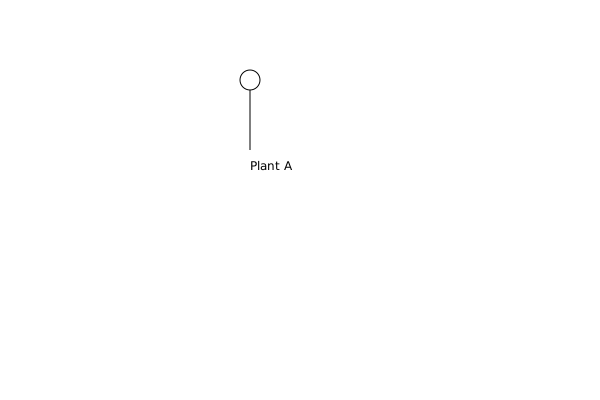
A diagram of a plant cell is shown below. Which of the following is a function of the cell wall?
A. Support and protection
B. Transport of materials
C. Synthesis of proteins
D. Storage of nutrients
Question 11
A 5-year-old child is diagnosed with acute lymphoblastic leukemia (ALL). The child's white blood cell count is 100,000 cells per microliter. Which of the following is the most appropriate initial treatment?
A. Vincristine and prednisone
B. Cyclophosphamide and doxorubicin
C. Methotrexate and cytarabine
D. L-asparaginase and mercaptopurine
Question 12
In the context of eco\logy, what is the term for the process by which plants convert light energy into chemical energy?
A. Photosynthesis
B. Respiration
C. Decomposition
D. Fermentation
Question 13
In the context of photosynthesis, what is the role of the enzyme RuBisCO in the Calvin cycle?
A. It catalyzes the conversion of CO2 to a 3-carbon molecule
B. It is involved in the light-dep\endent reactions
C. It is a key enzyme in the light-indep\endent reactions
D. It is responsible for the breakdown of glu\cose
Question 14
A 5.0 g sample of a subs\tance is burned in a combustion reaction. If the volume of carbon dioxide produced is 2.5 L at STP, what is the empirical formula of the subs\tance?
A. CH4
B. CO2
C. H2O
D. O2
Question 15
A diagram of the human respiratory system is shown below. What is the function of the structure labeled 'B'?
A. To filter the air entering the lungs
B. To warm and humidify the air entering the lungs
C. To produce mucus
D. To regulate the amount of air entering the lungs

Master the Exam!

You've seen a preview, but there are thousands more questions plus AI tutor to break down complex solutions.

Unlock Full Access Available for Android & Windows
Help others prepare! Share this practice hub: