POST UTME AAUA 2021 Biology | Objective

Practice these randomly selected questions to test your readiness.

Question 1
In a population of Drosophila melanogaster, the frequency of the recessive allele 'a' is 0.2. If the population is in Hardy-Weinberg equilibrium, what is the frequency of the homozygous dominant genotype 'AA'?
A. 0.64
B. 0.36
C. 0.48
D. 0.16
Question 2
In a population of Drosophila melanogaster, the frequency of the recessive allele 'b' is 0.2. If the population is in Hardy-Weinberg equilibrium, what is the frequency of the homozygous dominant genotype 'BB'?
A. 0.36
B. 0.64
C. 0.36
D. 0.64
Question 3
A cell is placed in a solution containing 0.1 M glu\cose and 0.2 M fructose. If the cell is permeable to both sugars, what is the concentration of glu\cose in the cell after 10 minutes?
A. 0.05 M
B. 0.1 M
C. 0.15 M
D. 0.2 M
Question 4
A diagram of the human respiratory system is shown below. Which part of the system is responsible for exchanging oxygen and carbon dioxide?
A. Trachea
B. Bronchi
C. Alveoli
D. Diaphragm
Question 5
The process of meiosis in humans results in the production of how many haploid cells from a diploid cell?
A. 4
B. 2
C. 6
D. 8
Question 6
In the human body, what is the primary function of the circulatory system?
A. Transport of oxygen and nutrients to cells
B. Removal of waste products from cells
C. Regulation of body temperature
D. Maintenance of fluid balance
Question 7
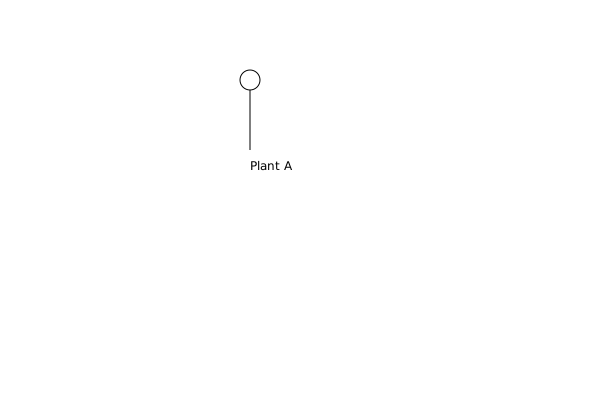
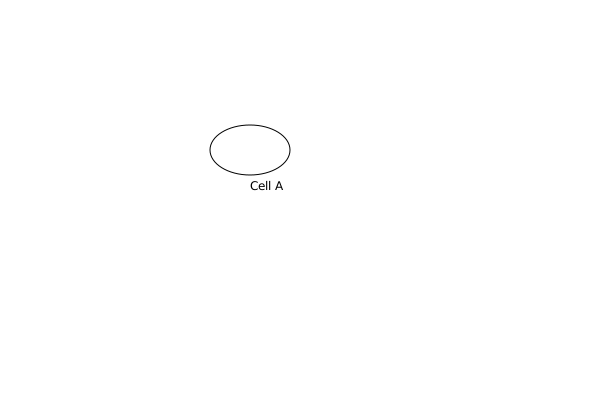
A diagram of a plant cell is shown below. Identify the part labeled 'A'.
A. Nucleus
B. Mitochondria
C. Chloroplast
D. Vacuole
Question 8
A 0.5 M solution of NaOH is mixed with a 0.5 M solution of HCl. What is the pH of the resulting solution?
A. 0
B. 1
C. 2
D. 3
Question 9
The process of meiosis is essential for the production of gametes in sexually reproducing organisms. Which of the following stages of meiosis is responsible for the reduction in chromosome number?
A. Meiosis I
B. Meiosis II
C. Prophase I
D. Anaphase II
Question 10
What is the process by which cells divide to produce two daughter cells?
A. Mitosis
B. Meiosis
C. Binary fission
D. Endosymbiosis
Question 11
What is the process by which plants release water vapor into the air?
A. Respiration
B. Photosynthesis
C. Transpiration
D. Evaporation
Question 12
A 2.5 kg block is attached to a horizontal, massless spring with a force cons\tant of 100 N/m. The block is displaced by 0.15 m from its equilibrium position and released from rest. Assuming the block undergoes simple harmonic motion, what is the maximum speed of the block?
A. 0.45 m/s
B. 0.55 m/s
C. 0.65 m/s
D. 0.75 m/s
Question 13
A patient is diagnosed with a bacterial infection. The bacteria are sensitive to penicillin, but the patient is allergic to penicillin. Which of the following antibiotics would be a suitable alternative?
A. Erythromycin
B. Tetracycline
C. Ciprofloxacin
D. Gentamicin
Question 14
In the human body, what is the primary function of the nervous system?
A. Control of body movements
B. Regulation of body temperature
C. Maintenance of fluid balance
D. Proces\sing and transmission of information
Question 15
A researcher is studying the effect of temperature on the growth of bacteria. Which of the following temperatures is most beneficial for bacterial growth?
A. 10°C
B. 20°C
C. 30°C
D. 40°C

Master the Exam!

You've seen a preview, but there are thousands more questions plus AI tutor to break down complex solutions.

Unlock Full Access Available for Android & Windows
Help others prepare! Share this practice hub: